

Resqme
Authorized Dealer • Made in USA • The Original Patented Car Escape Tool
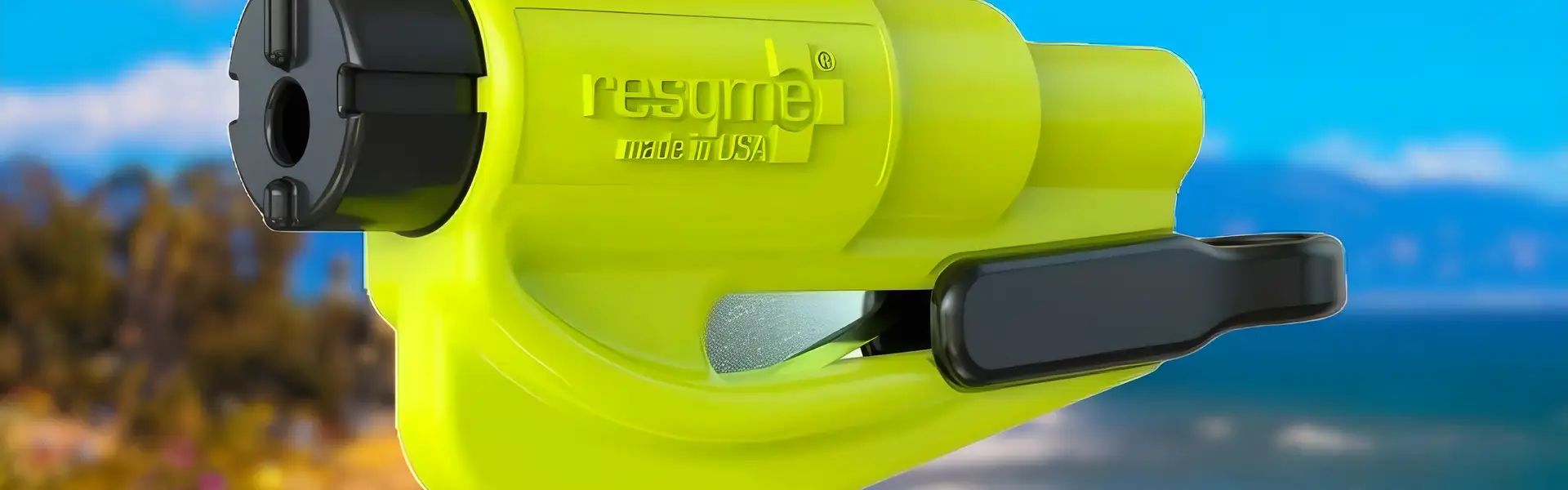
Resqme manufactures the original patented 2-in-1 keychain car escape tool — the spring-loaded window breaker and recessed seatbelt cutter first developed for firefighters, EMTs, and law enforcement before being released to civilian drivers. Made in the USA, sized to ride on a keyring at roughly three inches long, and engineered as a reusable tool rather than a single-shot punch. Keep Shooting stocks 1 Resqme SKU: the ResqME Keychain Car Escape Tool in Black at $9.95 — the matte-black colorway that disappears against a car-key fob or center console until it’s the one piece of gear standing between a driver and a wrecked, submerged, or burning vehicle.
Resqme at Keep Shooting
Resqme, Inc. manufactures the original patented 2-in-1 keychain car escape tool — a single compact device that combines a spring-loaded stainless-steel window punch with a recessed razor seatbelt cutter, sized to clip onto a key ring and engineered to survive everyday pocket carry without accidental deployment. The tool was originally developed for firefighters, EMTs, and law-enforcement first responders who needed a reliable way to extract trapped occupants from wrecked, flooded, or burning vehicles, and was later released to civilian drivers as the same hardware that crash responders were already carrying. Keep Shooting is an authorized Resqme dealer and our catalog stocks the ResqME Keychain Car Escape Tool in Black at $9.95 — one SKU, one colorway, the matte-black configuration that rides discreetly on a keyring or in a console without announcing itself until it’s needed.
Why a Vehicle Escape Tool Belongs on Every Keyring
Most drivers will never need a car escape tool. The drivers who do, need it immediately, in conditions that wouldn’t allow a slower response: a rollover that leaves the doors jammed against the ground or against a guardrail, a side-impact that crushes the door frame against the seat, an engine-compartment fire that fills the cabin with smoke in under a minute, and the scenario every first responder dreads most — submersion. Modern automotive safety engineering has made cars far less likely to catch fire or roll, but it has also made them harder to exit from the inside when something goes wrong. Crash-rated door frames resist deformation by design, which keeps occupants alive in the impact but traps them after it. Powered windows fail instantly when the battery is severed. Crumple-zone deformation can jam latches and misalign door seals. Seatbelt pre-tensioners lock the belt under load, and a belt under load can’t be unlatched by the standard push-button release.
That is the gap a Resqme is designed to close. The whole tool is roughly the size of a thick keyfob and weighs almost nothing, so the carry penalty is zero. It rides on a keyring, a sun-visor clip, or a center console mount, accessible by feel under panic conditions where a glove-box or trunk-stored tool would be useless. The two functions — window break and seatbelt cut — cover the two failure modes that account for the majority of in-vehicle entrapment scenarios. And the device is reusable, so a single $9.95 tool serves the whole vehicle life cycle rather than being consumed on first use.
How the Spring-Loaded Window Punch Works
Breaking automotive side and rear windows is not as simple as hitting them with something heavy. Automotive tempered glass — the glass used in side and rear windows — is heat-treated to put the outer surface under compression, which makes the pane roughly four times stronger than annealed glass and gives it the characteristic shatter pattern of small dull-edged cubes rather than dangerous shards. The strength gain is real but it comes with a known weakness: tempered glass shatters catastrophically when the compressive layer is broken at a single point, typically with a small, hard, sharply-pointed impactor. Hammers and soft tools tend to bounce off; spring-loaded carbide and hardened-steel punches don’t.
The Resqme’s window punch is a stainless-steel spike on a spring mechanism. The user presses the punch against the window glass and pushes; when the pressure exceeds the spring’s trigger threshold, the spike releases at high velocity into a small area of the glass and cracks the compressive layer. Tempered glass does the rest — the pane self-destructs into the safe, dull-edged crumble that’s the entire reason tempered glass exists in automotive applications. No hammer swing is required, which matters because a person trapped against a deformed roof, hanging upside-down from a seatbelt, or working with a broken arm doesn’t have the room or the strength for a full hammer stroke. The spring does the work; the user only has to push.
One important note that Resqme’s documentation and most first-responder training stress: the punch works on side and rear windows, not on the windshield. Auto windshields are laminated safety glass — two layers bonded around a plastic interlayer — and they don’t shatter when punched. Plan your escape route around the side and rear glass.
How the Recessed Seatbelt Cutter Works
Modern automotive seatbelts are made from high-tensile woven polyester webbing rated to hold a 200-pound occupant against several Gs of deceleration. The webbing resists cutting from the front because the weave absorbs and spreads the force of a knife blade. The reliable way to cut a loaded seatbelt is to draw a sharp edge across the webbing at an angle, slicing the weave rather than pressing into it. That is what the Resqme’s cutter is designed to do.
The cutter is a razor-sharp blade recessed inside the body of the tool, oriented at roughly 45° to the channel the webbing slides into. The user catches the belt against the cutter channel, pulls the tool along the belt’s length, and the recessed blade slices through the webbing in one or two strokes. Two engineering decisions make this work safely: the recess means the blade can’t cut the user or the trapped occupant if the tool slips, and the angled blade geometry means the cutting force translates into a slicing motion rather than a stabbing one. The same recessed-blade pattern is now standard across first-responder rescue tools for the same reason: it solves both the cutting physics and the secondary-injury risk in one small geometry.
Why “The Original” Matters Here
The 2-in-1 keychain car escape tool is now a commodity category — you’ll see molded-plastic copies for two or three dollars on auction sites and gas-station endcaps. The original was Resqme, and the copies have a couple of recurring problems worth knowing about before substituting:
- Spring fatigue. The spring-loaded window punch only works if the spring is correctly tensioned and holds tension across years of pocket carry. Generic copies frequently use under-spec springs that lose tension or deploy with insufficient velocity to crack tempered glass. A tool that doesn’t break the window when you push it isn’t a tool.
- Blade quality. The seatbelt cutter is only as good as its edge. Resqme uses a hardened stainless-steel blade designed to hold an edge in storage; generic copies often use stamped low-carbon steel that dulls sitting in a glove box or rusts to the point of uselessness in coastal climates.
- Accidental deployment. The Resqme is engineered so the punch mechanism requires a deliberate push against a hard surface to deploy. Cheaper copies sometimes deploy on keyring rattle or pocket pressure, which not only wastes the tool but can damage the surrounding contents of a pocket or bag.
- Made in USA vs. unmarked import. Resqme manufactures in the United States and the company holds the patents and trademarks on the design. Imported copies of unclear provenance don’t carry the same quality controls, and warranty service on a failed copy generally doesn’t exist.
Nine dollars is the right price to do this right once.
Where a Resqme Belongs
The Resqme is the kind of $10 piece of gear that belongs in more places than most drivers realize:
- Daily-driver keyring. The single most accessible place to carry one. Always with you, always within arm’s reach of the driver seat.
- Passenger keyring. If a primary driver is incapacitated in a crash, the passenger’s tool is the one that gets used.
- Sun-visor or center-console clip. The Resqme ships with a removable holster clip for exactly this mounting — useful in vehicles with multiple drivers, fleet vehicles, and rental cars.
- Family fleet. Teenage-driver vehicles, elderly-driver vehicles, and second cars all benefit from carrying one. Teen drivers statistically have the highest crash rates of any demographic; elderly drivers are most likely to be trapped by reduced strength and mobility after a crash.
- RV, travel trailer, and tow vehicle. Recreational vehicles are heavier, often have larger fixed windows, and tend to crash in remote areas where rescue response is slower.
- Bug-out and emergency bag. The Resqme rides alongside the rest of the survival kit naturally, and at $9.95 it’s the cheapest piece of gear in most preparedness loadouts.
- Cold-water or flood-region driving. Submersion in cold water leaves the occupant a window measured in seconds before incapacitation. The electric-window failure mode is essentially guaranteed within the first few seconds of submersion. A mechanical window-break tool is the only way out.
Pairing & Cross-References
The Resqme sits naturally alongside the rest of Keep Shooting’s safety, escape, and emergency gear. For the broader safety and security equipment catalog covering gas masks, escape kits, and protective gear, the parent equipment category is the place to start. For the breaching, forcible-entry, and rescue-tool slice of the catalog — shove knives, jiggler keys, and their kin now live in the lock pick tools sub-category — the Resqme is one of several keychain-form options worth comparing. For the wider survival gear catalog covering fire-starting, signaling mirrors, paracord, emergency blankets, and the rest of the lightweight emergency kit, see the survival sub-category. The multitools sub-category covers the broader EDC combination-tool space the Resqme sits adjacent to. And for in-vehicle medical kit to pair with the Resqme — because getting out of a wrecked car is only step one — the first aid catalog covers the trauma and IFAK kits that belong in the same glove box.
Bottom Line on the Resqme
The Resqme is one of those rare pieces of gear that crosses every demographic line in Keep Shooting’s customer base. It isn’t a firearm, isn’t military surplus, isn’t tactical kit. It’s a $9.95 stainless-and-polymer device that sits on a key ring for years without being thought about and earns its place the first time a driver finds themselves on the wrong side of a jammed door, a locked seatbelt, or a flooding cabin. The patent, the Made-in-USA manufacturing, and the first-responder origin story matter because they’re the difference between a device that works the one time it needs to and a copy that doesn’t. We stock the original.
Frequently Asked Questions — ResqME
Yes, we maintain inventory of the most popular ResqME products. Each product listing shows real-time stock status. If an item is temporarily out of stock, you can sign up for back-in-stock notifications on the product page.
Yes! All orders over $49.95 qualify for free shipping, including ResqME products. Orders typically ship within 1–2 business days.
Keep Shooting offers hassle-free returns on ResqME products. If you're not completely satisfied, contact our customer service team for a return authorization. All products must be in original, unused condition.
Yes, Keep Shooting is an authorized ResqME dealer. All products are sourced directly and include full manufacturer warranty coverage.