
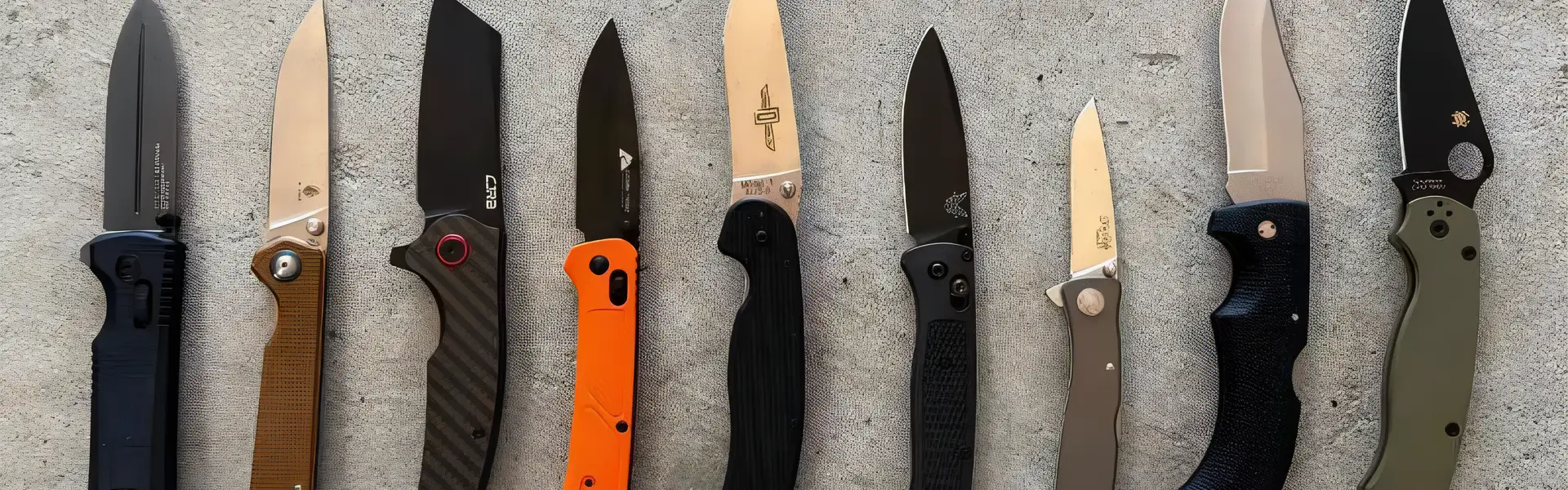
Folding Knives
OKC RAT • Ka-Bar Dozier • Gerber • S&W • Douk-Douk • Higonokami
The complete folding-knife catalog spanning modern tactical liner-locks through traditional international designs — Ontario RAT Model 1 and Model 2 EDC workhorses (the Jeff Randall / ESEE design for Randall Adventure Training), the iconic Ka-Bar Dozier Hunter, the Gerber Paraframe / Ripstop / STL / US1 line of American-engineered folders, Smith & Wesson Extreme Ops tactical folders, the French Douk-Douk (continuous production by Cognet in Thiers since 1929), and the Japanese traditional Higonokami friction folder. From under $10 traditional folders to premium tactical EDC — every major folding-knife pattern in one catalog.
About Folding Knives at Keep Shooting
Keep Shooting carries a focused folding-knife catalog covering the full spectrum from modern tactical liner-lock EDC folders through traditional European and Japanese non-locking designs that predate the tactical- folder era entirely. Our lineup includes the Ontario Knife Company RAT Model 1 and RAT Model 2 in plain and black-blade variants, the Ka-Bar Dozier Hunter and USSF Corser, the Gerber Paraframe Mini, Ripstop 1, STL 2.0, and US1, Smith & Wesson Extreme Ops and Tanto liner-lock folders, the Walther P99 folding knife, and historical and traditional patterns including the French Douk-Douk (in production by Cognet in Thiers since 1929), the Japanese Higonokami traditional friction folder, the German SS pocket knife, and the Spanish Army-style pocket knife.
A short history of the folding knife. Folding knives are among the oldest edged tools in human history — Roman gladius-era folding knives from the 1st century AD have been excavated from Herculaneum, and simple friction-folder designs (no lock, relying on finger pressure to hold the blade open) have existed in every European farming culture since at least the early medieval period. The defining modern innovations arrived in sequence: the slipjoint (a spring-tensioned back mechanism holding the blade open against moderate force, but not locked — the classic Swiss Army Knife and Case / Buck gentleman's-knife pattern), the back lock / lockback (Buck 110 Folding Hunter, 1964, popularized the positively-locked folder for American outdoors use), and the modern liner lock (originally patented by John Sinclair in 1906 but commercially refined by Michael Walker in 1981, becoming the dominant tactical-folder lock type of the 1990s onward).
Ontario Knife Company RAT series — the EDC workhorses. The RAT Model 1 and RAT Model 2 are Ontario Knife Company's collaboration with Randall Adventure Training (ESEE Knives) — Jeff Randall and Mike Perrin's jungle-survival training company that designs knives for ESEE under a separate brand and also designs folders for Ontario under the RAT name. The RAT (Randall Adventure Training) Model 1 is the full-size 3.6" blade EDC folder, and the Model 2 is the shorter 3" blade compact variant — both use AUS-8 stainless steel (a Japanese steel roughly comparable to 440C in American classification, known for good edge retention and ease of sharpening), nylon handle scales, and four-position pocket clip for deep-carry or tip-up/tip-down user preference. The RAT Model 1 in particular has built a reputation as one of the best value-tier tactical EDC folders on the American market — a sub-$50 knife that performs comparably to folders costing three times as much. For the complete Ontario lineup see our Ontario Knife Company brand page.
Ka-Bar Dozier Hunter — the compact outdoors folder. Ka-Bar's collaboration with knife designer Bob Dozier produced the Dozier Hunter — an inexpensive polymer-handled drop-point folder well-suited to general outdoors and utility use. The Dozier is particularly popular as an affordable gift knife — the under- $25 price point and the recognizable Ka-Bar name make it a common graduation, Father's Day, and entry-level EDC choice. Our Ka-Bar USSF Corser folding knife is the US Space Force-branded variant — a licensed military-branch piece for USSF active-duty personnel, veterans, and enthusiasts.
Gerber folder line. Gerber Gear (Portland, Oregon, founded 1939 as Gerber Legendary Blades) produces one of the widest folding- knife lineups in the American EDC market. Our catalog covers four Gerber folder patterns: the Paraframe Mini (the defining skeletonized-frame lightweight folder, the smaller variant of the classic Paraframe design), the Ripstop 1 (fiberglass-reinforced nylon handle, drop-point blade, tactical profile), the STL 2.0 (a compact skeletonized-frame liner-lock designed for lightweight EDC), and the US1 (a budget- friendly American-made folder at the sub-$20 price point).
Smith & Wesson Extreme Ops and Tanto. Smith & Wesson's folding-knife line — produced under license by Taylor Brands (the same Tennessee manufacturer that produces folding knives under the S&W, Schrade, Uncle Henry, and Old Timer brand licenses) — includes the S&W Extreme Ops liner-lock folder (tanto or drop-point blade, lightweight aluminum handle) and the S&W Tanto linerlock folder (traditional Japanese-style chisel-tip blade profile, serrated or plain edge). The Extreme Ops series is the core S&W tactical folder line and positions toward tactical/duty carry at a mid-tier price point.
Walther P99 folding knife. Walther's branded folding knife shares its name with the Walther P99 service pistol — a branded cross-promotion pattern common among European firearms manufacturers (SIG Sauer, Heckler & Koch, and Walther all license branded folding knives as complement items to their pistol lines). The Walther P99 folding knife is produced under license by Boker or similar German cutlery manufacturer, and carries the Walther Arms US-distributor branding for the American market.
Douk-Douk — the iconic French folder. The Douk-Douk is one of the most historically distinctive folding knives in European tradition — produced continuously by the Cognet company in Thiers, France since 1929, making it one of the longest continuously-produced knives in the world (nearly 100 years of unchanged design). The name "Douk-Douk" is a Kanak (New Caledonian indigenous) mythological figure whose image became the knife's distinctive handle stamp. The knife was originally exported to French colonies in North Africa, the Middle East, and Oceania, and became embedded in the material culture of those regions — used as a general field tool, a hunting knife, and (during the Algerian War of Independence) as a widely-distributed pocket knife that acquired complex political symbolism on both sides of the conflict. Our Douk-Douk catalog includes the Le Thiers (Cognet's flagship full-size model), the Squirrel (a smaller-bodied folder with the distinctive squirrel-figure handle stamp), and the El Baraka in both standard and pocket variants (El Baraka being the Maghrebi Arabic-origin name meaning "blessing" — specifically marketed to Cognet's North African/Islamic export market in the 1930s and after).
Higonokami — the Japanese traditional friction folder. The Higonokami (肥後守) is a traditional Japanese folding knife pattern that dates to the 1896 design by Komataro Murakami in the Miki City cutlery district of Hyogo Prefecture — the center of traditional Japanese edged-tool production. The Higonokami is a friction folder (no spring, no lock) with a distinctive chikiri thumb tab extending from the blade's back spine — a lever that allows one-handed opening by rolling the thumb against the tab, and also acts as a lever held against the handle during cutting to keep the blade in the open position under pressure. The blade is traditionally made from SK carbon steel (a Japanese high-carbon steel) forged and laminated in the classic Japanese warikomi (sandwich) technique — a high- carbon cutting edge laminated between softer iron cheeks for toughness. Only one forge — Nagao Kanekoma in Miki City — is authorized to use the "Higonokami" name on knives they produce, a restriction protected by Japanese cutlery trademark. Our Higonokami No. 4 (black) and Higonokami SK (brass) are authentic Nagao Kanekoma forge production — the genuine article rather than mass-produced copies.
Blade steels — what the numbers mean. Tactical folder blades in our catalog use four major steel families. AUS-8 (OKC RAT, Ka-Bar Dozier) is a Japanese stainless steel with 0.70 – 0.75% carbon, 13 – 14.5% chromium, good edge retention, and easy resharpening — the value-tier standard for modern tactical folders. 440C (some Gerber and S&W variants) is the classic American stainless with 1.00% carbon, 17% chromium, widely used in commercial cutlery since the 1960s and a known quantity for edge retention and corrosion resistance. 7Cr17MoV (some S&W and budget Gerber variants) is the Chinese stainless equivalent to 440A — slightly softer than 440C but easier to sharpen. SK carbon steel (Higonokami) is a traditional Japanese high-carbon tool steel — not stainless, which means it requires oil and care to prevent rust, but takes a sharper edge than any stainless and sharpens faster. Traditional European folders (Douk-Douk) use high-carbon steel with similar characteristics — tougher and sharper than stainless at the cost of corrosion resistance.
Lock types — a buyer's reference. Liner lock (most modern tactical folders, including OKC RAT, Ka-Bar, Gerber, S&W): an internal side-liner spring moves behind the blade tang when opened, holding the blade open; released by pressing the liner sideways with the thumb. The dominant modern tactical lock type — one-handed opening and closing, strong lock-up under use-force loads. Frame lock (a variant of liner lock where the handle frame itself acts as the locking liner — favored on premium folders for its strength and simplicity). Slipjoint (Douk-Douk, Swiss Army patterns, gentleman's folders): no positive lock, only spring tension holds the blade open, closing requires overcoming the spring force. Legal in every US state (no lock = generally not classified as a "switchblade" or restricted knife) but offers less in-use security than locking folders. Friction folder (Higonokami, original medieval pattern): no spring at all, blade is held open by thumb pressure on the chikiri tab or handle design. The oldest folder design, and still the defining pattern for traditional Japanese folders.
Historical and surplus folders. Our German SS pocket knife is a reproduction of WWII-era German military-style folding knives distributed to personnel — a pattern commonly used as a WWII reenactor piece or a historical-interest collector item (authentic WWII German knives of this pattern are increasingly rare and expensive; our reproductions provide the visual authenticity at a manageable price point for display or costume use). The Spanish Army-style pocket knife is similarly a traditional-pattern folder in the style issued by the Spanish military through much of the 20th century — a durable general- utility folder with a distinctively Spanish profile that complements Spanish military reenactment impressions or general Iberian- themed collector displays. For the broader knife catalog across fixed-blade, automatic, butterfly, and specialty patterns see our Fixed Blade Knives and Automatic Knives categories.
Legal note on folding-knife carry. Folding knives carry significantly different legal status across US jurisdictions. Most states permit legal carry of folders with blades under 3" (or sometimes 2.5") without special permit, and permit slipjoint and friction folders of any blade length as non-locking designs. Locking folders (liner-lock, frame-lock, lockback) sometimes face stricter carry restrictions in specific states (New York City, California school zones, and similar jurisdictions have their own rules). Automatic / switchblade-action folders are federally and state-restricted — see our Automatic Knives category for those state-compliance rules. Before carrying any folder, verify your state and local rules on blade length, lock type, and concealed- carry permit requirements.
Keep Shooting ships all folding knives from our Pennsylvania warehouse with free shipping on orders over $49.95 and hassle-free returns. Whether you are an EDC enthusiast building a tactical liner-lock rotation, a traditional- knife collector completing a Douk-Douk or Higonokami shelf, a WWII reenactor sourcing period German pocket-knife reproductions, or simply looking for the most cost-effective work-grade folder under $25, every knife in our catalog is from a respected manufacturer with genuine design pedigree — no anonymous Chinese mall-kiosk knockoffs, every folder backed by its manufacturer's name.
Frequently Asked Questions — Folding Knives
Keep Shooting carries a wide selection of Folding Knives products from trusted brands. Browse our catalog to see the full range, and use the filters on the left to narrow by brand, price, or product type.
Yes! All orders over $49.95 qualify for free shipping, including Folding Knives products. Orders typically ship within 1–2 business days.
Keep Shooting offers hassle-free returns on Folding Knives products. If you're not completely satisfied, contact our customer service team for a return authorization. All products must be in original, unused condition.
If you need help choosing the right Folding Knives product, our team is available to assist. Check individual product descriptions for detailed specifications, or contact us directly and we'll help you find the best fit for your needs.