
Compasses
Cammenga M1950 • Silva • Brunton TruArc • Lensatic • Tritium
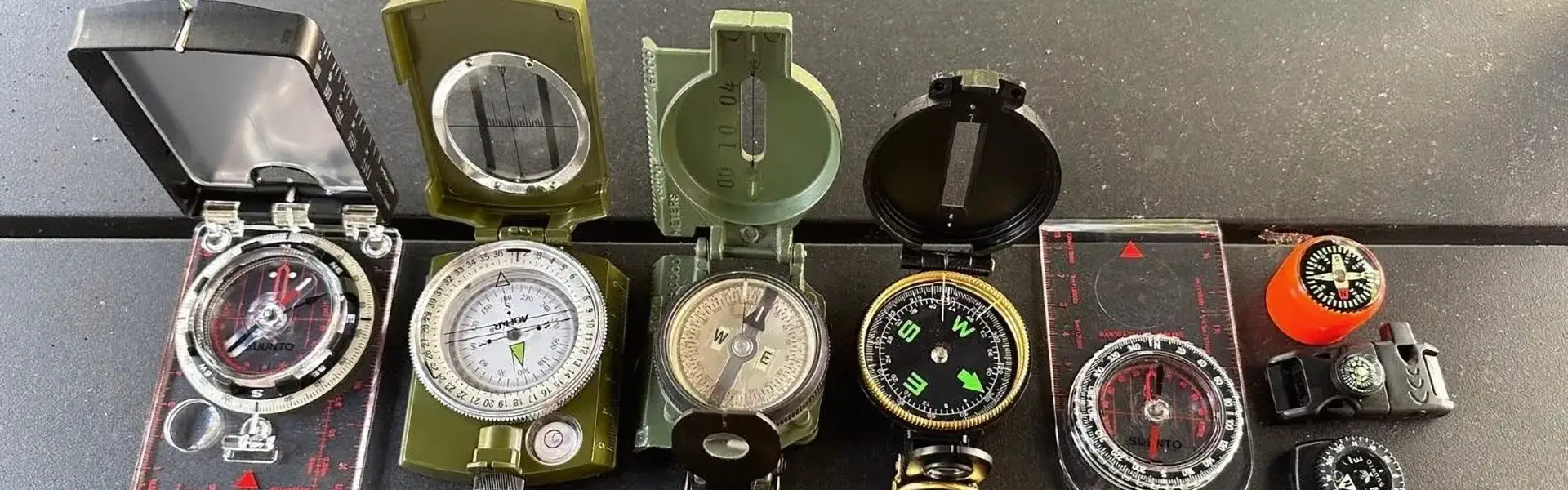
The complete land-navigation catalog spanning US-military-issue lensatic compasses, orienteering-pattern baseplate compasses, and supplemental navigation references — the Cammenga Tritium Lensatic Compass (the actual GI-issue M1950 pattern from Cammenga of Dexter, Michigan, sole-source DLA contractor since 1992), the Cammenga phosphorescent and wrist-pattern variants, the Silva Ranger 2.0 (from the Swedish house that invented the baseplate compass in 1933), the Brunton TruArc 15 (heir to the 1894 Brunton Pocket Transit used by USGS geological surveyors for over a century), the Mil-Tec digital compass, and ESEE Pocket Nav Cards. The complete land-nav toolkit for an age when GPS signal is no longer a guarantee.
About Compasses at Keep Shooting
Keep Shooting carries the two principal land-navigation compass families — the military lensatic pattern (the GI-issue Cammenga M1950 in tritium and phosphorescent variants, plus a Cammenga wrist-pattern) and the orienteering baseplate pattern (the Silva Ranger 2.0 from the Swedish company that invented the baseplate compass in 1933, and the Brunton TruArc 15 from the 1894-founded Wyoming maker of the legendary Brunton Pocket Transit). Plus the Mil-Tec digital compass and ESEE Pocket Nav Cards as supplemental navigation references. Land navigation skill is experiencing a quiet renaissance in the military and outdoor community as GPS-denied and GPS-degraded environments become routine — every special-operations training program continues to teach map-and-compass as the mandatory fallback when electronics fail or get jammed.
Cammenga and the M1950 lensatic — the actual GI compass. Cammenga Company of Dexter, Michigan has been the sole-source US Department of Defense contractor for the M1950 lensatic compass since winning the contract in 1992 (succeeding Stocker & Yale, who held the contract for the prior decades). The M1950 design itself dates to — the name gives it away — 1950, when the US Army standardized the lensatic pattern with a tritium-illuminated dial after WWII experience showed that radium-painted dials posed unacceptable health risks. The Cammenga M1950 has been carried by every US Army, Marine Corps, Army special-forces, and allied service member for whom land-navigation is a tested skill since the early 1990s — there is no other GI-issue lensatic compass in current US inventory. Our Cammenga Tritium Lensatic Compass with Case ($127.66) is the actual M1950 in US-military issue specification — the same compass packed in the Army compass pouch on every infantryman's and SOF operator's load-bearing equipment.
Tritium versus phosphorescent illumination. The M1950 comes in two illumination variants and the difference matters. The tritium version uses sealed glass vials of tritium gas — radioactive hydrogen-3 — which beta-decays into helium-3 and emits low-energy electrons that excite a phosphor coating on the inside of the vial, producing a soft, continuous, battery-free glow. Tritium has a 12.3-year half-life, so a tritium compass illumination loses about half its brightness every 12 years — a 30-year-old tritium compass is still functional but visibly dimmer. The phosphorescent version uses standard glow-in-the- dark phosphor that must be charged by exposure to sunlight or a flashlight and then fades over minutes to hours. The phosphorescent variant is substantially less expensive (~$76 vs ~$128) and is the right choice for daylight or well-illuminated nighttime use where you have a flashlight to charge the dial. The tritium variant is the right choice for sustained light-discipline operations where any flashlight use compromises position — the actual military use case the M1950 was designed for.
The lensatic pattern — how it works. A lensatic compass is named for the lens on the rear sight that allows the user to read the compass dial through the sighting wire while simultaneously aligning the wire on a distant landmark — the technique called "shooting an azimuth" or "taking a bearing." This is the foundational military land-navigation skill: pick a landmark in your direction of travel, read the magnetic bearing to it, walk to the landmark, repeat. The lensatic's all-in-one design — fixed sighting wire, magnifying lens, free-rotating magnetic card, hinged case that protects the dial — makes it purpose-built for this task. Other Cammenga products in our catalog include the Cammenga Phosphorescent Wrist Compass (the wrist-mounted version for fast general-direction reference without unfolding a full lensatic) and the Cammenga Destinate Model D3-T Tritium Protractor Compass — a hybrid baseplate-protractor design with tritium illumination that combines baseplate-style map-plotting features with the lensatic family's tritium light.
Silva and the Kjellström baseplate revolution. The baseplate compass — the rectangular transparent-plastic plate with a rotating compass housing and printed scales for map work — was invented in 1933 in Stockholm, Sweden by Gunnar Tillander and brothers Alvar and Björn Kjellström. The Kjellström brothers were competitive orienteers, and they developed the baseplate compass to solve the practical problem of plotting bearings on a map without lifting the compass off the map surface. The resulting Silva compass design — so dominant that "Silva compass" became the generic term for a baseplate compass in many languages — completely revolutionized land navigation, scouting, military map-work, and the sport of orienteering itself. Our Silva Ranger 2.0 Compass ($63.70) is the modern flagship of that lineage — a full-feature orienteering compass with adjustable declination, mirror sighting cover, and the standard Silva baseplate scales. For topographic map navigation — the kind of detailed terrain analysis hikers, hunters, backcountry skiers, and search-and- rescue teams perform — the Silva baseplate is the right tool, not the lensatic.
Brunton — the Wyoming legacy. Brunton of Riverton, Wyoming was founded in 1894 by David W. Brunton, a Canadian-American mining engineer who designed the Brunton Pocket Transit — a precision compass, clinometer, and surveying instrument in one pocketable brass case. The Brunton Pocket Transit became the standard instrument of US Geological Survey field geologists, mining engineers, and land surveyors and remains in production today substantially unchanged from its 1894 design — 130 years of continuous production is rare among American precision instruments. The modern Brunton TruArc consumer line evolved from that professional surveying heritage, applying Brunton's precision- instrument quality to baseplate- compass form factors for outdoorsmen and backcountry users. Our Brunton TruArc 15 ($84.95) is the mid-range TruArc offering with a global needle (the "15" in the model name refers to 15-degree declination tolerance, meaning the compass operates accurately across hemispheric magnetic-dip variations).
Modern digital compass — Mil-Tec. The Mil-Tec Digital Compass ($30.95) is the modern electronic-sensor compass — a small Hall-effect or magnetoresistive electronic compass with LCD readout, often combined with thermometer, altimeter, and chronograph functions. Mil-Tec (the German tactical-equipment brand owned by Sturm Handels) is the European value-tier outdoor and tactical brand whose digital compass offers the backpacker-friendly form factor and modest price point the traditional analog compasses cannot match. The trade-off: digital compasses require batteries, eventually fail in cold weather, and are less reliable for precision-bearing work than a well-tuned analog instrument — but for general-direction reference on a casual day hike, they are the right tool.
ESEE Pocket Nav Cards. The ESEE Pocket Nav Cards ($14.95) from ESEE Knives (Randall's Adventure & Training, the Alabama-based bushcraft-and-survival school) are a set of laminated pocket-sized reference cards covering essential land-navigation procedures: compass declination adjustment, UTM coordinate plotting, dead-reckoning timing, pace counts, and field improvisations (using a watch as a compass, using stars for direction, etc.). The cards are designed as an instructional fallback for navigators whose training is rusty or who want a quick reference in the field — not a replacement for the actual compass and map, but the kind of supplemental tool that Randall's Adventure & Training teaches in their field-craft courses.
The renaissance of land navigation. For roughly the decade from 2000 – 2015, land navigation skill was viewed in many military and outdoor communities as a museum-grade craft — interesting history but not actually operationally relevant given GPS ubiquity. That view has reversed sharply in recent years. Russian and Chinese GPS-jamming and GPS-spoofing capability is now operationally demonstrated; the war in Ukraine has shown sustained GPS denial across major theater regions; and electronics failure (battery, water immersion, cold weather) remains a perennial failure mode of any digital navigation tool. Every US special-operations training program — Ranger School, SFAS, BUD/S, MARSOC selection — continues to teach map-and-compass as a graded core competency. Civilian search-and-rescue, backcountry hunting, and mountain rescue all assume that primary navigation is the analog compass and topographic map; GPS is the cross-check, not the other way around. A working analog compass — Cammenga lensatic for military- style azimuth work, Silva or Brunton baseplate for topo-map work — belongs in every serious outdoor kit.
Companion outdoor gear. A compass is one component of a complete outdoor or field kit. Our Outdoors department includes the natural companion categories — Paracord for lashing and shelter construction, Lanterns for camp lighting, Rain Gear for weather protection, Water Purification for field hydration, and our Shovels & Entrenching Tools category for digging tasks. For cutting tools see our Knives & Tools department covering knives, machetes, axes, and multitools.
Keep Shooting ships all compasses from our Pennsylvania warehouse with free shipping on orders over $49.95 and hassle-free returns. Whether you are a service member replacing an issue-pattern Cammenga lensatic, an orienteering competitor sourcing a Silva Ranger 2.0, a backcountry hunter or hiker setting up topographic navigation with a Brunton TruArc, a bushcraft student following the Randall's Adventure & Training ESEE curriculum, or simply building a serious GPS-denied field kit — every product in our compass catalog is from a respected manufacturer with genuine professional design pedigree.
Frequently Asked Questions — Compasses
Keep Shooting carries a wide selection of Compasses products from trusted brands. Browse our catalog to see the full range, and use the filters on the left to narrow by brand, price, or product type.
Yes! All orders over $49.95 qualify for free shipping, including Compasses products. Orders typically ship within 1–2 business days.
Keep Shooting offers hassle-free returns on Compasses products. If you're not completely satisfied, contact our customer service team for a return authorization. All products must be in original, unused condition.
If you need help choosing the right Compasses product, our team is available to assist. Check individual product descriptions for detailed specifications, or contact us directly and we'll help you find the best fit for your needs.