
Beretta 21A Magazines
Factory Beretta & Mec-Gar • .22 LR / .25 ACP Bobcat
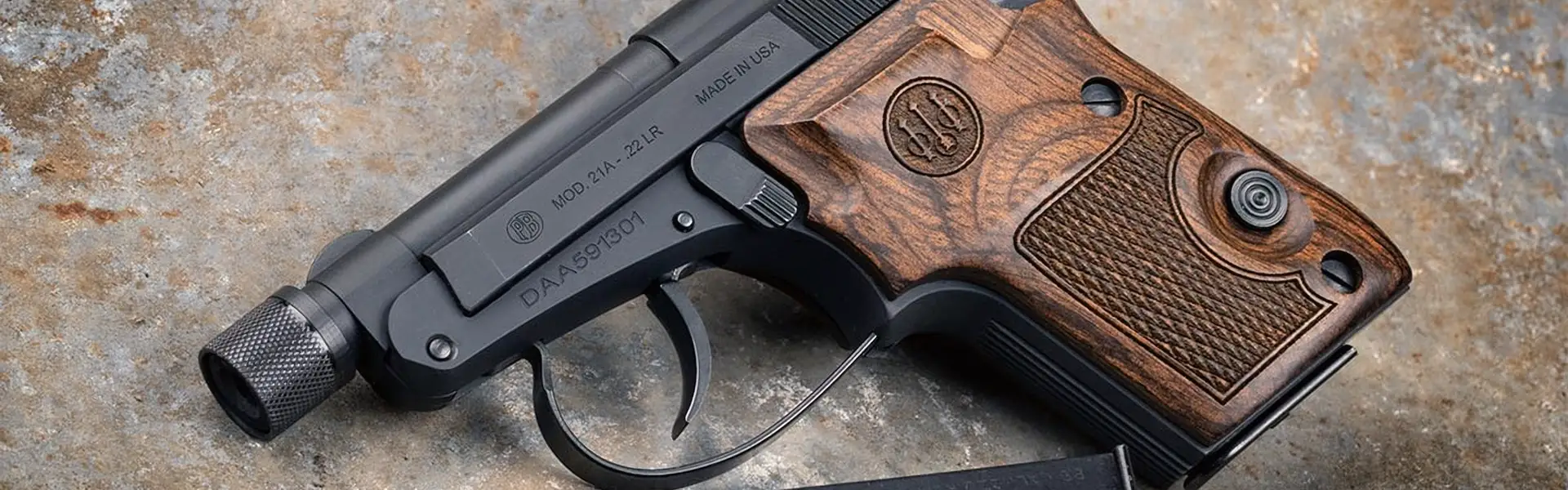
The Beretta 21A Bobcat is the iconic American pocket pistol — introduced in 1984 at Beretta USA Accokeek, Maryland, built around the tip-up barrel that traces back to the 1952 Beretta 950 Jetfire and the original Italian pocket-pistol design tradition. Keep Shooting carries five magazines for the 21A family: factory Beretta and Mec-Gar OEM production in both .22 LR (7-round) and .25 ACP (8 or 9-round) capacities, priced from $22.37 through $37.18.
About Beretta 21A Magazines at Keep Shooting
Keep Shooting carries five magazines for the Beretta 21A Bobcat pocket pistol: two Mec-Gar magazines ($22.37 each — the .22 LR 7-round and the .25 ACP 9-round extended-capacity), three factory Beretta-branded magazines (.22 LR 7-round at $37.18, .25 ACP 8-round at $30.95, and a generic 21A magazine at $25.78). The Mec-Gar magazines are functionally identical to factory Beretta production — Mec-Gar is Beretta's OEM magazine supplier — so the lower-priced Mec-Gar entries offer factory-grade quality at a meaningful discount. For the broader Beretta magazine ecosystem, see our parent Beretta Magazines category.
The Beretta 21A Bobcat is one of the most historically iconic American pocket pistols of the modern era — a tiny semi-automatic compact enough to disappear in a pocket, a purse, or an ankle holster, with a design lineage that traces back through seven decades of Beretta pocket-pistol refinement. The 21A entered production in late 1984 at the Beretta USA facility in Accokeek, Maryland — replacing the Beretta Model 20 (1968-1985), which was itself a refinement of the earlier Beretta 950 Jetfire (1952). The Jetfire, Model 20, and 21A share the same fundamental pocket-pistol silhouette: a small single-action (or double-action) blowback pistol with an external hammer, tip-up barrel, and compact enough slide to conceal in a shirt pocket. The 21A's introduction in 1984 modernized the Jetfire-descended design with a DA/SA trigger — mirroring the same DA/SA action that Beretta was preparing to field in the full-size 92F that would be adopted as the US military M9 in 1985.
The defining mechanical feature of the 21A is its tip-up barrel design. A small lever on the left side of the frame, positioned above the trigger, releases the barrel at the breech end — the barrel pivots upward on a pin at the muzzle, exposing the chamber for direct hand-loading of the first round. This solves a specific problem the Bobcat's target user base often has: the slide on a small pocket pistol is physically difficult to rack for users with small hands, arthritis, limited grip strength, or wet/gloved hands. The tip-up barrel means an elderly user, a concealed- carry license holder with a hand injury, or a home-defense user responding in the middle of the night can load the pistol without any slide manipulation at all. For the full Beretta brand context and the 500-year Italian factory tradition behind the 21A, see our Beretta brand page.
A second 21A design quirk worth understanding is the extractorless action. Unlike most modern semi-automatic pistols, the 21A was designed without a spring-loaded extractor — the spent case is ejected purely by the expanding gas pressure of the fired cartridge, which pushes the empty case backward into the breech face and allows the slide's ejection port to strip it out. The design saves weight, cost, and complexity, but it makes the 21A unusually sensitive to ammunition selection — specifically, the pistol needs reasonably hot ammunition to cycle reliably, and weak or low-pressure loads (low-velocity .22 LR subsonic rounds, some older .25 ACP target ammunition) will produce failure-to-eject stoppages. This is well-documented in the Bobcat community and drives the consensus recommendation: shoot hot .22 LR ammunition like CCI Mini-Mag or CCI Stinger in .22 LR Bobcats, and standard-pressure brand- name .25 ACP (Fiocchi, Winchester, Speer Gold Dot) in .25 ACP Bobcats. Cheap bulk ammunition often won't cycle reliably.
The Bobcat is available in two calibers that represent different tradeoffs. .22 LR — with a 7-round magazine capacity — offers the lowest ammunition cost (roughly $0.10-0.15 per round), the lightest recoil impulse (important in a pocket pistol where grip surface area is minimal), and the widest ammunition selection at any sporting goods store. The tradeoff is that .22 LR is widely considered marginal for defensive use — the cartridge delivers low muzzle energy and limited penetration, and while a well-placed .22 hit can be incapacitating, it's not the first-choice defensive caliber. .25 ACP — with an 8-round factory magazine or 9-round Mec-Gar extended capacity — delivers roughly 60% more muzzle energy than .22 LR and the advantages of a centerfire primer (more reliable ignition than rimfire), at the cost of higher per-round ammunition cost ($0.50-1.00 typical) and a slightly heavier recoil impulse. Both calibers remain marginal defensive rounds compared to 9mm Parabellum or .380 ACP, but both are dramatically more defensive- capable than not carrying a gun at all — which is the pocket pistol's entire market justification.
The five magazines in our catalog cover the practical range of 21A capacity and pricing. The Mec-Gar Beretta 21 .22 LR 7-round ($22.37) and Mec-Gar Beretta 21 Bobcat .25 ACP 9-round ($22.37) are the best-value options in the catalog. Mec-Gar is the Italian magazine manufacturer that produces the factory- branded Beretta magazines as an OEM contractor, so these are functionally identical to the factory-branded magazines sold at higher price points — different packaging, same magazine inside. Interestingly, the Mec-Gar .25 ACP 9-round is a one-round-extended capacity over the standard factory 8-round Beretta-branded version. The factory Beretta 21 .22 LR 7-round ($37.18) and factory Beretta 21 .25 ACP 8-round ($30.95) are the Beretta-packaged equivalents for customers who want the factory box and warranty paperwork. The generic Beretta 21A Magazine ($25.78) covers mixed-caliber compatibility (verify specific caliber before ordering — our customer-service team can confirm which variant fits your specific 21A).
Production history worth noting: Beretta discontinued the 21A Bobcat in 2013 after a 29-year production run, responding to declining pocket- pistol market demand and the rise of subcompact polymer pistols (Ruger LCP, Smith & Wesson Bodyguard, and similar .380 ACP designs) that offered meaningfully better defensive capability in comparable form factors. Customer demand persisted, however, and in 2017 Beretta rebooted 21A production to meet continued market interest. In 2020, Beretta introduced the 21A Covert variant with a threaded barrel for suppressor compatibility — a specialty offering for concealed-carry users who want the option of a sound-suppressed pocket-pistol package. Manufacturing transitioned from the original Accokeek, MD facility to Beretta's newer Gallatin, Tennessee plant when Accokeek manufacturing operations closed in mid-2015. All current production 21A magazines are compatible with both the pre-2013 and 2017+ Bobcat production runs.
The 21A's design ancestry deserves historical context. The Beretta 950 Jetfire was introduced in 1952 as Beretta's compact pocket pistol, featuring the tip-up barrel, external hammer, and overall silhouette that would define the Bobcat family. The Jetfire was a refinement of the earlier Beretta 418 — most famously carried by the fictional James Bond in the original Ian Fleming novels, before Bond was reissued the Walther PPK in "Dr. No" (1958). The Beretta Minx was the .22 Short sister to the Jetfire, and the Beretta Model 20 (1968) added the full double-action trigger that the 21A inherited. The 21A sits at the culmination of this 30-year Italian- American pocket-pistol design tradition.
For the parent Beretta magazine catalog see our Beretta Magazines category; for the full Mec-Gar catalog covering Beretta, Sig, Smith & Wesson, CZ, and other platforms see our Mec-Gar brand page; for the broader magazine ecosystem across all manufacturers see our Magazines category.
Keep Shooting ships all Beretta 21A magazines from our Pennsylvania warehouse with free shipping on orders over $49.95 and hassle-free returns. Pocket-pistol magazines rarely hit state-level capacity restrictions (the 7-9 round capacities fall well below even the strictest 10-round limits), and all five magazines in our catalog ship to every US state where mail-order firearm accessories are legal. Whether you're a current Bobcat owner replacing a worn-out factory magazine, a 21A Covert owner sourcing spares for the suppressor-compatible variant, a vintage Model 20 or 950 Jetfire collector, or a new-production Bobcat buyer picking up spare mags for the first time, every 21A magazine in our catalog is authentic factory or Mec-Gar OEM production — the only magazines Beretta itself will warranty on the 21A platform.
Frequently Asked Questions — 21A Mags
Keep Shooting carries a wide selection of 21A Mags products from trusted brands. Browse our catalog to see the full range, and use the filters on the left to narrow by brand, price, or product type.
Yes! All orders over $49.95 qualify for free shipping, including 21A Mags products. Orders typically ship within 1–2 business days.
Keep Shooting offers hassle-free returns on 21A Mags products. If you're not completely satisfied, contact our customer service team for a return authorization. All products must be in original, unused condition.
If you need help choosing the right 21A Mags product, our team is available to assist. Check individual product descriptions for detailed specifications, or contact us directly and we'll help you find the best fit for your needs.