
Brand Spotlight • May 2026
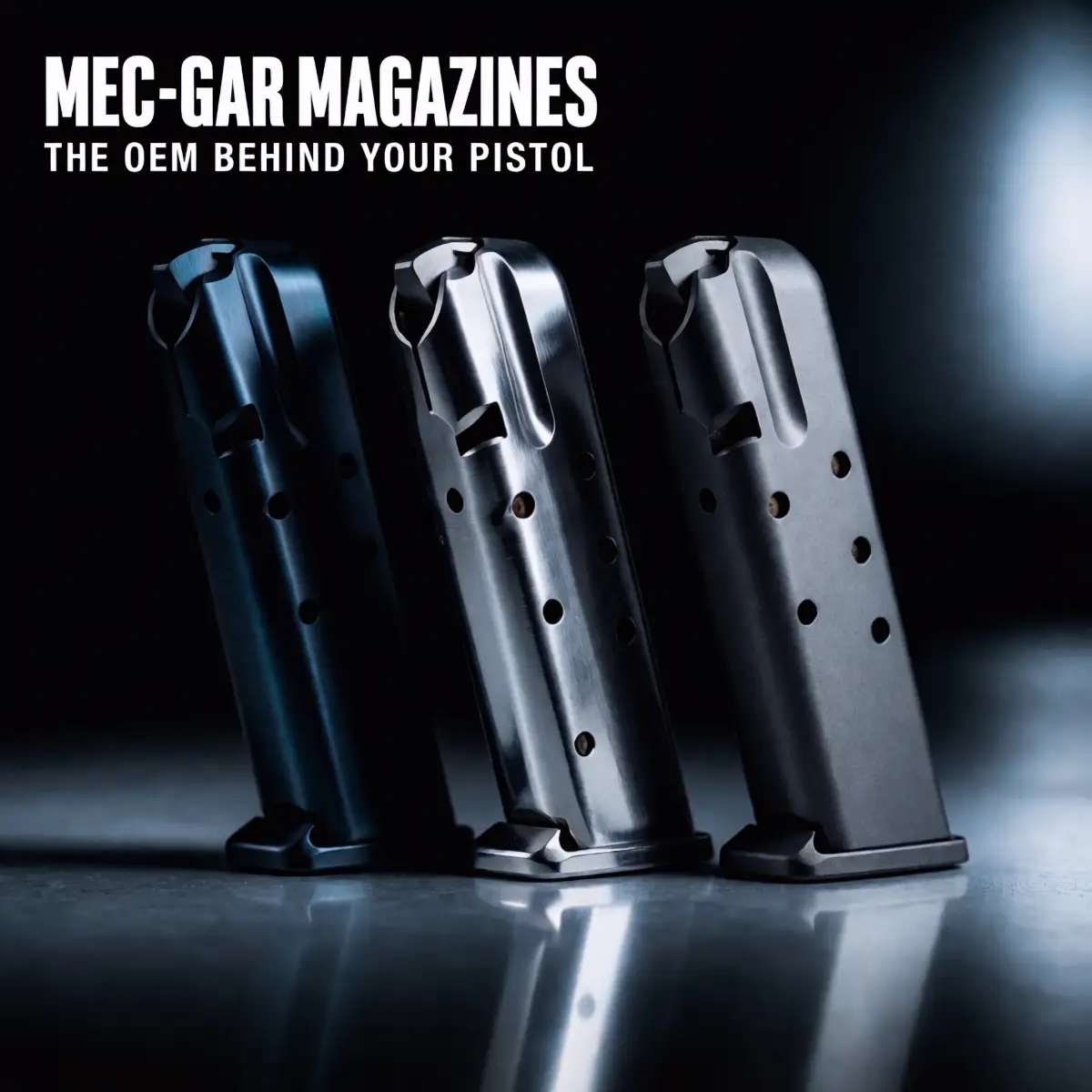
Mec-Gar Magazines: The Italian OEM Behind Your Pistol
The Italian company that makes the factory magazines in your Beretta, SIG, and CZ — and sells them for less.
Pull the magazine out of a brand-new SIG P226, flip it over, and read the floorplate. There's a good chance it says Mec-Gar, not SIG. Here's who Mec-Gar is, what the finishes mean, the flush-fit capacity trick that sets them apart, and how to pick the right one for your pistol.
Pull the magazine out of a brand-new SIG P226, flip it over, and read the floorplate. There's a good chance it says Mec-Gar, not SIG.
That surprises a lot of people. You paid a premium for “factory” magazines, and the part that actually feeds your pistol turns out to be made by an Italian company you may never have heard of. Here's the thing: that's not a downgrade. It's the same magazine the gun maker would have sold you, often for several dollars less.
Mec-Gar magazines have quietly fed millions of handguns for decades. The company is the OEM — the original equipment manufacturer — behind factory mags for Beretta, SIG Sauer, CZ, Walther, and a long list of others. We've sold them across dozens of platforms for years, and we'll walk you through who Mec-Gar is, what the different finishes mean, the flush-fit capacity trick that sets them apart, and how to pick the right one for your pistol.
Who is Mec-Gar?
Mec-Gar was founded in 1965 by Edoardo Racheli in Gussago, a town in Italy's Brescia province. That region is the historic heart of Italian gunmaking, home to Beretta and a dense web of suppliers who've been building firearms and parts for generations. The company is still family owned and operated.
What started as a small metal-stamping shop grew into the largest dedicated pistol magazine manufacturer in the world. Today Mec-Gar runs three facilities totaling more than 82,000 square feet, builds over 250 different models, and has produced well past 130 million magazines, according to the company's own figures. Production runs to ISO 9001:2015 quality standards using certified carbon steel and high-tensile music-wire springs.
That scale matters for one simple reason. When a company makes more pistol magazines than anyone else on earth, it has worked out the engineering problems that smaller makers are still figuring out.
What “OEM” actually means for your magazine
Here's the part that confuses buyers, so let's clear it up plainly.
When you buy a “Beretta” or “SIG” magazine at full price, you are very often buying a Mec-Gar magazine with the gun maker's name stamped on it. Mec-Gar builds them on the same tooling, from the same certified materials, to the same specifications, and ships them to the firearm manufacturer to package and sell. The magazine that came in the box with your pistol may have rolled off the exact same line as the Mec-Gar-branded version on our shelf.
So a Mec-Gar-branded magazine is not an “aftermarket gamble.” It is the factory magazine, minus the brand markup. The savings come from skipping the middleman's name on the label, not from cutting corners on the part.
That's the whole hook, and it's worth saying clearly: for many duty and service pistols, the OEM magazine and the Mec-Gar magazine are the same magazine. If you've ever paid $40 for a factory-branded mag when the identical Mec-Gar was sitting nearby for $28, you've paid for the stamp.
Want to see which ones fit your handgun? You can browse our full Mec-Gar magazine selection and sort by platform.
What pistols does Mec-Gar make magazines for?
Mec-Gar's catalog is broad, which is part of why the brand is easy to overlook. It isn't tied to one platform the way some makers are. Here's where you'll run into them most:
- Beretta 92, 92FS, M9, and 96 series
- SIG Sauer P226, P228, and P229
- CZ 75, 75 Compact, and related models
- Browning Hi-Power
- Walther PPK and PPK/S
- Taurus PT92 and PT99
- Ruger Mark series and the P-series pistols
- Colt 1911 and other single-stack platforms
- Smith & Wesson, Kimber, Kel-Tec, and more
Calibers run from .22 LR up through 9mm, .40 S&W, and .45 ACP. If you own a mainstream duty or service pistol designed in the last 50 years, there's a strong chance Mec-Gar makes a magazine for it, and a decent chance they already made the one that came with the gun.
Mec-Gar magazine finishes: blued vs. nickel vs. anti-friction coating
This is the question we field most often, and it's the one most guides skip. Mec-Gar offers the same magazine in up to three finishes, and the difference is real, even though the internals are identical.
| Finish | Corrosion resistance | Feel / smoothness | Relative price | Best for |
|---|---|---|---|---|
| Blued carbon steel | Lowest | Standard | Most affordable | Range mags kept clean and dry |
| Nickel | Good | Slick, easy to clean | Small upcharge | Value pick for humidity or carry |
| Anti-Friction Coating (AFC) | Best | Slickest, drops free | Top of the range | Carry, duty, humid climates |
A few notes from experience. Blued magazines work fine, but the carbon-steel finish is the least corrosion-resistant of the three. Leave a blued mag in a damp range bag or a sweaty waistband and you can get surface rust faster than you'd like. It wipes off, but it's a hassle.
Nickel is the value sweet spot for a lot of buyers. It resists corrosion noticeably better than bluing, cleans up with a wipe, and only costs a little more. The anti-friction coating is Mec-Gar's premium option. Shooters who've run AFC magazines for years report the coating stays slick and holds up well, and the mags drop free a touch more reliably when you're reloading.
Tip: If you carry the pistol or live somewhere humid, spend the extra few dollars on nickel or AFC. If these are dedicated range mags that live in a dry case, blued is perfectly good.
In practice
Consider the case of Tom, a customer down in the Florida panhandle who carried a blued Mec-Gar in an inside-the-waistband holster through a long, swampy summer. By August he had light rust speckling the magazine body — nothing dangerous, but annoying. He switched his two carry mags to AFC and kept the blued ones for range duty. Problem solved, and he spent maybe $15 total to fix it. The lesson: match the finish to how and where you'll actually use the magazine.
The flush-fit capacity advantage
Here's where Mec-Gar earns its reputation instead of just borrowing it.
Mec-Gar's Optimum series uses a patented spring and follower design that fits more rounds into the same footprint. In plain terms, you get extra capacity without a magazine that sticks out below the grip. For a carry gun or a duty pistol, that's a genuine advantage, because a flush magazine conceals better and doesn't snag.
The numbers tell the story:
- Beretta 92FS: 18 rounds flush, where many factory mags hold 15 to 17. Add the Plus-2 base and you're at 20.
- CZ-75: 17 rounds flush, one more than the standard factory magazine.
- SIG P226: 18 rounds flush in AFC, with a 20-round option available.
The Plus-2 adapter deserves a mention. It's a replacement floorplate and inner base that adds two rounds to select Optimum magazines. Unlike a clamp-on extension that dangles off the bottom, the Mec-Gar system is engineered into the magazine, so it stays tidy and feeds reliably.
In practice
Take Rachel, who shoots a CZ-75 in local club matches. She was running factory 16-round mags and constantly doing one extra reload per stage. Switching to Mec-Gar 17-round Optimum magazines didn't sound like much — one round each — but across a six-mag rig it added up to a full stage's worth of rounds and one fewer reload at the worst possible moment. She wasn't paying premium-custom-mag prices to get there, either.
If you're building out a Beretta 92, our Beretta magazine selection carries the Mec-Gar Optimum mags in both flush and Plus-2 configurations.
Are Mec-Gar magazines reliable?
Short answer: yes, with the honest caveats any product earns.
The consensus across reviewers and longtime owners is consistent. Mec-Gar magazines function on par with factory mags, and many shooters say they drop free and seat a little slicker than the phosphate factory versions. That tracks with what the OEM relationship would predict, since they often are the factory mags. The Truth About Guns and other independent reviews land in the same place: solid build, dependable feeding, fair price.
The construction backs it up. You get certified carbon-steel bodies, strengthened feed lips, high-tensile music-wire springs, and reinforced polymer base plates. These are the parts that matter, and Mec-Gar doesn't skimp on them.
Now the honest part. A few owners report that older blued magazines can surface-rust if stored damp, which circles back to the finish discussion above. And as with any magazine run hard for years, feed lips can spread eventually, though that's rare and a replacement is affordable. The most common “problem” people report is self-inflicted: magazines loaded up with oil and grit feed worse than clean, dry ones. Keep them clean, and they'll keep working.
Where do Mec-Gars sit against premium names like Wilson Combat? They're the value-priced, OEM-quality workhorse, not a boutique match magazine built to a different standard. For most shooters, that's exactly the right tool, and it's no knock at all. If you're chasing the last fraction of a percent in a competition 1911, you might reach for a specialist mag; for everything else, Mec-Gar is hard to beat on value.
How to choose the right Mec-Gar magazine
Putting it all together, here's the order of operations we'd suggest.
- Confirm your exact model and caliber. A Beretta 92FS and a 96 take different magazines; so do a P226 and a P229, and a full-size CZ-75 versus the Compact. Match the magazine to the specific pistol, not just the family.
- Pick your capacity. For carry or concealment, go flush-fit. For range or competition, the Plus-2 or extended options give you more rounds between reloads.
- Pick your finish. Use the table above. Carry or humidity means nickel or AFC; dry range use means blued is fine.
- Buy from someone who lists specs clearly. Fitment mistakes are the most common ordering error, and they're avoidable when the model compatibility is spelled out.
If you're not sure which Mec-Gar fits your handgun, reach out to our team and we'll help you sort it out. We've been doing this since 2002, and we'd rather get you the right magazine the first time than process a return.
The bottom line on Mec-Gar magazines
Mec-Gar magazines are one of the better-kept open secrets in the handgun world. The company has been building pistol mags in Brescia since 1965, makes more of them than anyone else, and supplies the factory magazines for a who's-who of duty and service pistols. Odds are good you already own a few without knowing it.
Three things to remember. First, a Mec-Gar-branded magazine is the OEM part minus the markup, not an aftermarket compromise. Second, the finish matters, so match blued, nickel, or AFC to how you'll actually use and store the magazine. Third, the Optimum flush-fit design gives you extra capacity without a magazine that hangs out below the grip, which is real value for a carry or duty gun.
If you're buying spares for a Beretta, SIG, CZ, or just about any mainstream pistol, Mec-Gar belongs on your short list. Browse our pistol magazine selection to find the Mec-Gar that fits your handgun, or pair them with a fresh case of handgun ammunition and make a range day of it.