
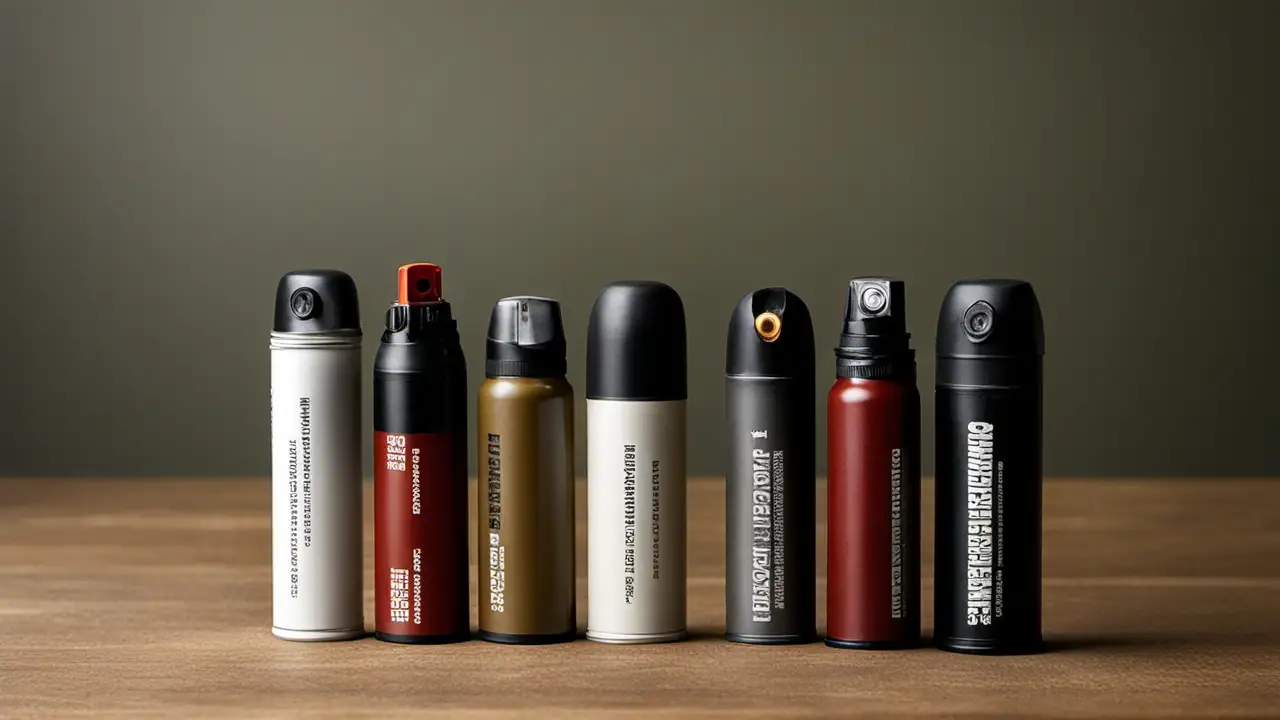
Walk into any sporting goods store and find the personal defense aisle. You'll see six or eight different pepper spray packages on the peg hooks, and almost every one of them claims to be "maximum strength." Some are stream sprays. Some are foggers. Some are gels. A few are labeled with words like "police strength" or "2 million SHU" in big print on the front.
Most buyers stand there for a minute, pick the one with the loudest label, and head to checkout.
We've sold personal defense gear for over two decades, and here's what we've learned: the right pepper spray for one person is the wrong pepper spray for another. The labels don't make it easy to tell them apart, and the marketing makes everything sound the same.
This guide walks through the actual differences between pepper spray types, so you can pick the one that fits how you live, where you carry, and what you're trying to do with it.
What pepper spray actually is (and isn't)
Pepper spray is a defense aerosol containing oleoresin capsicum, or OC, derived from the same family of plants that produces hot peppers. When OC contacts the eyes, nose, mouth, or lungs, it causes intense burning, involuntary eye closure, and difficulty breathing. The effects are temporary, the recovery is generally complete, and the chemistry doesn't rely on someone having a normal pain response — which is why OC works on subjects who are drunk, high, or in an adrenaline state.
That last point matters because not every product labeled "pepper spray" is actually OC.
You'll sometimes see "Mace" used as a generic term for pepper spray, the way "Kleenex" gets used for tissues. The original Mace formula, going back to the 1960s, was actually CN tear gas. The Mace brand sells OC products today, but the historical confusion persists. Some older or budget-priced "Mace" products still contain CN or CS rather than OC, and they don't work the same way.
A few other terms you'll see on packaging:
- OC: Oleoresin capsicum. The active ingredient in real pepper spray.
- CS: A synthetic chemical irritant. The standard military and law enforcement tear gas.
- CN: An older chemical irritant, less common today.
- Blends: Some products mix OC with CS or CN. More common in law enforcement formulations than in civilian products.
For personal defense, straight OC is what most buyers should pick. The reason is simple: it works on a wider range of subjects, and it doesn't rely on the target having a normal pain response.
The four common pepper spray types and patterns
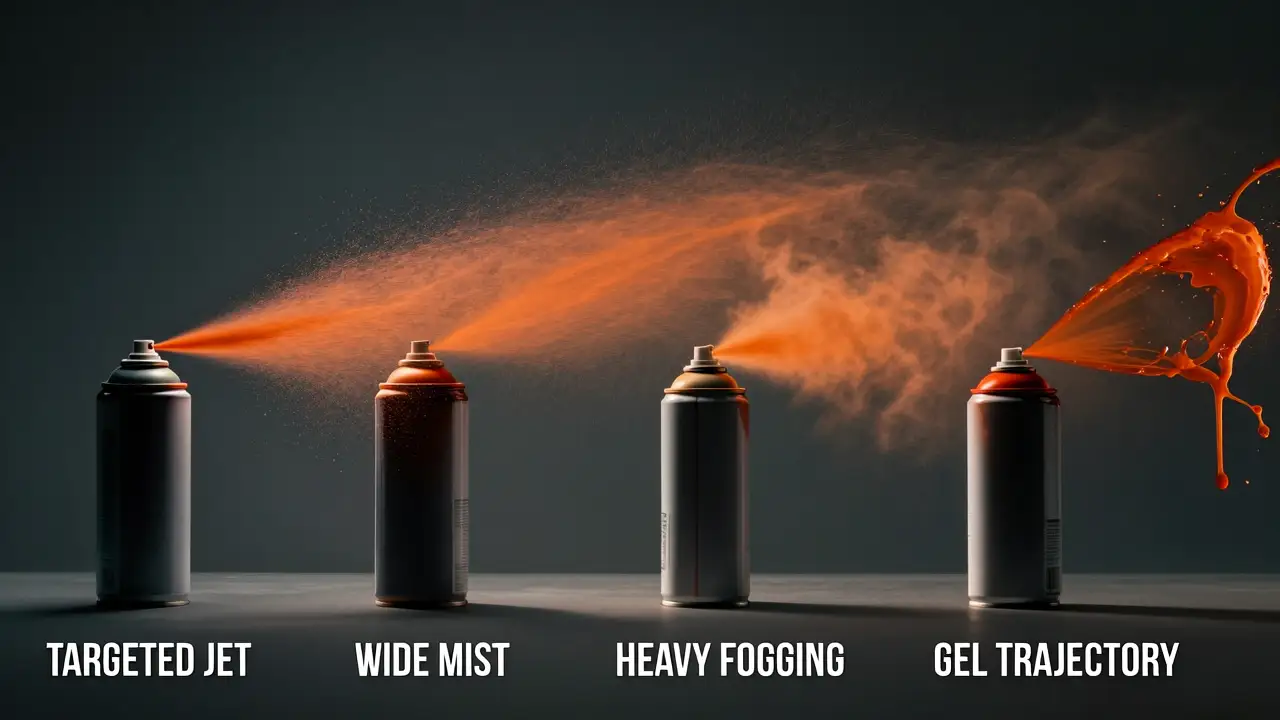
Once you know you want OC, the next decision is the spray pattern. This is where the differences between pepper spray types matter most in real-world use, and where most buyers don't get useful guidance.
Stream
A stream spray fires a tight, focused jet. Range is typically 8 to 18 feet, depending on the can size and pressure.
Streams shine in outdoor or windy conditions because the focused pattern resists wind drift better than wider spray patterns. You can also aim a stream more precisely, which matters at distance.
The trade-off: you have to hit the target's face. Under stress, with adrenaline shaking your hands and the target moving, that's harder than it sounds. Streams are unforgiving of poor aim.
Cone or mist
A cone spray, sometimes called a mist or fog mist, releases a wider dispersal pattern. Range is typically 6 to 10 feet.
The wider pattern is more forgiving under stress because partial hits still land OC on the target's face. For most users, especially those without significant practice time, a cone is the more practical pattern.
The trade-off: cone sprays are more vulnerable to wind. A breeze in the wrong direction can blow the cloud back at you, which is why these are not the right choice for breezy outdoor environments.
Fogger
A fogger throws a heavy, fire-extinguisher-style cloud. Range can reach 12 to 25 feet.
Foggers are designed for multi-attacker scenarios, animal defense (dogs, bears with bear-specific products), or situations where you need to fill an area rather than hit a single target. The cloud is dense and hard to evade.
The trade-offs are significant. Foggers are terrible indoors because they contaminate everything, including you. They also burn through their capacity in a hurry. The big cloud means a small can might give you only one or two bursts.
Gel or foam
Gel and foam pepper sprays use a thicker formulation that sticks where it lands. Range is typically 8 to 18 feet.
Gels are the right choice for indoor environments, situations with bystanders nearby, or windy outdoor conditions where a stream or cone would drift. The sticky formula stays on the target's face and doesn't atomize into a contamination cloud the way traditional sprays do.
Trade-offs: gels can be slightly slower to take effect because the formula has to make eye contact rather than being inhaled. The range is decent but the flight characteristics are different from stream sprays, which takes some practice to use well.
If you're building out a layered approach to personal defense, pepper spray works best as one piece alongside other tools. Many of the people we serve also carry EDC knives and a tactical flashlight, each of which solves a different problem.
OC vs. CS vs. CN: the chemistry behind the label
The chemistry comparison comes up often enough that it's worth slowing down on.
OC is an inflammatory agent. It works by causing inflammation of the mucous membranes regardless of the subject's pain tolerance. There's no built-up immunity to OC, no tough-guy resistance, and no way to "push through" it. Some subjects react more strongly than others, but everyone reacts.
CS is a chemical irritant. It works by triggering the body's pain response. That makes it effective against most subjects, but a small percentage of people — particularly those with high pain tolerance or under the influence of certain drugs or stimulants — can fight through CS more easily than OC.
CN is an older irritant similar to CS but generally considered less effective. Most modern formulations have moved away from CN.
Blended formulas like OC plus CS combine the inflammatory and irritant effects. They show up most often in law enforcement and military products. For civilian personal defense, blends are usually overkill, and straight OC products are easier to find, easier to buy, and well-suited to the use case.
The honest version
If you're buying pepper spray for yourself, family, or a gift, look for "OC" on the label. That's what you want.
How to read strength ratings (the honest version)
Open most pepper spray packaging and you'll see a strength rating. Sometimes it's a percentage, sometimes it's an SHU number, and sometimes it's both. They don't measure the same thing, and one of them is a lot more useful than the other.
| Rating | What it measures | How useful is it? |
|---|---|---|
| SHU (Scoville Heat Units) |
Heat of the OC resin before it goes into the can. Common claims: 500K – 5M SHU. | Misleading on its own. A 2-million-SHU label tells you about the extract, not how much made it into the spray. |
| MC (Major Capsaicinoids %) |
Actual capsaicinoid content of the finished spray. Effective civilian range: 1.0% – 1.4%. | The honest number. This is what's actually in the can. |
When two products are sitting next to each other on the shelf and one says "5 million SHU" while the other says "1.3% Major Capsaicinoids," the second one is giving you the more honest number. Both can be effective, but the labeling tells you which manufacturer is being upfront about what's actually in the can.
You'll see law-enforcement-grade products in the 1.3% MC range that work as well as anything on the market. This is one of those topics where the marketing makes everything sound bigger than it is. A 2-million-SHU spray with 0.5% MC will perform differently than a 1-million-SHU spray with 1.3% MC, and the only way to know is to look past the headline number.
Carry formats: match the tool to how you live
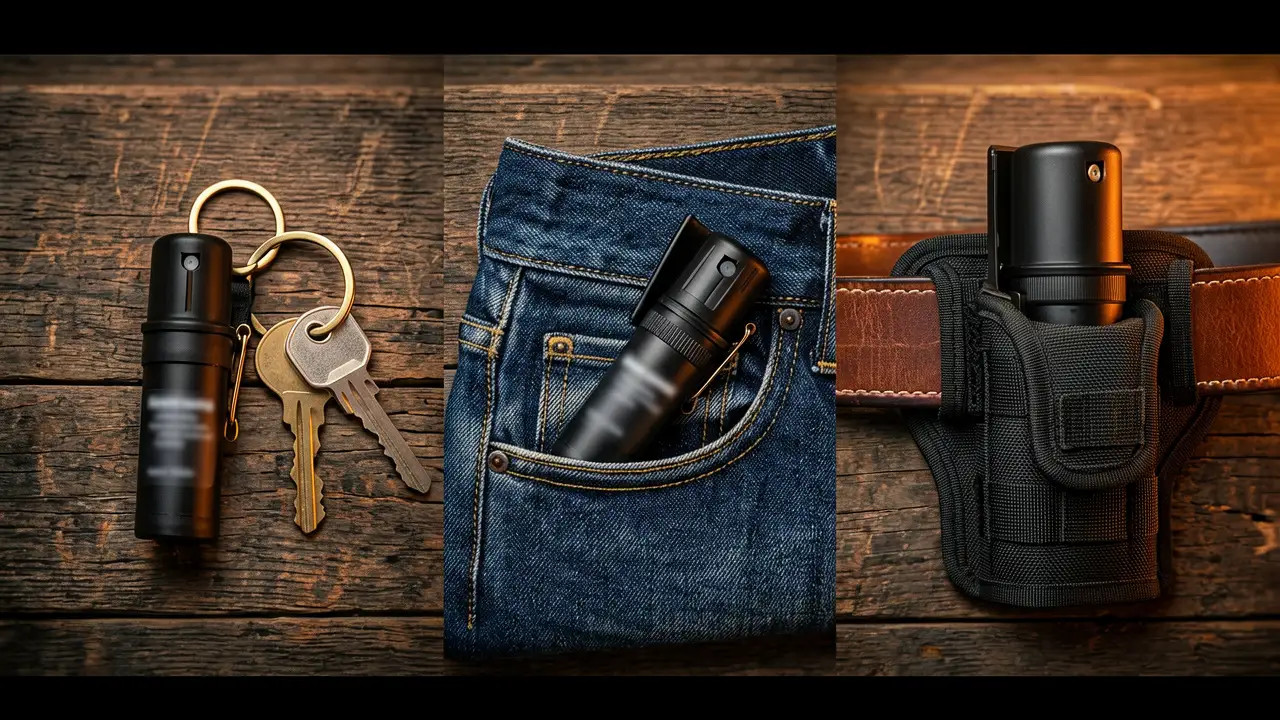
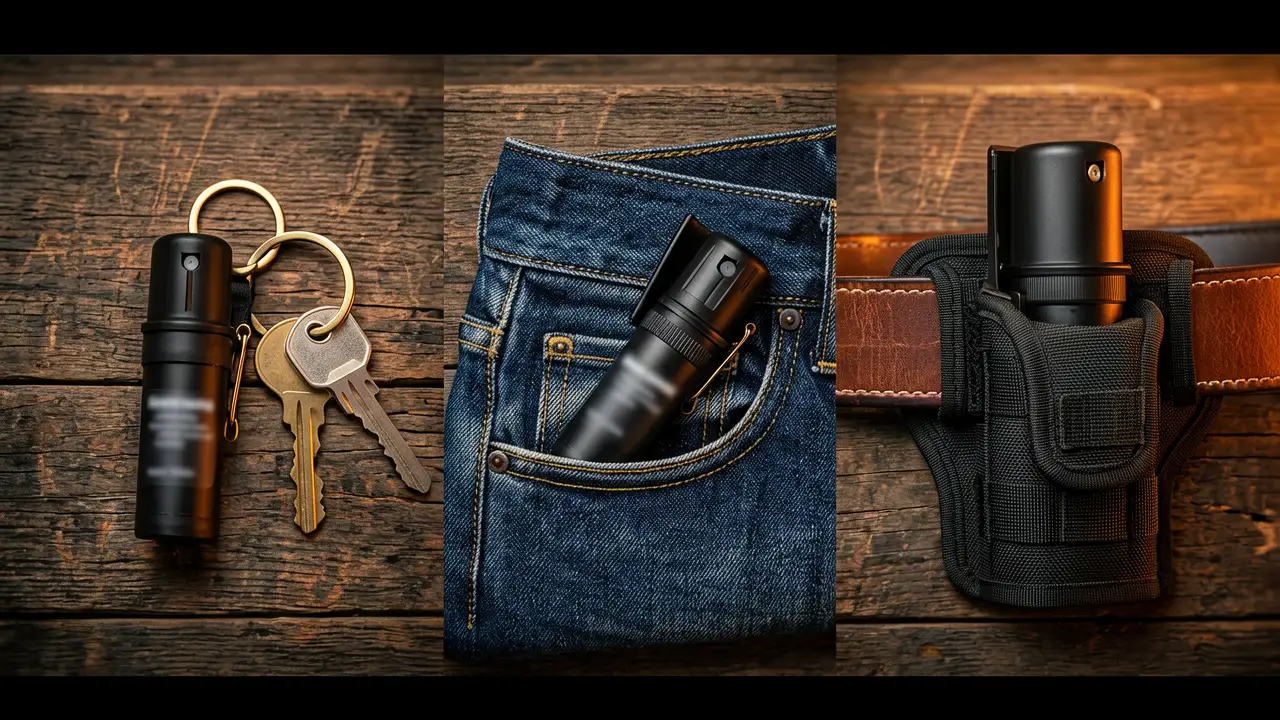
The right pepper spray for daily carry depends less on chemistry and more on how you'll actually carry it. A 4-ounce hip-holstered fogger is the wrong tool for someone walking through a parking garage. A keychain spray is the wrong tool for hiking remote trails.
Keychain
~½ oz • $10–20
Best for: short walks from car to door, daily commutes, anyone who wants something on hand without a separate carry decision.
Trade-off: small capacity (3–6 bursts), short range (~6–8 feet) leaves less margin for error.
Pocket / compact
~½–1 oz • recommended for most
Best for: most adults looking for a daily-carry option that balances concealment, capacity, and range.
If we had to name one format for general civilian use, this would be it.
Belt holster / hip-carry
~1.5–4 oz • 18–25 bursts
Best for: hikers, joggers, dog walkers, rural property owners, and anyone in lower-population areas where bigger threats are realistic concerns.
Trade-off: separate carry decision from your normal EDC.
Specialty (lipstick, pen, ring)
Novelty more than utility
Honest take: tiny capacities, awkward deployment under stress, and the format usually exists to disguise the product rather than to function well as a defense tool.
You can browse our full pepper spray selection alongside other personal defense tactical gear when you're ready to compare.
What to actually expect when you deploy it
The marketing on most pepper spray packages shows a clean, decisive deployment. Real-world use is messier, and knowing what to expect ahead of time changes how you should think about the product.
Reality check
- Wind matters. A 10 mph breeze in the wrong direction can carry a cone or fogger spray right back at you. The single biggest thing that surprises new users.
- Indoor deployment contaminates the room. If you spray pepper spray in your apartment, hallway, or car, you and everyone else in that space are going to feel it. Gels minimize this; nothing eliminates it.
- Onset takes 1 to 3 seconds. That's fast, but not instant. A target moving toward you will keep moving for another step or two.
- Effects last 20 to 45 minutes. Enough time to escape and call for help. Not enough time to assume the threat is gone forever.
- Some subjects push through. Stimulants, alcohol, severe mental illness, and a high adrenaline state can all reduce OC effectiveness. The product is one tool, not a guaranteed stop.
- Inert trainers exist. Most major manufacturers, including Fox Labs, sell non-active training versions of their spray. If you carry pepper spray seriously, an inert trainer is a smart investment.
Shelf life and replacement
Pepper spray expires. Most cans carry an expiration date 3 to 4 years after manufacture, printed somewhere on the canister. After that point, the propellant pressure decreases and the OC formulation can break down — both of which reduce effectiveness.
The expiration date is not marketing. A five-year-old can might still spray, but the range, the dispersal pattern, and the chemical effectiveness are all going to be reduced compared to a fresh unit.
Check your dates. If the can in your purse or glovebox is older than its expiration, replace it. Keep the old one for practice if you want, but don't rely on it.
A quick word on choosing for yourself
Pepper spray is one tool in a thoughtful approach to personal safety, not a magic wand. The right one for you is the one that matches your daily routine, your environment, and the realistic threats you face.
A few practical rules of thumb from selling this stuff for over two decades:
Rules of thumb
- For most adults: pocket-size OC, cone or stream pattern, 1.0% to 1.4% MC, fresh within the expiration date.
- For indoor environments or near bystanders: gel, every time.
- For hikers, joggers, or rural settings: hip-carry size, longer range, more capacity.
- For multiple-attacker concerns or animal defense: a fogger sized to the job.
Pepper spray is broadly legal across all 50 states, but specific restrictions on size, formulation, and minimum age vary. A handful of states cap concentration or require permits for certain configurations. Before you order, it's worth checking your local rules — and we list our shipping restrictions for the products that have them.
Whatever pepper spray type you end up choosing, get one that fits how you actually live, practice with an inert trainer if you're serious about being ready, and replace it when the date comes up. That's the difference between gear that works and gear that's just sitting in your bag.
Ready to pick your pepper spray?
Browse OC pepper sprays in every pattern and carry format — keychain through hip-holster.