
Knife Law Guide
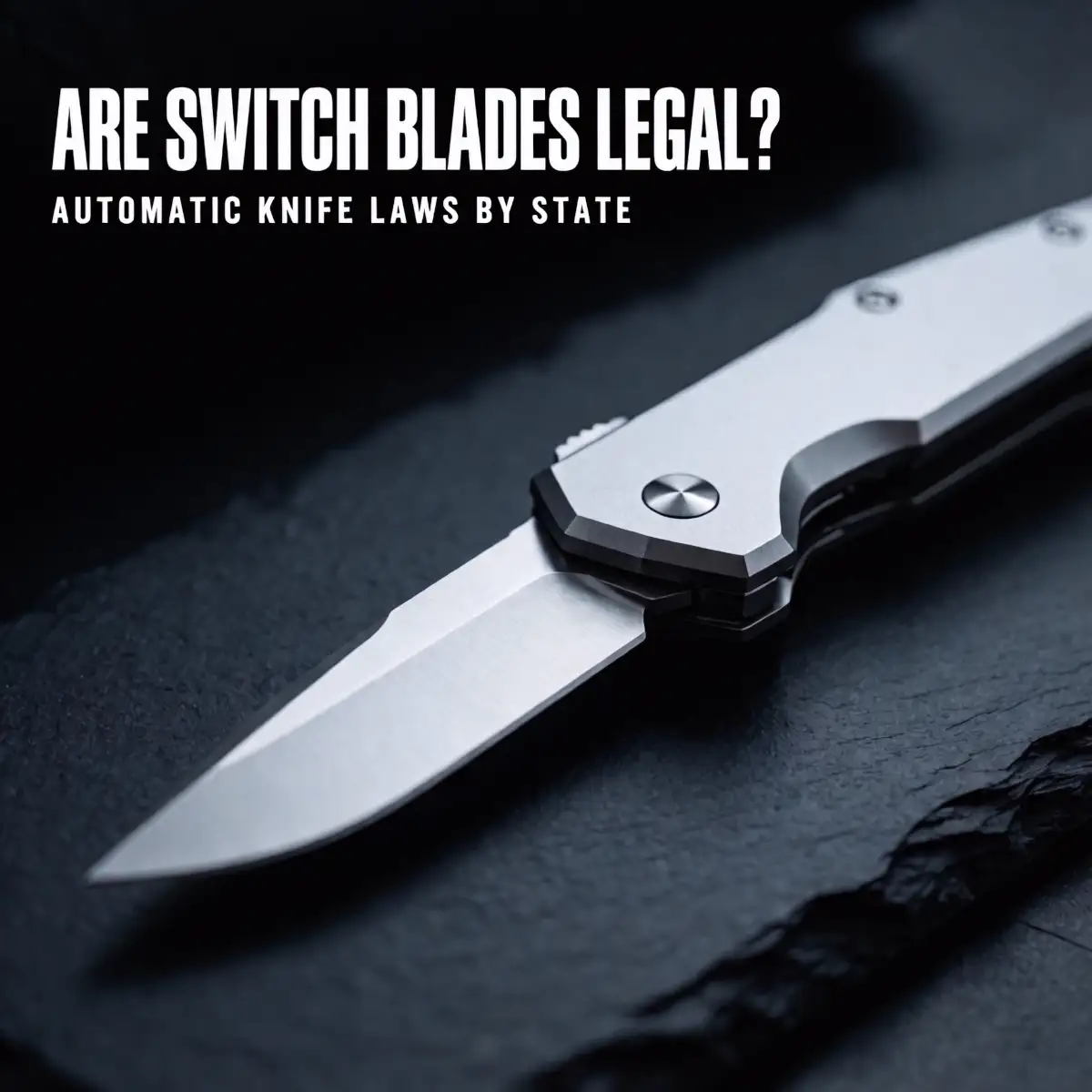
Are Switchblades Legal? Automatic Knife Laws Explained
For most Americans, the answer is yes — and that surprises a lot of people.
Decades of movie mythology and a 1958 federal law built a reputation the actual laws stopped matching years ago. Here’s what the Federal Switchblade Act really does, which states still restrict automatics, and the practical stuff nobody explains — like why a retailer sometimes can’t ship a knife to your address.
Walk the aisles at any knife or gun show and you’ll hear it within the first hour: “Aren’t those illegal?” Somebody says it every time an automatic knife comes out of a display case.
It’s a fair question. Are switchblades legal? For most Americans, the answer is yes, and that surprises a lot of people. Decades of movie mythology and a 1958 federal law built a reputation that the actual laws stopped matching years ago. Most states now allow you to own an automatic knife, and many let you carry one. But the details vary by state, a few states still say no, and the federal rules affect how you can buy one in the first place.
We’ve sold knives to this community for 23 years, and the legality question comes up constantly, usually from someone who’s wanted an automatic for years and assumed they couldn’t have one. This guide walks through the federal law, the state rules, and the practical stuff nobody explains, like why a retailer sometimes can’t ship a knife to your state.
Note: This article is general information, not legal advice. Knife laws change, and local ordinances can differ from state law. Verify your own state and city rules before you buy or carry.
Are switchblades legal in the United States?
Switchblades are legal to own in the vast majority of U.S. states. Federal law, the Switchblade Knife Act of 1958, restricts importing automatic knives and selling them across state lines, but it does not prohibit owning or carrying one. Legality is decided at the state level, and only a couple of jurisdictions still ban them outright.
That’s the short version. The longer version is worth reading, because “legal in most states” comes with real exceptions: blade-length limits, concealed-carry restrictions, age requirements, and city ordinances that are stricter than the state around them.
What counts as a switchblade?
Before we get into the laws, the terminology matters, because a lot of people who think they own a switchblade don’t, and the legal difference is significant.
Automatic knives: side-opening and OTF
“Switchblade” is the older, legal-code term. The industry calls them automatic knives, and the definition is consistent: the blade opens on its own when you press a button, lever, or switch in the handle. Spring pressure does the work; your hand just triggers the release.
Automatics come in two configurations. A side-opening automatic pivots the blade out of the handle like a conventional folder, just under spring power. An OTF (out-the-front) knife fires the blade straight out of the top of the handle, and on a double-action OTF, the same switch retracts it. Both are automatic knives under the law. So are OTF knives legal? Wherever automatics are legal, yes; a statute that restricts switchblades covers both configurations.
Assisted-opening knives are not switchblades
Here’s a conversation our team has had more times than we can count. A customer calls about a Kershaw folder with SpeedSafe, worried he’s been carrying an illegal switchblade for years because the blade “springs open.” He hasn’t. Assisted-opening knives are legally distinct from automatics, and the difference is in how the opening starts.
An assisted opener stays closed on its own. The spring holds a bias toward closure, and nothing happens until you manually start the blade moving with a thumb stud or flipper tab. Only after you’ve pushed the blade partway does the mechanism take over. No button in the handle, no automatic deployment.
That distinction is written directly into federal law. A 2009 amendment to the Federal Switchblade Act excludes any knife with “a spring, detent, or other mechanism designed to create a bias toward closure” that requires manual effort to overcome. In plain terms: assisted openers from brands like Kershaw and SOG are not switchblades under federal law, and they’re legal in states that restrict automatics. If a spring-assisted flipper does what you need, the legal picture gets much simpler.
Gravity knives and balisongs are a different category
Two related designs get lumped in with switchblades but are covered by separate (and often different) laws: gravity knives, which deploy by the weight of the blade when you release a lock, and balisongs (butterfly knives), which open by manipulating the split handle. Some states treat them like automatics; others don’t mention them at all. If you’re shopping for either, research those laws separately — this guide covers automatics.
The Federal Switchblade Act, in plain English
The law that started the whole reputation is the Switchblade Knife Act, signed on August 12, 1958, and codified at 15 U.S.C. §§ 1241–1245. Here’s what it actually does, and just as important, what it doesn’t.
What it prohibits: importing switchblades into the United States, and manufacturing, selling, or transporting them in interstate commerce. It’s a trade law. Congress passed it under its commerce power, so it reaches goods crossing borders and state lines.
What it does not prohibit: owning a switchblade, carrying one, or buying one within your own state. Federal law is silent on possession. That’s why a knife that can’t legally be mailed across certain lines can still sit legally in your pocket, depending on where you live.
The act also carves out specific exceptions:
- Common carriers transporting knives in the ordinary course of business
- Armed Forces contracts, manufacture and sale of automatics for the military
- Members of the Armed Forces acting in performance of duty
- One-armed individuals, who may possess and transport a switchblade with a blade 3 inches or shorter
- Bias-toward-closure knives, the 2009 amendment protecting assisted openers, described above
That one-armed exception isn’t trivia. It’s a reminder of what these knives are for a lot of owners: a working tool you can open with one hand when the other one is holding a ladder, a fish, or a trailer hitch.
Switchblade laws by state
State law is where the real answer to “are switchblades legal” lives, and the trend in automatic knife laws over the past 15 years has moved steadily toward legalization. Michigan repealed its ban in 2017. Colorado legalized the same year. Hawaii allowed possession in 2024, and Massachusetts dropped its ban in August 2024 after a court ruling.
According to the American Knife and Tool Institute (AKTI), which maintains the most current state-by-state chart, only a few jurisdictions still shut the door on ordinary owners as of this writing: Minnesota and Washington, D.C. prohibit automatic knives outright, Washington state limits possession to law enforcement and emergency personnel, and New York allows them only with a valid hunting, trapping, or fishing license. Most other states allow ownership, though several attach conditions worth knowing:
| Jurisdiction | Legal to own? | Key restriction |
|---|---|---|
| Minnesota | No | Automatic knives prohibited |
| Washington, D.C. | No | Prohibited within the District |
| Washington (state) | No, for most people | Possession limited to law enforcement and emergency personnel |
| New York | Limited | Legal only with a hunting, trapping, or fishing license |
| California | Limited | Legal only with a blade under 2 inches |
| Connecticut | Limited | Maximum 1.5-inch blade |
| North Dakota | Yes | Maximum 5-inch blade |
| Colorado | Yes | Concealed carry limited to 3.5-inch blade |
| Hawaii | Yes | Ownership legal (2024); no concealed carry |
| Illinois | Yes | Requires a valid FOID card |
| Kentucky | Yes | Must be 21 or older |
| West Virginia | Yes | Must be 21 or older |
| North Carolina | Yes | Concealed carry is legally risky; open carry safer |
| Massachusetts | Yes | Ban removed August 2024 |
The big-population states most people ask about are on the permissive side of the ledger. Texas legalized switchblades in 2013. Florida and Georgia never enacted state switchblade bans at all. Pennsylvania repealed its ban effective January 2, 2023, so automatics are now legal for our neighbors here in PA. In all of these, ownership is legal; carry rules and local ordinances are what’s left to check.
Everywhere else, ownership is broadly legal; but “broadly legal” is not the same as “no rules.” Blade-length limits, carry restrictions, and location prohibitions still apply state by state, and legislatures amend these laws regularly. Before you buy, spend five minutes with AKTI’s chart or your state’s statutes. The laws above are accurate as of July 2026; treat any knife-law article, including this one, as a starting point rather than the final word.
Local ordinances, carry rules, and other gotchas
State law is the framework, but it isn’t the whole picture. This is the section that keeps people out of trouble.
City and county ordinances can be stricter
Massachusetts is a good example of why local research matters. The statewide ban fell in 2024, but Boston and Salem maintain their own knife ordinances that are tougher than state law. The same pattern shows up around the country: a state allows automatics while a specific city restricts blade length, carry method, or the knife type entirely. If you live in or near a major city, check the municipal code, not just the state statute.
Concealed versus open carry
Many states that allow you to own an automatic knife draw a line at how you carry it. Colorado permits concealed carry only up to a 3.5-inch blade. Hawaii allows ownership but no concealed carry at all. Other states regulate concealed carry of any knife over a certain length, automatic or not. When a state’s carry rules are ambiguous, open carry in a pocket clip or belt sheath is generally the more defensible choice, but again, verify locally.
Schools, courthouses, and federal property
Even in the most permissive states, knives are prohibited in predictable places: school grounds, courthouses, secure areas of airports, and many federal buildings. These restrictions usually apply to all knives, not just automatics, and they’re enforced. The TSA checkpoint is not the place to discover you forgot what’s clipped in your pocket.
Crossing state lines with an automatic knife
Your knife’s legality travels with the ground under your feet, not with you. A scenario we’ve seen more than once: a Pennsylvania customer keeps an automatic clipped to his pocket every day, perfectly legally, then drives into a jurisdiction with a blade-length limit and is suddenly carrying a violation without knowing it. If a road trip takes you through multiple states, check each one, especially the restrictive jurisdictions in the table above. When in doubt, stow the automatic in your luggage and carry a conventional folder for the trip.
Buying an automatic knife: what to know before you order
Here’s the part of the process we know from the seller’s side of the counter.
Because the Federal Switchblade Act restricts interstate shipment and states set their own possession rules, responsible retailers restrict where they’ll ship automatic knives. That’s why you’ll sometimes add a knife to your cart and find it can’t be delivered to your address. It’s not the retailer being difficult, it’s the retailer following the law that applies to your state. Our shipping restrictions page lists the state-specific rules we follow, and it’s worth a look before you order any regulated item.
A few practical checks before you buy any automatic:
- Confirm your state allows it. Use the AKTI chart and your state’s statute, not a forum thread.
- Check the blade length. If your state has a limit, measure against the manufacturer’s spec, not the product photo.
- Check your city. Municipal ordinances override your assumptions, if not the state law itself.
- Know your carry plan. Legal to own and legal to carry concealed are separate questions in several states.
- Consider an assisted opener instead. If your state restricts automatics, a spring-assisted folder delivers most of the one-handed speed with far fewer legal complications.
That last point solves the problem for a lot of buyers. Our knife selection includes assisted-opening folders and fixed blades that are legal virtually everywhere, alongside brands like Kershaw whose SpeedSafe assisted models built the category. And if your state does allow them, our automatic knives cover both side-opening and OTF designs. If you’re not sure what’s legal to ship to your state, ask before you order. We’d rather answer the question up front than cancel your order after.
Quick answers to common switchblade questions
Are switchblades illegal in California?
Mostly. California allows automatic knives only with blades under 2 inches, which rules out nearly every production automatic. Larger switchblades are illegal to possess in public, carry, sell, or transfer in the state.
Are switchblades illegal in Texas?
No. Texas removed switchblades from its prohibited weapons list in 2013. Adults can own and carry automatic knives, though location-based restrictions (schools, bars, secure facilities) still apply.
Are switchblades legal in Florida?
Yes. Florida never enacted a state switchblade ban, so automatic knives are legal to own. Check local ordinances and carry rules before pocketing one concealed.
Are switchblades legal in PA?
Yes. Pennsylvania repealed its switchblade ban effective January 2, 2023. Automatics are now legal to own and carry in the state, subject to the usual off-limits locations.
The bottom line on switchblade legality
So, are switchblades legal? In most of the United States, yes. Here’s what to remember:
- Federal law restricts commerce, not ownership. The 1958 Switchblade Knife Act governs importation and interstate sales; owning and carrying are state matters.
- Only a few places still shut out ordinary owners: Minnesota, Washington, D.C., and Washington state, per AKTI’s current chart. New York requires a hunting, trapping, or fishing license, and California and Connecticut impose blade limits so tight they function as near-bans.
- Assisted-opening knives are not switchblades. The 2009 federal amendment settled it, and they’re the practical alternative in restrictive states.
- Local ordinances and carry rules are the traps. Legal ownership doesn’t guarantee legal concealed carry, and cities can be stricter than their states.
- Laws change, recently and often in favor of knife owners. Verify your state’s current rules before buying, and recheck before traveling.
We’ll keep this guide updated as state laws move, because they will. In the meantime, know your local rules, measure twice on blade length, and if a question comes up that this article didn’t answer, get in touch. After 23 years of shipping knives across the country, odds are we’ve heard it before.
Reminder: This is general information, not legal advice. For a legal question about your specific situation, talk to an attorney licensed in your state.