
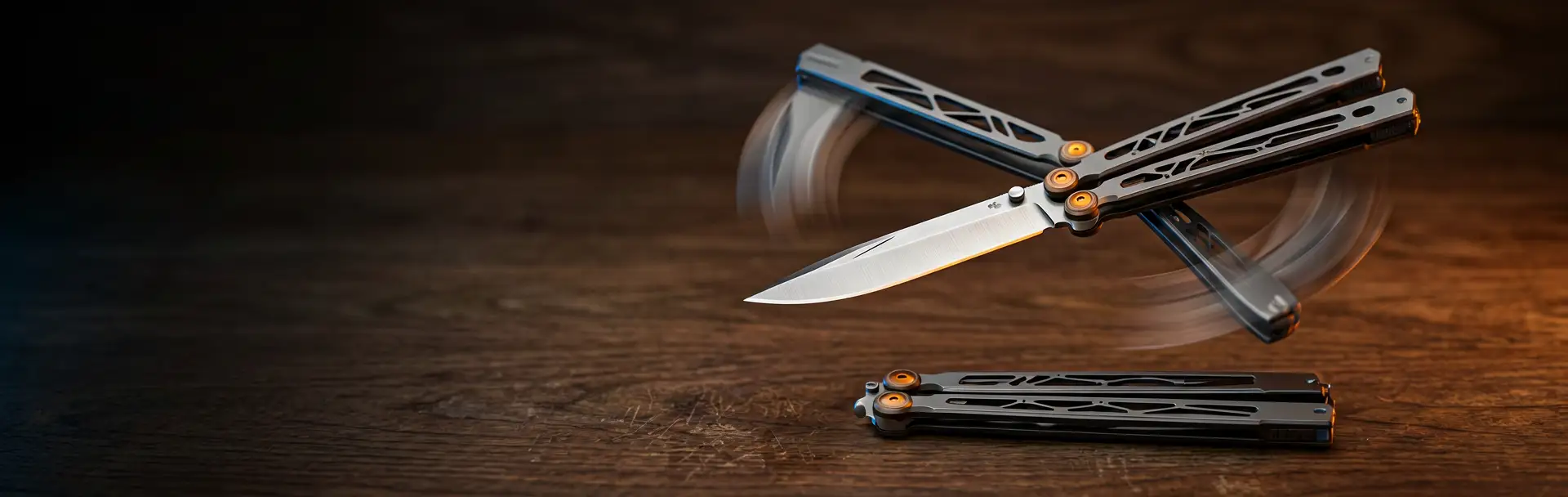
Butterfly Knives
Balisong • Batangas • Bear & Son • Kershaw Lucha
The Filipino balisong — the counter-rotating twin- handle folding knife that originated in Taal, Batangas province and was brought home to the United States by American soldiers after WWII. Keep Shooting carries four balisongs from the two most respected US butterfly-knife makers: three Bear & Son models (Black, Silver Vein, and Silver Vein Damascus) manufactured in Jacksonville, Alabama, and the premium Kershaw Lucha — a channel-construction flipping balisong designed for the modern manipulation community. Legal in most US states with restrictions varying by jurisdiction — check your state before ordering.
About Butterfly Knives at Keep Shooting
Keep Shooting carries four butterfly knives — balisongs, as they're called in the Philippines where the design originated — from Bear & Son Cutlery and Kershaw Knives, the two most established American manufacturers producing balisongs in volume today. Our lineup spans the Bear & Son Black Butterfly Knife ($45.31), the Bear & Son Silver Vein Butterfly Knife ($54.38), the Bear & Son Silver Vein Damascus Steel Butterfly Knife ($79.95), and the premium Kershaw Lucha Butterfly Knife ($150.05) — a flipping-community flagship with channel-construction handles and machined bronze bushings that took the modern balisong market by storm when Kershaw introduced it.
The balisong — known in the United States as the butterfly knife, fan knife, or Batangas knife — is a folding pocketknife with two counter-rotating handles that hinge around the blade tang, concealing the blade inside the handle grooves when closed. The name derives from Filipino: bali meaning "bend" or "break," and song derived from sungay, the horn of the water buffalo — a reference to the water-buffalo horn that was the traditional handle material on early Filipino-made balisongs. The design is most closely associated with the municipality of Taal in Batangas province, where the two barangays of Balisong and Pandayan were the original Filipino manufacturing centers from the early 20th century onward. Traditional sources credit a Taaleño craftsman named Perfecto de Leon with the first Filipino-made balisong in 1905, though European precursor designs — particularly a French measuring tool called the pied du roi ("foot of the king") and later utility-knife adaptations — predate the Filipino production by at least two centuries. The 1710 French reference work Le Perret contains what is believed to be the earliest technical drawing of a counter-rotating twin-handle folding blade.
Regardless of its ultimate pre-Columbian or European origins, the modern American association of the butterfly knife with the Philippines dates to WWII. US military personnel deployed to the Philippines — during the Japanese occupation in 1941-42, during the reconquest campaign of 1944-45, and during the long post-war American military presence at Clark Air Base and Subic Bay Naval Station — were widely exposed to Batangas-manufactured balisongs as everyday pocket-knife kit among Filipino civilians and allied forces. The knife's one-handed deployment capability (flicked open with a single motion) and compact folded profile made it attractive to US troops, and thousands of balisongs came home to the United States as personal kit in the late 1940s and early 1950s. The mid-20th-century Filipino balisong entered American pop culture through the same channel that introduced the Gurkha kukri, the Japanese tanto, and the Vietnamese montagnard knife — returning veterans' personal kits. By the 1970s the balisong was established in the American knife- enthusiast vocabulary, and by the 1980s it had picked up the "butterfly knife" name that has since become the generic English- language term.
The balisong's design solves a specific problem — rapid one-handed deployment — and the technique of flipping the knife open is a skill that ranges from basic (two flips: index finger lift, thumb press, handles snap together, blade is deployed) to expert-level manipulation sequences that turn the knife into a kinetic performance prop. The modern balisong flipping community — an active subculture of knife enthusiasts who compete in manipulation showcases, train at conventions, and produce YouTube tutorial content — has driven a parallel market for purpose-built "flipper" balisongs with tuned pivot bearings, weighted handle geometry, and "trainer" variants that use blunt-edge or unsharpened blades for safe practice of manipulation techniques. The Kershaw Lucha is Kershaw's flagship entry into this market — the 4.6-inch 14C28N stainless blade, channel-construction 6061-T6 anodized aluminum handles, machined phosphor-bronze bushings, and mass distribution designed around manipulation weight balance make it one of the most-respected sub-$200 flipping balisongs on the current market. Kershaw released the Lucha in 2018 and it remains in active production. For the full Kershaw catalog across folders, fixed blades, and specialty knives, see our Kershaw Knives brand page.
The three Bear & Son Cutlery butterfly knives in our catalog represent the more traditional end of the American balisong market. Bear & Son is a family-owned knife manufacturer based in Jacksonville, Alabama, producing USA-made butterfly knives and traditional-pattern folders since the 1990s. Their butterfly knife line uses stainless steel blades, die-cast zinc handles with various finishes, and the classic "latch" closure mechanism that identifies a traditional-construction balisong. The Black variant ($45.31) is the entry-level stainless-blade model with black-anodized handles; the Silver Vein ($54.38) has the distinctive silver-grey veined anodizing finish that gives the line its name; the Silver Vein Damascus ($79.95) is the premium entry with a pattern-welded Damascus steel blade — the heat-forged multi-layer steel that produces the characteristic wavy cloud-pattern blade finish. For the complete Bear & Son Cutlery lineup including their traditional-pattern folders and other specialty knives, see our Bear & Son Cutlery brand page.
The single most important consideration before buying a butterfly knife is state-level legality. Balisongs are legal to own and carry in the majority of US states, but a meaningful minority of states either prohibit them outright, classify them alongside switchblades or "gravity knives" under laws that pre-date the modern balisong design, or impose blade-length or carry restrictions that affect practical use. California classifies balisongs as switchblades under Penal Code 17235 and prohibits any blade over 2 inches. Hawaii, New Mexico, and Kansas have specific restrictions. New York previously prohibited balisongs entirely but passed major reform in 2019 removing most knife restrictions — check current state law before assuming a specific restriction still applies. Several jurisdictions that permit ownership prohibit concealed carry. Our order system will flag destination-state restrictions at checkout, but you are ultimately responsible for understanding the knife laws of your specific state, county, and city before ordering.
Training balisongs — also called "trainers" or "balisong trainers" — are a specific subcategory of the market worth calling out. A trainer balisong has the same handle construction, pivot geometry, and manipulation characteristics as a live-blade balisong, but the blade is either blunt, unsharpened, or cut down to an unsharpened training profile. Trainers let flipping-community practitioners develop and refine manipulation sequences without the risk of finger and hand cuts that live-blade practice produces; they also fall outside the state-legal restrictions on balisong possession in several jurisdictions that regulate the blade rather than the mechanism. Keep Shooting does not currently carry dedicated trainer balisongs — all four of the balisongs in our catalog are live-blade units. If you're learning manipulation from scratch we strongly recommend starting with a purpose-built trainer from a specialist retailer before moving to a live-blade unit; even the most experienced flippers keep trainers in their rotation for new-technique drilling.
The butterfly knife's functional strengths and limitations are worth understanding before buying. Strengths: rapid one-handed deployment once the technique is learned, a satisfying mechanical fidget-toy quality for handling-focused users, minimal moving parts (just two pivot pins) that don't degrade like spring-assisted or automatic knife mechanisms do, and a distinct cultural heritage that appeals to knife collectors and Filipino-heritage buyers. Limitations: the deployment sequence is a learned skill rather than an instant action — an automatic, assisted, or even conventional locking-folder knife will be open and in use faster than a balisong for most users who don't practice flipping regularly; the unlocking-handles design means a balisong is never as rigid under load as a fixed-blade or a solid lock-back folder, so the tool is less suitable for heavy utility work like batoning, prying, or hard chopping; and the state-legal restrictions noted above limit where the knife can be carried. A balisong is primarily a pocket utility knife with a strong cultural and manipulation character, not a combat knife or a heavy-duty field tool.
Butterfly knives sit inside our broader Knives catalog, which also includes our Automatic Knives catalog (switchblades — the closest functional alternative for rapid one-handed deployment without the learning curve), Folding Knives (traditional lock-back and liner-lock pocket knives), Fixed Blade Knives (belt-carry fighting and utility knives), and Specialty Knives (boot knives, karambit, push daggers, and other non-standard patterns).
Keep Shooting ships all butterfly knives from our Pennsylvania warehouse with free shipping on orders over $49.95 and hassle-free returns, subject to destination-state legal restrictions. Orders to prohibited states will not ship; orders to restricted states may be subject to additional documentation requirements. Whether you're a balisong flipper shopping for a manipulation-tuned live blade, a knife collector building a Filipino-heritage or American-made collection, a Kershaw enthusiast adding the Lucha to your collection, or a general-interest buyer picking up your first butterfly knife, every balisong in our catalog is authentic factory-direct inventory from Bear & Son Cutlery (Jacksonville, Alabama) and Kershaw Knives (Tualatin, Oregon) — the two US manufacturers whose ongoing commitment to the butterfly-knife category has kept American-made balisongs available in the modern market.
Frequently Asked Questions — Butterfly Knives
Keep Shooting carries a wide selection of Butterfly Knives products from trusted brands. Browse our catalog to see the full range, and use the filters on the left to narrow by brand, price, or product type.
Yes! All orders over $49.95 qualify for free shipping, including Butterfly Knives products. Orders typically ship within 1–2 business days.
Keep Shooting offers hassle-free returns on Butterfly Knives products. If you're not completely satisfied, contact our customer service team for a return authorization. All products must be in original, unused condition.
If you need help choosing the right Butterfly Knives product, our team is available to assist. Check individual product descriptions for detailed specifications, or contact us directly and we'll help you find the best fit for your needs.