
Style • Surplus Guide
Military Surplus Fashion: How to Wear the Real Thing
The fashion world keeps rediscovering what surplus buyers never forgot.
Which pieces to buy first, how to tell genuine issue from reproduction, and how to wear it all without looking like you’re headed to a costume party — from a shop that’s bought and sold this gear for 23 years.
Cargo pants are back on fashion runways. Field jackets keep showing up in street-style photos. Designers are charging $400 for jackets that look suspiciously like something that spent the 1980s in a Pennsylvania National Guard armory.
If you’ve noticed military surplus fashion having a moment, you’re not imagining it. Army surplus fashion ran all over the Spring/Summer 2026 runways, and cargo trousers are as popular as they’ve been since the late 90s.
Here’s the part that makes us smile after 23 years of buying and selling this gear: the fashion world keeps rediscovering what surplus buyers never forgot. These clothes were built to a standard, they cost a fraction of the designer version, and they come with a history no reproduction can fake.
This guide covers the whole picture. You’ll learn why surplus clothing keeps coming back in style, whether it’s legal (and respectful) to wear it, which pieces are worth buying first, how to tell genuine issue from reproduction, and how to wear it all without looking like you’re headed to a costume party.
Why military surplus clothing is back in style
Military surplus clothing is popular because it delivers four things fast fashion can’t: proven durability, low cost, authentic design, and sustainability. A field jacket built to a military specification was made to survive years of hard field use. Most mall-brand jackets are made to survive one season of light wear.
Start with the construction. Genuine issue clothing is produced to contract specifications that dictate fabric weight, stitch density, and hardware quality. Nobody at a defense contractor is shaving two ounces of fabric to hit a retail price point. That’s why 40-year-old field jackets are still in circulation while last year’s fast-fashion jacket is already in a landfill.
Then there’s the price. A genuine wool military sweater typically runs $25 to $40. The boutique “military-inspired” version of the same sweater runs $100 or more, and it’s usually made from thinner material.
The sustainability angle matters too, especially to younger buyers. Secondhand clothing is one of the fastest-growing corners of the apparel market. According to ThredUp’s Resale Report, the U.S. secondhand apparel market is on pace to reach roughly $74 billion by 2029. Buying surplus is recycling at scale: the garment already exists, it was built to last, and wearing it keeps it out of a landfill.
And here’s the part nobody in the fashion press says out loud: surplus never went anywhere. Hunters, hikers, collectors, and working folks have relied on it continuously since the first Army-Navy stores opened after World War II. The military surplus fashion cycle just circles back every decade or so.
If you want the full value case beyond the style angle, we wrote an honest look at why people buy military surplus that covers where surplus beats commercial gear and where it doesn’t.
Is it legal to wear military surplus clothing?
Yes. It is legal for civilians to buy and wear military surplus clothing in the United States, including genuine uniforms. The Stolen Valor Act of 2013 only prohibits falsely claiming military decorations or honors to obtain money, property, or other tangible benefits. Wearing a surplus field jacket as everyday clothing breaks no law.
This question comes up constantly, and the confusion is understandable. The original 2005 version of the law was broader before the Supreme Court struck it down, and the “is this allowed?” worry stuck around. The current law targets fraud, not fashion.
Legality and etiquette are different questions, though. Here’s the approach we recommend, and it’s the one most veterans we talk to appreciate:
- Remove name tapes, rank insignia, and unit patches before wearing a uniform piece as civilian clothing. That jacket served with a real person. Wearing their name and rank invites confusion you don’t want.
- Never claim service you didn’t perform. This should go without saying, but it’s the actual line the law draws, and it’s the line that matters to the people who did serve.
- Wear it with some awareness. A field jacket is clothing. A dress uniform with full decorations is a different thing, better suited to collecting and display than street wear.
Treat the garment with a little respect for its first life, and you’re on solid ground. These pieces had a job before they had a look.
The surplus pieces worth building around
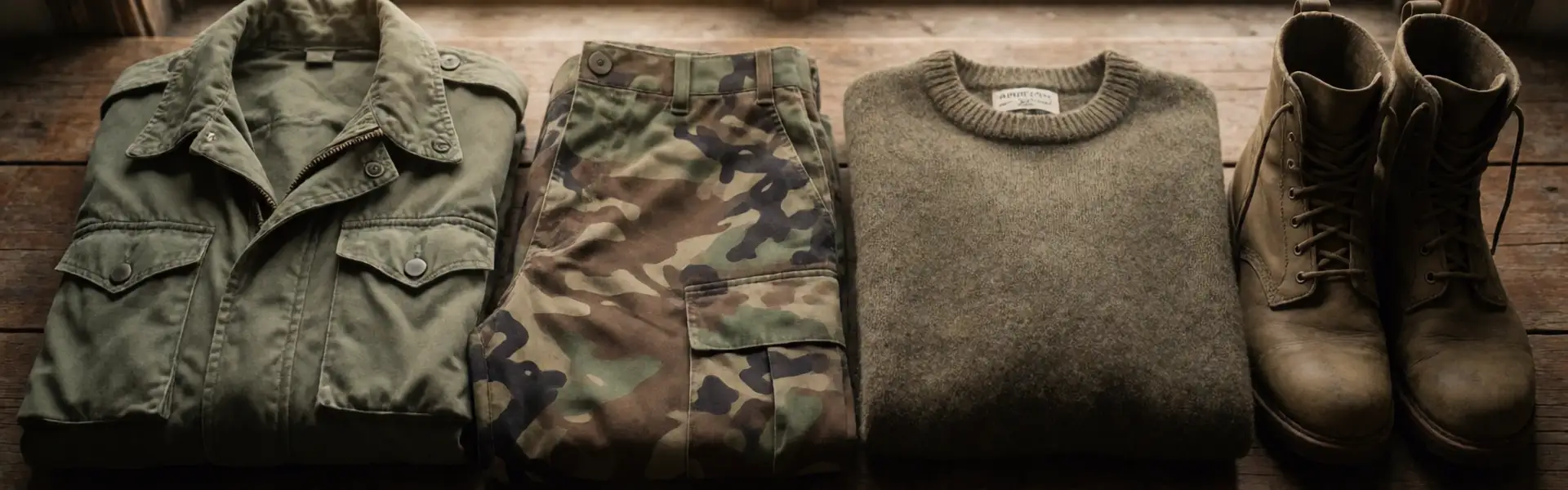
You don’t need a closet full of camo to wear surplus well. Most people who dress with surplus successfully lean on a handful of proven pieces:
- M65 field jacket: the icon of surplus outerwear, wearable with almost anything
- BDU or cargo pants: the originals every runway cargo pant copies
- Combat boots: broken-in leather that outlasts fashion boots by years
- Wool sweaters and field shirts: the best value-per-dollar in surplus
- Foreign surplus standouts: flecktarn, Austrian wool, and Eastern Bloc pieces nobody else owns
Here’s what to know about each.
The M65 field jacket
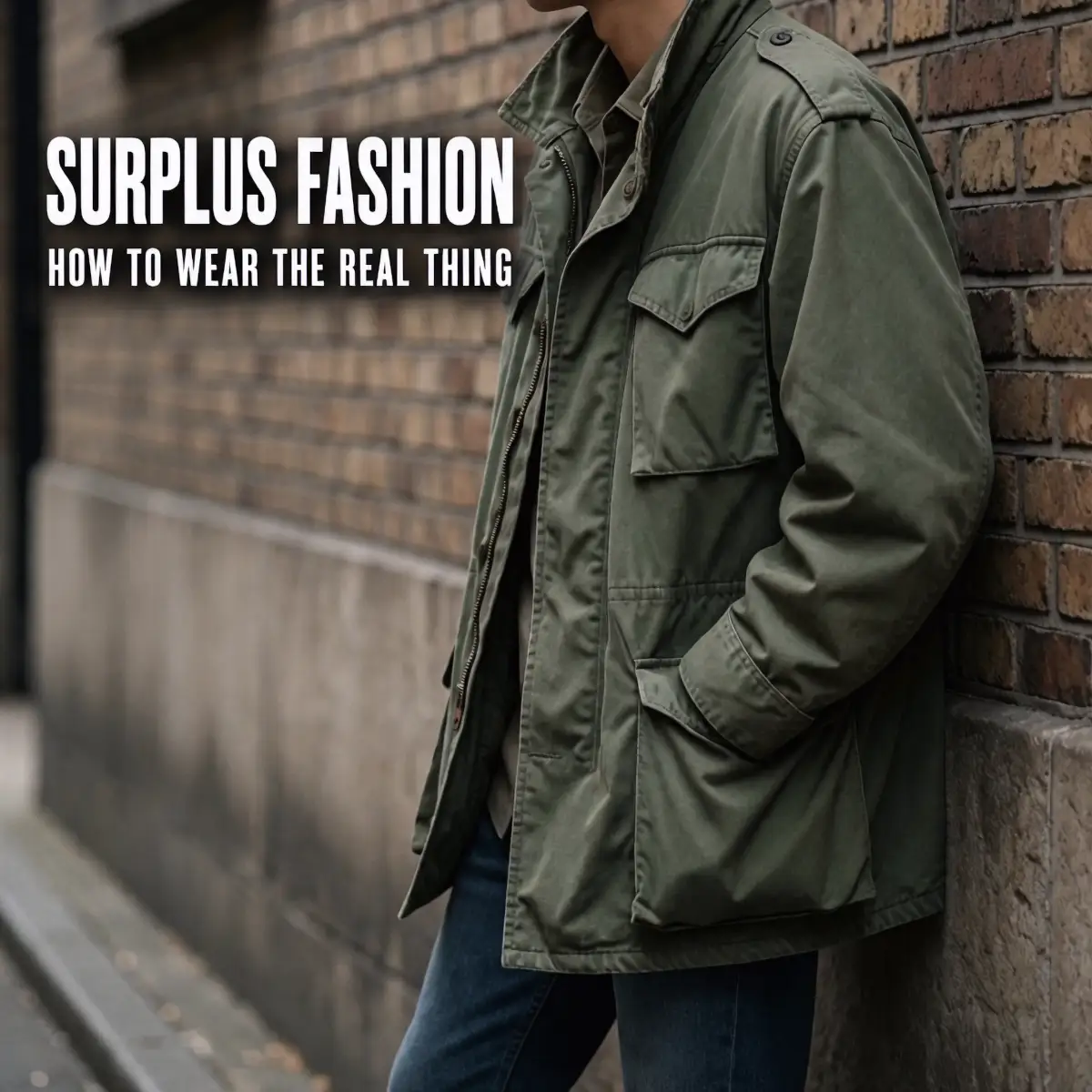
The M65 is the icon. Introduced in 1965 and issued into the 2000s, it defined the look of the American soldier for a generation and crossed into civilian wardrobes in the 1970s, where it has stayed ever since. Four front pockets, a concealed hood in the collar, a cotton-nylon sateen shell, and a cut roomy enough to layer under. Olive drab is the classic; woodland camo versions are just as wearable, and we’ve covered why that pattern conquered the world.
A genuine issue M65 in good condition usually costs less than half of what fashion brands charge for their copies of it. Check our surplus jacket selection to see what’s currently on the shelf.
BDU and cargo pants
Every cargo pant on a runway traces back to military field trousers. The M81 woodland BDU trouser and the older olive OG-107 pattern are the originals: double-stitched seams, reinforced seat and knees, and the roomy straight cut that fashion keeps trying to reproduce. They take a beating, they wash well, and they pair with plain civilian pieces exactly the way stylists keep recommending. Our surplus pants and trousers cover the genuine issue versions.
Combat boots
Surplus boots are a category of their own, and honestly, a debated one. Broken-in leather combat boots look right with almost anything and outlast most fashion boots by years. The tradeoff is sizing: military boots follow their own measurement systems, and used boots have molded to someone else’s feet. Buy unissued when you can. Our surplus combat boots listings note condition and sizing details for exactly this reason.
Wool sweaters and field shirts
The underrated value buy in all of surplus. Military wool commando sweaters, with their shoulder and elbow patches, have quietly become a menswear staple — and the same shelf holds genuine surplus field shirts.
Here’s a scene we’ve watched play out for years. A customer, we’ll call him Dan, spent months eyeing a $120 “military-style” sweater from a heritage menswear brand. Then he found a genuine Dutch Army wool commando sweater in our inventory for about $30.
Same look. Heavier wool. An actual service history. He bought two, and the follow-up email said the surplus sweater was the better garment of the pair. That story repeats itself every winter.
Foreign standouts: flecktarn, Austrian wool, and Eastern Bloc gear
If you want a piece nobody else at the coffee shop is wearing, foreign surplus is the treasure map. German flecktarn parkas, Austrian wool field pants, and Czech field jackets all deliver distinctive looks at reasonable prices, and they carry stories most fashion labels can’t match. We organize our surplus by country of origin, which makes hunting for a specific military’s gear a lot easier than digging through a generic surplus pile.
Genuine issue vs. reproduction: how to tell the difference
This is where a surplus dealer can tell you things a fashion blog can’t. Both vintage military surplus clothing and modern reproductions exist in the market, they often look similar in photos, and they should not cost the same money. Here’s how to tell them apart.
Check the label first. Genuine U.S. issue (USGI) clothing carries a contract label listing the item’s official nomenclature, a contract number, an NSN (National Stock Number), and sizing in the military format. A jacket labeled “Coat, Cold Weather, Field, M-65” with a contract number is issue. A jacket labeled with only a brand name and S/M/L sizing is commercial.
Feel the fabric. Genuine BDUs come in NyCo (nylon-cotton) ripstop or twill with a distinct grid weave and real weight to it. M65 shells are a dense cotton-nylon sateen. Costume-grade reproductions use thinner, shinier material that you can usually identify the moment you touch it.
Look at the details. Issue garments have consistent, dense stitching, spec hardware, and no decorative extras. Reproductions often add fashion details, adjusted fits, or modern zippers that never appeared on the original.
Now for the honest part: reproductions aren’t the enemy. Quality manufacturers like Rothco and Mil-Tec make military-pattern clothing in new condition, consistent modern sizing, and colors the military never issued. If you want the M65 look in a true modern medium, a new reproduction is a legitimate choice.
What you want to avoid is paying genuine-issue collector prices for a reproduction, and that happens constantly. One of our longtime customers, a reenactor named Steve, once showed us a “1970s M65” he’d bought at a flea market for $95. Thin fabric, plastic zipper, no contract label. It was a $40 costume jacket.
The seller may not have even known. The label knowledge above is how you avoid being Steve that day.
How to wear military surplus fashion without looking like a costume
The difference between wearing surplus well and looking like you raided a props department comes down to three habits:
- Follow the one-piece rule. One military item per outfit, surrounded by plain civilian clothing. A field jacket over a t-shirt and jeans works. BDU pants with a plain sweatshirt and sneakers work. A field jacket, BDU pants, and combat boots all at once reads as a uniform, because it basically is one.
- Understand military sizing before you order. U.S. clothing sizes pair a width with a length: Small-Short, Medium-Regular, Large-Long, and so on. The first word tracks your chest measurement, the second your height. Military cuts also run roomy by design, since they were made to fit over layers. Many buyers size down for a modern fit. European surplus adds metric sizing on top. When we list measurements on a garment, use them; they beat guessing every time.
- Care for it like the old fabric it is. Wash cold, skip the bleach, and air dry. A 40-year-old cotton sateen jacket has plenty of life left, but a hot dryer is hard on aging fabric and can crack older waterproof coatings. Wool pieces want a gentle wash or hand washing. Treat these garments the way you’d treat anything else that has already outlived its designer.
Where to buy military surplus clothing
Where you buy matters as much as what you buy, because surplus is a condition-graded, provenance-dependent product. A good surplus dealer will:
- Grade condition honestly and tell you about stains, repairs, and wear instead of hiding them
- Show real photos of actual inventory, not stock images of a perfect example
- Know what they’re selling, including country of origin, era, and whether an item is genuine issue or reproduction
- Price genuine and reproduction differently, because they are different products
That standard is exactly how we’ve operated for 23 years. Every surplus garment in our warehouse near Gettysburg was bought, inspected, and described by people who handle this gear daily. When something is field-grade, we say so. When it’s unissued, we say that too.
Military surplus fashion done right: the real thing is the point
Military surplus fashion works because the clothes are genuinely good, not because a runway said so. Keep these points in hand and you’ll buy well:
- Surplus delivers durability, price, authenticity, and sustainability that fast fashion can’t touch
- It’s fully legal to wear, and removing name tapes and insignia is the respectful move
- Start with the proven pieces: an M65 field jacket, BDU or cargo pants, wool sweaters, and combat boots
- Learn the labels so you pay genuine prices for genuine items and reproduction prices for reproductions
- One military piece per outfit, sized with the measurements, cared for gently
The military surplus fashion trend will cycle out eventually. It always does. The jacket, though, will still be hanging in your closet in twenty years, which is more than anyone can say for most of what’s on a runway this season. Browse our surplus clothing selection to see what’s in stock, and if you’re hunting for something specific, get in touch. There’s a decent chance we’ve got it on a shelf.