Camo History • Surplus Buyer’s Guide
Woodland Camo: How M81 Became the World’s Favorite Pattern
The green-brown-black pattern from every 1980s war movie became the most copied camouflage in history. Here’s why.
It outfitted a generation of American troops, then got copied by more foreign militaries than any pattern ever made. Decades after the U.S. moved on, woodland is still everywhere — still effective in the woods it was built for, and still affordable as surplus.
Picture “military camouflage” in your head. Odds are you’re seeing green, brown, tan, and black splotches on a soldier’s uniform — the pattern that showed up in every 1980s war movie and half the hunting photos from that decade. That’s M81 woodland camo, and it earned its place in your memory honestly.
It outfitted a generation of American troops. Then it got copied by more foreign militaries than any camouflage pattern in history. Decades after the U.S. moved on to newer designs, woodland camo is still everywhere, still effective in the woods it was built for, and still affordable as surplus.
We’ve had woodland gear from a dozen different militaries come through our doors over the years. Here’s the real story of the pattern, why the whole world adopted it, and how to buy the genuine article today.
What is M81 woodland camo?
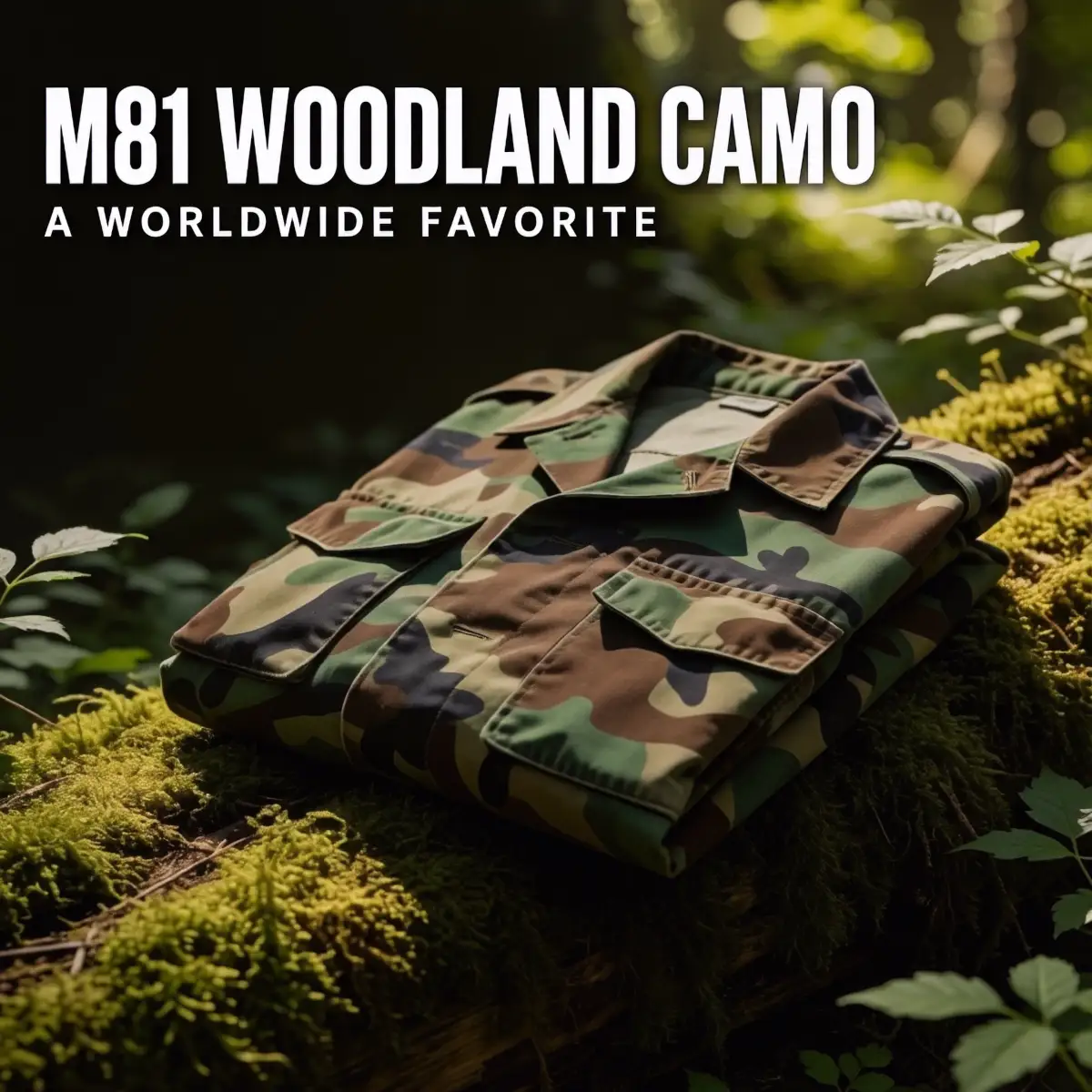
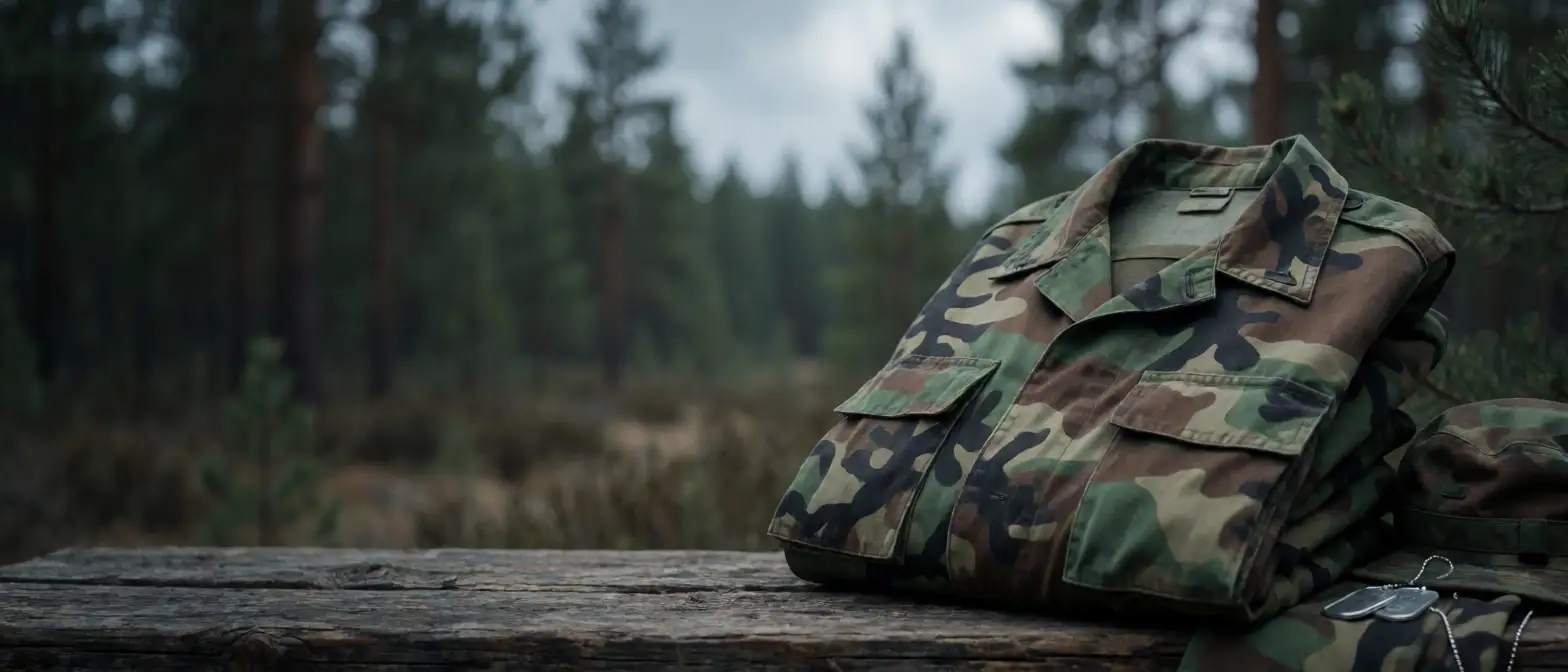
M81 woodland camo is a four-color military camouflage pattern of light green, dark green, brown, and black, arranged in large organic blotches. The U.S. military adopted it in 1981 for the Battle Dress Uniform (BDU), and it became the standard field pattern across every branch through the 1980s and 1990s.
The “M81” designation points to that 1981 adoption date. You’ll also see it called U.S. Woodland, and in the surplus world, most people just say “woodland.” All three names point to the same thing.
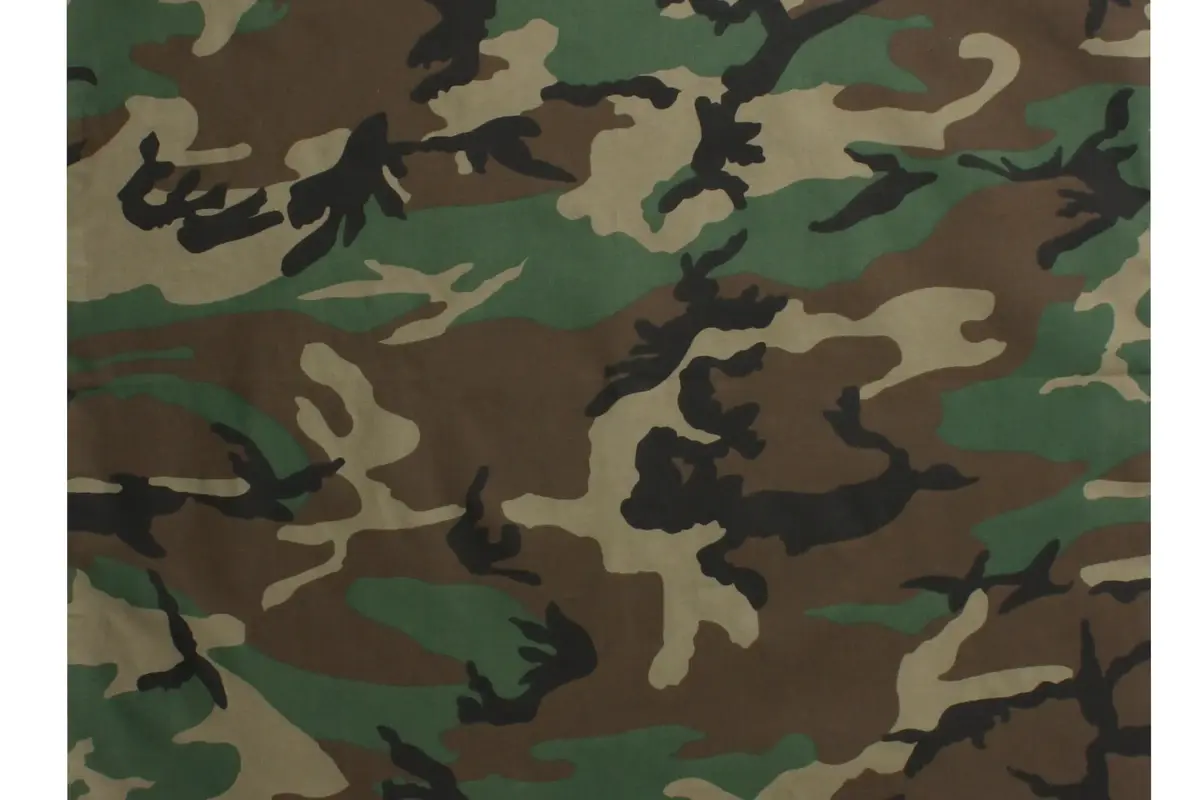
The four colors and how the pattern works
The genius of woodland camo isn’t complicated. Those four colors, laid out in big irregular shapes, mimic the way light and shadow break up in a temperate forest. Leaves, branches, bark, and the dark gaps between them all get suggested by the pattern.
Unlike a digital or geometric camo, woodland uses soft organic blobs. At a distance, they blur together and read as dappled forest rather than a person-shaped outline. The design goal was to keep a soldier concealed out to roughly 350 meters, which is a big jump from the close-range jungle fighting the previous patterns were built for.
From ERDL to M81: a short history
Woodland camo didn’t appear out of nowhere. It grew directly out of the ERDL pattern, developed by the U.S. Army Engineer Research and Development Laboratory back in the 1940s and put into real service during the Vietnam War.
The ERDL pattern came in two colorways: a green-dominant version and a brown-dominant version. When the military designed M81, they took the transitional ERDL artwork and enlarged it by about 60 percent, then adjusted the contrast between the colors.
Why make it bigger? The tactical thinking had shifted. Vietnam meant close-range fighting in dense jungle, where a small-scale pattern worked fine. By the late 1970s, planners were looking at a potential fight across the woodlands of Europe, at longer distances. A larger pattern holds together better at range, so they scaled it up. According to Camopedia, that enlargement is the single biggest difference between late-war ERDL and the woodland pattern that replaced it.
One more thing made M81 a landmark. It was the first camouflage adopted across every branch of the U.S. military — Army, Marine Corps, Air Force, and Navy alike. Earlier patterns like tiger stripe or the “duck hunter” frog-skin camo were used by specific units. Woodland was universal.
The BDU era: woodland goes to war
For roughly two decades, if you saw an American service member in the field, they were wearing woodland. The Battle Dress Uniform in M81 was standard issue, and it went everywhere the military went.
That includes real combat. Woodland-clad troops served in the 1983 Grenada operation, Operation Just Cause in Panama in 1989, and the first Gulf War (Desert Storm), along with countless Cold War training rotations and peacekeeping missions. Soldiers trusted it enough that it picked up a nickname you still hear today: “God’s Plaid.” The name stuck because the tight crisscross of green, brown, and black reads a little like a plaid shirt, and because troops swore by how well it hid them once they stepped into the trees.
Here’s a scenario that plays out constantly in the surplus world. A customer named Dave emails us because his father wore woodland BDUs in the Army in the late 1980s, and Dave wants a set that matches what he remembers from old family photos. He’s not a collector or a reenactor. He just wants the real thing, the same pattern, the same cut. That kind of personal connection is a big part of why demand for genuine woodland surplus clothing never really faded.
Eventually the military moved on. The Marines adopted MARPAT, the Army went to the digital ACU pattern and later to OCP (MultiCam), and woodland was phased out of front-line issue. But “phased out of issue” and “gone” are two very different things.
Tip: If you’re chasing a specific era of U.S. woodland, check the contract label sewn inside the garment. It lists the manufacturer and often a date, which is the easiest way to confirm you’re holding genuine issue rather than a commercial copy.
Why woodland became a worldwide favorite
This is where woodland camo separates itself from every other pattern. It didn’t just serve the United States. It became the most duplicated and adapted camouflage design ever made, worn by militaries on nearly every continent.
Some countries adopted a near-direct copy. Others took the woodland concept and adjusted the colors for their own terrain. According to the U.S. Woodland reference on Wikipedia, the list of militaries that adopted or closely adapted the pattern includes:
- China produced its own woodland-style camo in the 1980s, then in 2003 began using a near-literal copy of the M81 design.
- Jordan used a copy of U.S. woodland as its standard pattern for years.
- South Korea rolled out a locally produced woodland-based pattern across all branches in 1990.
- France fielded the CCE (“Centre Europe”) pattern, a woodland-family design with its own distinct colorway.
- Italy, Spain, Croatia, Slovakia, Portugal, and other European militaries adopted woodland or close variants.
- Guatemala, Lebanon, Pakistan, Thailand, Iran, Syria, and Kazakhstan, among others, ran their own versions.
That reach is the whole reason “a worldwide favorite” isn’t marketing hype. It’s just accurate.

Notable foreign variants worth knowing
For collectors and surplus buyers, the foreign variants are half the fun. They’re often more affordable than U.S. issue, and each one has its own character.
The French CCE pattern is a good example. It uses the woodland layout but shifts the greens and browns toward the tones of Central European forests. We’ve carried French CCE pieces, and you can see the family resemblance to M81 the moment you lay them side by side. Browse our French Army surplus to see what’s in stock.
The Croatian woodland pattern runs even closer to the American original. Our Croatian woodland field shirt is a near-direct M81 derivative, and it’s one of the more budget-friendly ways to get an authentic woodland piece. Check the Croatian Army surplus collection if that’s the route you want. Organizing gear this way, by the actual military that issued it, is something most surplus sellers don’t bother with, and it makes hunting down a specific variant a lot easier.
Is woodland camo still effective? Woodland vs. MultiCam
Short answer: yes, in the environment it was built for. Woodland camo was designed for temperate and deciduous forest, and in dense summer green it still disappears about as well as anything.
The honest comparison most people want is woodland versus MultiCam, the pattern the U.S. Army adopted for general issue. They take genuinely different approaches:
| Feature | M81 Woodland | MultiCam |
|---|---|---|
| Colors | 4 (light green, dark green, brown, black) | 7 blended tones |
| Approach | High-contrast, disrupts your outline | Muted, blends into background |
| Best terrain | Dense deciduous and conifer forest | Mixed and transitional terrain |
| Era | Adopted 1981 | Adopted for Army use in the 2010s |
The practical takeaway is straightforward. In thick woods, especially in summer when everything is green, woodland’s dark high-contrast blobs match the shadows and vegetation well, and many users still reach for it there. MultiCam earns its reputation by staying versatile across a wider range of environments, from open ground to brush to fall and winter terrain where the leaves have dropped.
For a deer hunter working temperate hardwoods, woodland is far from obsolete. For someone who wants one pattern that covers a lot of different ground, MultiCam has the edge. Neither is wrong. It comes down to where you’ll actually use it.
Buying woodland camo surplus: what to know
If you’ve decided you want woodland gear, you’ve got two honest routes: genuine military issue, or commercial reproduction. Both have their place.
Genuine issue means a uniform actually made on a military contract. It’ll have that contract label, real service wear if it was used, and the authenticity collectors care about. U.S. woodland BDUs, French CCE, Croatian field shirts, and dozens of other national variants all fall here.
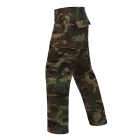
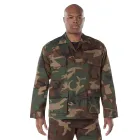
Commercial reproduction means gear made in the woodland pattern by companies that sell to the civilian market. Rothco is the best-known name here, and their woodland BDU shirt and woodland BDU pants are a solid, affordable way to get the look and function without hunting for surplus sizes. If you want new condition and predictable sizing, repro is often the smarter buy.
A few things to check before you order surplus:
- Read the label. A contract stamp confirms genuine issue and often gives you a date.
- Know your fabric. Woodland BDUs came in ripstop and in a hot-weather twill, plus a cotton-poly (NyCo) blend. Ripstop resists tearing; twill breathes better in heat.
- Expect surplus sizing quirks. Foreign sizing rarely maps cleanly to U.S. sizes, and issued gear may have shrunk or stretched. Check measurements when they’re listed.
- Accept honest wear. Surplus has been used. Fading, a name written inside the collar, a field repair — these are normal, and they’re part of what makes a genuine piece genuine.
There’s one more point worth making plainly. Because woodland is retired from U.S. front-line issue, wearing it doesn’t step on anyone’s service the way current-issue patterns can. That’s part of why it’s become such an easy, popular choice for hunters, campers, airsoft and milsim players, reenactors, and folks who just like the way it looks.
Putting together a woodland kit
Once Sarah, a weekend camper we heard from last fall, got her first woodland BDU jacket, she wanted the rest to match. That’s the usual pattern. A field shirt or jacket and a set of BDU pants are the core, and from there most people add a boonie hat, maybe a set of load-bearing gear or an old ALICE pack in the same camo.
The uses are as broad as the pattern’s history. Woodland earns its keep for:
- Hunting in temperate woods, especially in summer green
- General camping and bushcraft
- Airsoft and milsim
- Historical reenacting of 1980s and 1990s impressions
- Everyday work-wear for anyone who spends time outdoors
Because so many countries made it, you can mix a U.S. BDU top with a foreign variant and still stay in the woodland family.
If you’re building a kit from scratch, our full military surplus catalog, the surplus by country collections, and our field gear are the easiest places to see what’s on the shelf right now. Stock turns over as we bring in new lots, so it’s worth checking back.
The bottom line on woodland camo
Woodland camo earned its worldwide status the hard way. It started as a smart enlargement of a Vietnam-era pattern, became the first camouflage every U.S. branch wore, served in real operations from Grenada to the Gulf, and then got adopted or copied by militaries across the globe. That’s not nostalgia talking. That’s a track record.
For the buyer today, a few things are worth remembering:
- M81 woodland camo is a four-color pattern built for temperate forest, adopted by the U.S. in 1981.
- It’s the most copied camo in history, which is why foreign variants like French CCE and Croatian woodland are out there and affordable.
- It still works in dense woods, even if MultiCam covers more varied terrain.
- You can buy genuine surplus or commercial repro, and both are legitimate choices depending on what you want.
If you’re after a specific country’s woodland variant, or you just want a solid BDU set for the woods, take a look at our surplus clothing selection. And if you’re hunting something particular we don’t have listed, get in touch — and if you’ve got woodland pieces of your own to move, we buy collections too. We’ve had woodland gear from a lot of militaries pass through here over the years, and there’s a good chance we know where it turns up.