

Trauma Preparedness • May 2026
Why a Tourniquet Belongs in Your Range Bag, Hunting Pack, and Vehicle
Severe bleeding can kill in minutes. Here's what to carry, what to avoid, and how to be useful in the worst few minutes of someone's day.
The importance of tourniquets in civilian hands is one of the quietest shifts in trauma medicine over the last twenty years — and the people who'd benefit most from carrying one tend to be the same people we've been selling gear to for 23 years.
It's a Saturday in October. A buddy of yours is field-dressing a buck three miles back from the truck, the knife slips, and suddenly there's arterial blood on the snow. The nearest paved road is fifteen minutes out. The nearest hospital is forty.
That's the kind of scenario most people who shoot, hunt, or spend serious time outdoors don't plan for. Eye pro, ear pro, a sharp knife, the right ammo, the right boots: those checklists are second nature. A tourniquet usually isn't on the list at all.
It should be. The importance of tourniquets in civilian hands is one of the quietest shifts in trauma medicine over the last twenty years, and the people who'd benefit most from carrying one tend to be the same people we've been selling gear to for the past 23 years. Here's why they matter, what to actually carry, what to avoid, and how to be useful in the worst few minutes of someone's day.
What a tourniquet actually does (and what it doesn't)
A tourniquet is a band you cinch around an arm or a leg, above a serious wound, tight enough to stop arterial blood flow until the patient gets to a hospital. That's the entire job. It buys time.
It works on extremity wounds: arms and legs, above the injury, high and tight. It does not work on the torso, the neck, the groin, or the armpit. Those are called junctional bleeds, and they need pressure plus hemostatic gauze, not a tourniquet. Anyone selling you on a tourniquet as a one-stop trauma fix is overselling it.
The why matters too. Severe arterial bleeding from a major limb can kill in three to five minutes. That's faster than almost any EMS can reach you, even in a city. In rural America, where most hunters and a lot of private-range shooters operate, average EMS response times run well past that window. On scene, the only thing standing between a survivable injury and a fatal one is whoever's there with whatever they brought.
Why tourniquets save lives
For most of the 20th century, the conventional wisdom in civilian medicine was that tourniquets were a last resort, that they caused nerve damage and limb loss, and that direct pressure was almost always enough. That wisdom was wrong, and it took two decades of combat medicine to put it to rest.
During Operation Enduring Freedom and Operation Iraqi Freedom, the U.S. military pushed tourniquets back into universal issue, trained troops to apply them early, and tracked the results. Preventable death from extremity hemorrhage, once one of the leading causes of battlefield fatalities, dropped dramatically. The Committee on Tactical Combat Casualty Care, or CoTCCC, codified the protocol that's now the foundation for civilian trauma response.
Then in 2013, the Boston Marathon bombing happened. Bystanders used belts, shirts, and a small number of real tourniquets to stop bleeding in the street. Most of the people who lost limbs that day kept their lives because somebody acted in the first few minutes. That event, combined with the lessons of Sandy Hook the year before, became the impetus for the Stop the Bleed campaign, launched in 2015 by the American College of Surgeons.
The short version of what we've learned since:
- Early tourniquet application saves lives in scenarios where pressure alone won't keep up
- Modern tourniquets, applied correctly and removed within two hours, almost never cost a limb
- The old “last resort” framing was based on incomplete data and outdated equipment
- The people most likely to need one aren't soldiers, they're civilians in car wrecks, workshop accidents, hunting mishaps, and active-violence events
That's the case in one paragraph. The rest of this article is what to do about it.
When you'd actually reach for one
Most of our customers will go their entire lives without needing a tourniquet. A few will need one and not have it. That second group is who this is written for.
The scenarios that come up most often in the world our audience lives in:
Range incidents. Accidental discharges into a leg or arm happen, especially during reholstering and at private ranges without an RO. A round through the femoral artery is a five-minute clock. Same goes for serious lacerations from sharp optic mounts, malfunctioning firearms, or dropped scopes catching the wrong way on the way down.
Hunting and field-dressing accidents. The knife-slip scenario from the intro isn't rare. Treestand falls that produce open fractures, ATV rollovers, and chainsaw kickbacks when you're cutting shooting lanes can all produce limb bleeding that direct pressure won't handle, especially when you're an hour from a road.
Vehicle accidents. Statistically, this is the scenario any of us is most likely to encounter. Car crashes are the single largest civilian source of preventable trauma deaths from limb injuries. A tourniquet in the console of your truck is more likely to save a life than one in your range bag, just on probability.
Workshop, ranch, and property work. Anyone clearing brush, running power tools, working with livestock, or doing the kind of jobs our customers do on their own land has a non-trivial risk of a serious limb injury where minutes matter.
When you would not use one: minor bleeding that direct pressure handles in a few seconds. A nail through the hand. A bad shaving cut. Tourniquets are for the bleeds that won't stop, not the ones that will.
Choosing a real tourniquet: CAT and SOFTT-W
There are two windlass tourniquets with a long, documented track record of working in real bleeds: the Combat Application Tourniquet, or CAT, made by North American Rescue, and the SOF Tactical Tourniquet Wide, or SOFTT-W, made by TacMed Solutions. Both are TCCC-recommended. Both have been used in combat and in civilian trauma response for years.
A windlass is the rigid rod you twist to tighten the band. That mechanical advantage is what allows a properly applied tourniquet to actually stop arterial flow on a thick leg. Elastic-band tourniquets, ratcheting designs that don't lock, and any device that requires two hands to apply on yourself are not in the same category. They have their uses, but for severe extremity bleeding, stick with what's been proven.
If you're buying one and you only buy one, get a CAT. It's the most common, the most trained-on, and the easiest to find replacements for. SOFTT-W is an excellent alternative if you prefer the metal windlass and slightly wider band. Either one belongs in a serious first aid kit alongside hemostatic gauze, a pressure bandage, and a pair of nitrile gloves.
For a closer look at the broader trauma category, our first aid kits and trauma supplies page is the right starting point. You don't need everything in there. You do need a tourniquet, gauze, and a way to apply pressure.
The counterfeit problem (and how to spot a fake)
Here's the part nobody's talking about loudly enough: there are a lot of fake CAT tourniquets in circulation, and they fail in ways that kill people.
A real CAT has a clear lot number, an NSN on the packaging, a stiff windlass that doesn't flex when you twist it, and a band with a specific weave you can feel. The plastic feels like it'll hold. The Velcro grabs aggressively. North American Rescue has publicly documented counterfeit versions of their tourniquet that look correct in product photos and snap or stretch under real load. Some of these counterfeits sell for half the price of a real CAT on large online marketplaces. Some sell for the same price, which is worse.
If you're shopping for a tourniquet, a few rules:
- Buy from a known firearms or medical retailer, not a generic online marketplace
- Verify the manufacturer's name on the packaging matches the manufacturer's actual name (real CATs are made by North American Rescue, real SOFTT-Ws are made by TacMed Solutions)
- Look at the windlass: if it feels like a flimsy plastic stick, it isn't real
- Trust your gut on price: a real CAT runs around $30, give or take. A “CAT tourniquet” at $12 is almost certainly a fake
A counterfeit tourniquet is worse than no tourniquet, because it gives you the false confidence to skip a real one. We've sold first aid gear since before most of our customers carried EDC trauma kits, and we'd rather you spend the extra ten dollars now than find out the hard way later.
Where to carry: range bag, pack, vehicle, on-body
A tourniquet you can't reach in 60 seconds, one-handed, in a stressful moment isn't a tourniquet, it's a souvenir. Where you carry it depends on what you're doing.
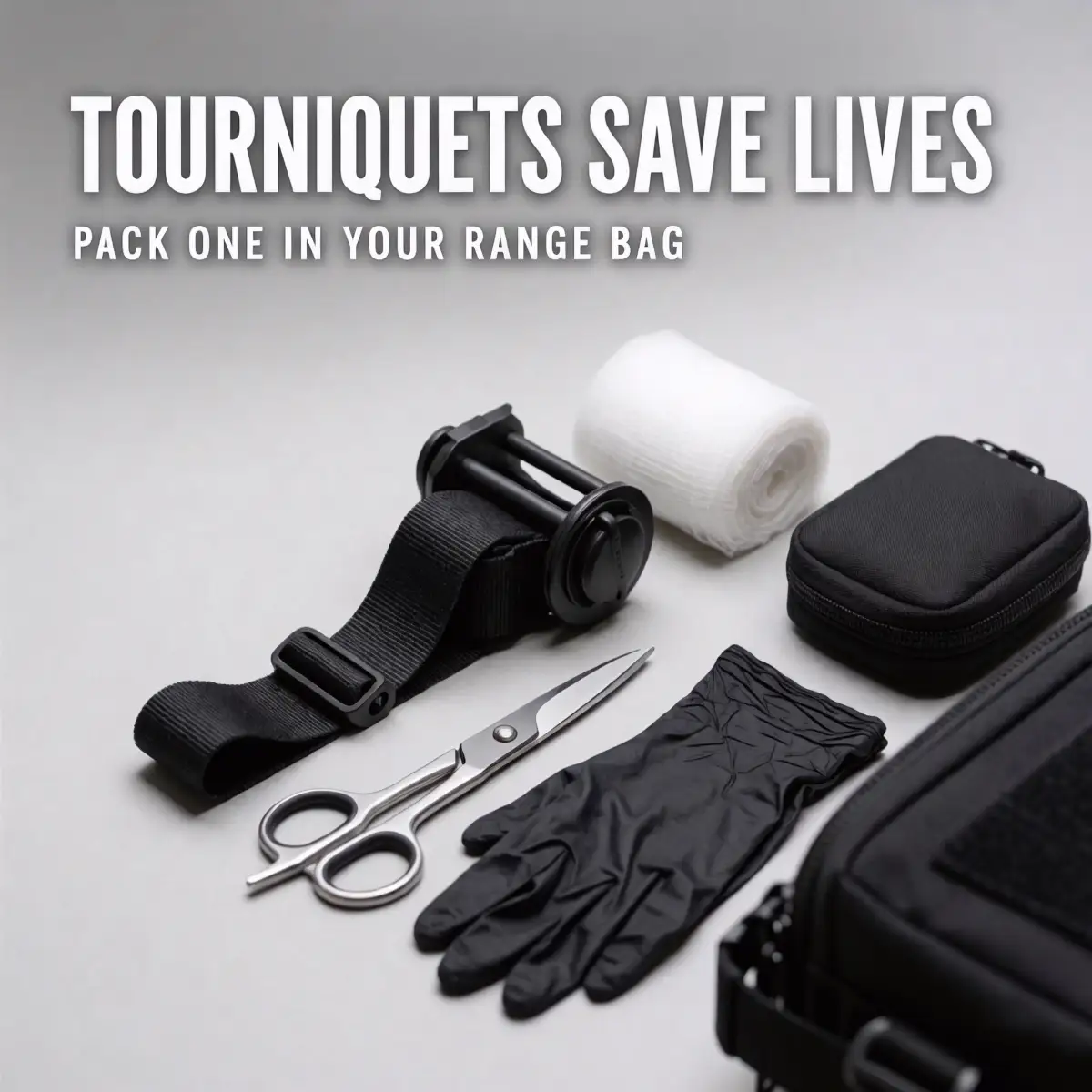
Range bag. Outside pocket, accessible without unpacking the bag, near the top. If you have to dig past three magazines and a cleaning kit to find it, move it.
Hunting pack. Top lid, chest strap, or a dedicated pouch on the shoulder strap. Some hunters run a small trauma kit on their belt or on a chest rig. Buried in the main compartment under your lunch is the wrong place. Consider that the pack you choose should let you reach the kit with one hand while the other is doing something else, probably applying pressure.
Vehicle. Console or door pocket, not the trunk. The trunk is fine for a larger trauma kit. The tourniquet you'd grab for a roadside crash needs to be within arm's reach from the driver's seat.
On-body. Ankle rigs, belt pouches, and plate-carrier mounts make sense for people who carry every day and treat it the way they treat a sidearm. For most enthusiasts, range and vehicle carry covers the realistic scenarios.
Wherever you carry it, carry the companions: a pressure bandage, hemostatic gauze (real Combat Gauze or QuikClot, not unbranded knock-offs), nitrile gloves, and a permanent marker. The marker is for writing the application time on the patient's forehead, which EMS will ask for the moment they arrive.
If you're building out broader preparedness gear, our safety and survival gear category covers most of the rest of what belongs in a serious kit.
Common myths that get people killed
A few persistent ones, because they still drive bad decisions:
- “You'll lose the limb if you use a tourniquet.” Modern data says no, especially under two hours. Tourniquets left in place under that window almost never produce permanent damage. Tourniquets left on indefinitely, or applied incorrectly low on the limb, can cause issues, which is why you write the time and get the patient to a hospital. But the binary “tourniquet equals limb loss” claim is decades out of date.
- “Tourniquets are a last resort.” Old TCCC doctrine. Current doctrine, civilian and military, says apply early on serious extremity bleeding. Waiting until pressure obviously isn't working wastes the time you needed.
- “I'd never need one.” Same logic as not wearing eye pro. The whole point is you don't know when you'll need it. The cost of carrying one is roughly $30 and the size of a fist. The cost of needing one and not having it is unrecoverable.
- “I can improvise one with a belt and a stick.” No, you can't, not for an arterial bleed. Belts don't generate enough mechanical advantage. Sticks slip. Improvised tourniquets are a topic in disaster medicine, not range-bag medicine. If you're going to carry, carry a real one.
A tourniquet you can't use is a placebo: training matters
The tool is half the equation. The other half is knowing how to use it under stress, when your fine motor skills are shot and your hands are slick and someone you care about is on the ground.
Stop the Bleed classes are free, run roughly 90 minutes, and are offered by hospitals, fire departments, and community centers nationwide. They cover tourniquet application, wound packing with hemostatic gauze, and direct pressure technique. If you take one class on trauma response in your life, take that one.
For shooters and range members specifically, our shooting safety and training gear category covers the eye, ear, and incidental safety equipment that belongs in any range bag alongside trauma gear. Same principle: the gear that prevents an injury is cheaper and easier than the gear that addresses one.
If you spend significant time in the field, a TECC (Tactical Emergency Casualty Care) or similar civilian trauma course goes deeper than Stop the Bleed. For most of our customers, the free class is a perfectly reasonable starting point. The point isn't to become a paramedic. It's to not freeze when it matters.
Carry one, train once, hope you never use it
The importance of tourniquets in the kit of anyone who shoots, hunts, drives, or works with sharp tools comes down to three things worth remembering:
- Severe extremity bleeding kills in minutes, and EMS rarely arrives in minutes. The person on scene is the one who matters.
- Buy a real CAT or SOFTT-W, not a $12 counterfeit, and carry it somewhere you can actually reach. A range bag pocket, a truck console, or a top-lid pack pouch beats a kit buried in the back seat.
- Take the free training. A tourniquet you've never applied is a tourniquet you'll fumble when it counts.
We've spent 23 years selling gear to people who handle firearms, edged tools, and the outdoors with skill and respect. The people who hunt with us, shoot with us, and outfit themselves through us are the same people most likely to be useful in a real emergency, if they've put thirty dollars and one afternoon into being ready. If you're already heading to build out a first aid kit or your outdoor and field gear, this is the piece worth not skipping.
Carry one. Learn it once. And here's hoping you spend the rest of your range days, hunts, and drives never opening the package.