
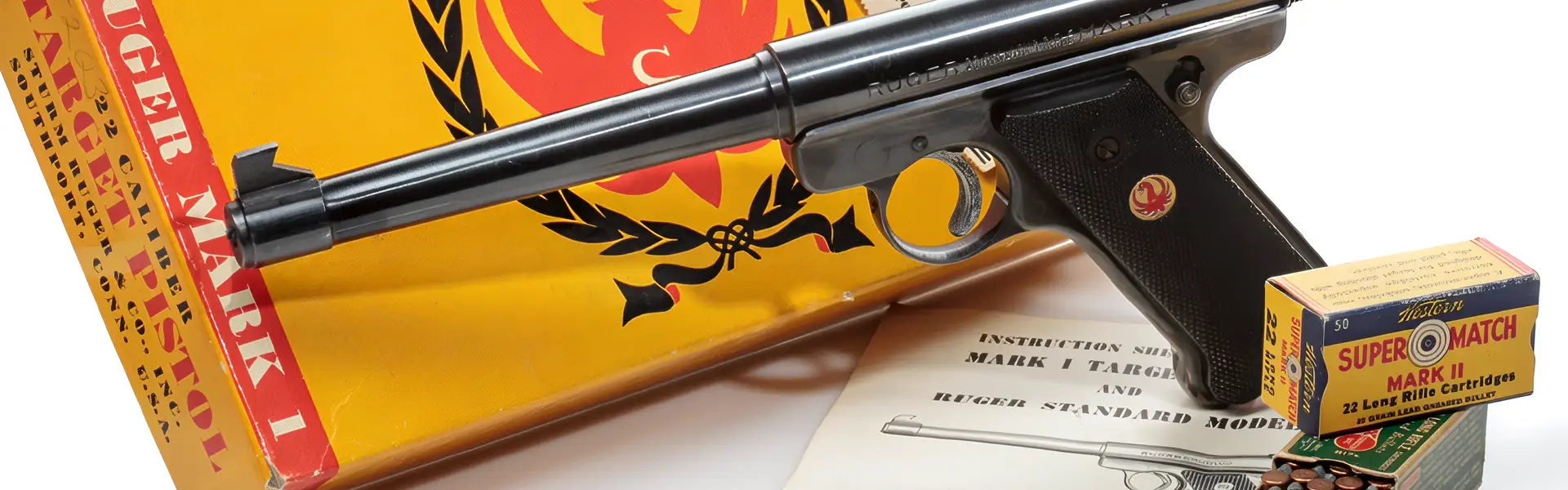
Ruger Mark I Magazines
Factory Ruger OEM • Mark I (1951–1982) • .22 LR • 10-Round
The Ruger Mark I Target Pistol — produced 1951 through 1982 as the first target-grade variant of Bill Ruger's 1949 Standard and the foundational pistol of the 76-year Mark-series lineage — established Ruger as a serious competitor in the American .22 LR bullseye match market and remained in continuous production for 31 years. Mark I pistols are now 43 to 74 years old; factory magazine production has been minimal for decades, and the commercial Mark I magazine supply is primarily collectors and long-term owners replacing original-production magazines with developed spring fatigue. Keep Shooting carries the factory Ruger Mark I 10-round magazine at $27.24.
About Ruger Mark I Magazines at Keep Shooting
Keep Shooting carries the factory Ruger Mark I Magazine ($27.24, 10-round) for the Ruger Mark I Target Pistol produced 1951 through 1982. The Mark I is the foundational pistol of Bill Ruger's 76-year Mark-series lineage — the first target-grade .22 LR from Sturm, Ruger & Co. and the pistol that established Ruger as a serious competitor in the American bullseye-match market. Mark I magazines are NOT cross-compatible with the Mark II (1982–2004), Mark III (2005–2016), or Mark IV (2016–present) — each generation used incrementally different magazine release geometry. For the Mark II, Mark III, and Mark IV magazines, see our Mark II Magazines, Mark III Magazines, and Mark IV Magazines categories respectively. For the broader Ruger magazine lineup, see our parent Ruger Magazines category, or the Ruger brand page for the full Ruger catalog.
The Ruger Mark I Target Pistol was introduced in 1951 — two years after Sturm, Ruger & Co. launched the original Ruger Standard in 1949 — as the first target-grade variant of the platform. Where the 1949 Standard had been a general-purpose .22 LR pistol with a fixed 4.75-inch barrel and simple fixed sights, the Mark I introduced two specific features that defined its target-pistol positioning: a longer bull barrel (typically 5.5 inches for target work or 6.88 inches for the Hunter-style variant, vs. the Standard's 4.75 inches) and fully adjustable rear sights for precision zero adjustment. These two changes alone transformed the platform from a recreational plinking pistol into a legitimate bullseye-match competition pistol — and the Mark I Target became the pistol Ruger sent to the American NRA Conventional Pistol match circuit to compete against Colt Woodsman, High Standard Olympic, and Smith & Wesson .22 target pistols.
The Mark I remained in continuous production for 31 years through 1982, a production run that covered Ruger's transformation from a small Southport, Connecticut startup (founded 1949 with $50,000 in capital contributed by Alexander Sturm) into one of the largest American firearm manufacturers. Throughout the Mark I's lifecycle the original Ruger Standard continued to be produced alongside it — same receiver, same action, same magazine, but with the shorter barrel and fixed sights that kept the Standard in the general-purpose rimfire market. The Mark I and Standard together comprised Ruger's .22 LR pistol lineup from 1951 through 1982, when the Mark II launched and replaced both variants simultaneously with a common updated platform.
The Mark I's engineering architecture is the foundation that every subsequent Mark-series generation was built on, with changes accumulating incrementally over 74 years. The round receiver with fixed barrel, the straight- blowback rimfire action with a bolt that travels rearward through the receiver on firing, the grip angle (which visually resembles the German Luger P08 but is mechanically derived from Ruger's reverse-engineering of a Japanese Nambu Type 14), and the detachable 10-round single-stack magazine that feeds from below the bolt — all of these design elements were established in the original 1949 Standard and 1951 Mark I, and persisted through 74 years of Mark-series evolution to the current Mark IV. The defining architectural continuity is the reason the Mark IV's one-button take-down (introduced 2016) was considered such a revolutionary change: it was the first fundamental departure from the 1949 disassembly sequence in 67 years of continuous production.
The Mark I was notably lacking a bolt hold-open on empty magazine — the Mark II's 1982 addition of this feature was one of the specific engineering improvements that justified the generational transition. Mark I shooters had to manually lock the bolt back after firing the last round or visually check the chamber to confirm empty — a quirk that's noticeable coming from any modern service pistol but that Mark I owners have typically adapted to through decades of practice. The Mark I also lacks the magazine disconnect and loaded chamber indicator that appeared on the Mark III in 2005 for California-compliance reasons — Mark I pistols will fire with no magazine inserted, and have no visible-tactile indication of chamber state.
Magazine compatibility for Mark I owners. Mark I magazines fit the Mark I Target Pistol and the original Ruger Standard (1949–1982 production) — both variants share the same magazine geometry. Mark I magazines do NOT fit the Mark II (1982–2004), Mark III (2005–2016), or Mark IV (2016–present) — Ruger made incremental magazine-release changes at each generational transition. A Mark II magazine will not seat in a Mark I frame despite visual similarity; a Mark I magazine will not seat in a Mark II. If you have a mix of Mark-series pistols in your safe, the magazines are generation- specific — keep them organized by pistol.
Why factory Mark I magazine production is minimal. Ruger discontinued Mark I / Standard production in 1982 when the Mark II launched, and factory magazine production for the older generation was gradually wound down over the following two decades. Ruger's long-tail practice of supporting orphaned platforms with continued magazine production (the P-series pistols remained supported for decades after catalog discontinuation) has generally applied to the Mark I, but at dramatically reduced volumes — the Mark I installed base is much smaller than the Mark II's, and the pistols themselves are now 43 to 74 years old, placing most of them in collector-ownership or secondary-market conditions rather than daily-use ownership. Keep Shooting's $27.24 factory Mark I magazine represents one of the few commercial channels where factory Ruger Mark I magazines are currently available — supply is thin and intermittent.
The Mark I civilian market today is a specialized collector and long-term-owner community. Mark I collectors — including serious Ruger historical collectors who maintain representative pistols across the full Mark-series generational lineage (Standard, Mark I, Mark II, Mark III, Mark IV) and specialized Mark I collectors who focus on specific production-year variants, red-eagle-era pre-1951 Standard production, and early-run Mark I Target variants — are the largest buyer cohort. Long-term Mark I owners who have shot the same pistol for 40+ years represent the second major cohort, typically replacing magazines with significant accumulated spring fatigue. Inheritance buyers — shooters who received a Mark I from a parent or grandparent's estate — form a distinctive third cohort, often buying their first Mark I magazine simply to restore the inherited pistol to shooting condition.
The Mark I in bullseye match history: through the 1950s, 1960s, and 1970s, the Mark I Target was the principal American-made affordable competition pistol on the NRA Conventional Pistol circuit. Olympic- level competitors used European match pistols (Hämmerli, Walther, FWB), and the top tier of American competitive shooters often migrated to High Standard Olympic or Supermatic variants, but the working bullseye match shooter — club competitor through regional championship — typically carried a Mark I Target. The Mark I also appeared prominently at Camp Perry, Ohio through the three decades of the platform's dominance — the national US matches where Mark I Target pistols won club and regional-level medals throughout the platform's production run. A factory Mark I Target from 1965 that is still shooting reliably today is a piece of American bullseye-match history.
Keep Shooting ships Mark I magazines from our Pennsylvania warehouse with free shipping on orders over $49.95 and hassle-free returns. The Mark I's 10-round capacity ships to all 50 US states — the rimfire target-pistol capacity falls below every state-level magazine capacity restriction. Whether you're a Mark I collector rebuilding factory-correct magazine inventory across production-year variants, a 40-year Mark I shooter replacing an original-era magazine with spring fatigue that has finally affected feed reliability, an inheritance buyer bringing a grandfather's Mark I back into shooting condition, or a bullseye shooter who still competes with the 1960s- or 1970s-production Mark I Target that launched their competitive shooting career, the factory Ruger Mark I magazine in our catalog is authentic Ruger production from Prescott, Arizona and carries Ruger's manufacturer warranty.
Frequently Asked Questions — Mark I Mags
Keep Shooting carries a wide selection of Mark I Mags products from trusted brands. Browse our catalog to see the full range, and use the filters on the left to narrow by brand, price, or product type.
Yes! All orders over $49.95 qualify for free shipping, including Mark I Mags products. Orders typically ship within 1–2 business days.
Keep Shooting offers hassle-free returns on Mark I Mags products. If you're not completely satisfied, contact our customer service team for a return authorization. All products must be in original, unused condition.
If you need help choosing the right Mark I Mags product, our team is available to assist. Check individual product descriptions for detailed specifications, or contact us directly and we'll help you find the best fit for your needs.