
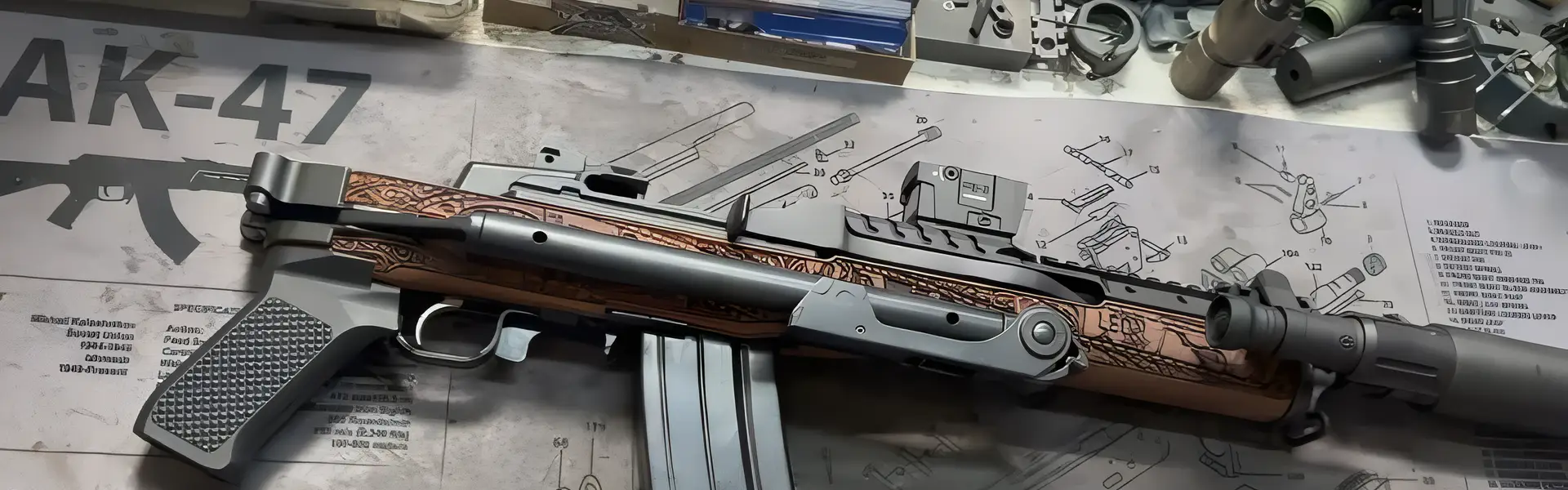
Ruger Mini-14 Magazines
Factory Ruger OEM / ProMag / United Defense • .223 Rem / 5.56mm / .300 BLK • 5 / 10 / 20 / 30 Round
The Ruger Mini-14 — introduced 1973 as the "miniature M14" ranch rifle, designed by Bill Ruger and L. James Sullivan — is the American ranch, farm, and truck-gun reference rifle across 52 years of continuous production. Gas- operated semi-auto in .223 Remington / 5.56 NATO (and since 2020 in .300 Blackout), with the rotating-bolt lock-up architecture derived from the M14 battle rifle. Keep Shooting carries the complete Mini-14 magazine lineup — factory Ruger OEM 5-, 20-, and 30-round magazines plus the .300 BLK-specific 20-round, ProMag 30-round aftermarket, and United Defense 10-round magazines.
About Ruger Mini-14 Magazines at Keep Shooting
Keep Shooting carries six magazines for the Ruger Mini-14 — factory Ruger OEM 5-round ($26.60), 20-round ($38.50), 30-round ($43.14), and a dedicated .300 Blackout 20-round magazine ($34.34) for the 2020+ .300 BLK variant; ProMag's 30-round aftermarket magazine ($29.81) at roughly 70% of factory OEM pricing; and the United Defense 10-round magazine ($19.95 sale price) for capacity-restricted states. The Mini-14 has a historically reputation for being picky about magazine choice — factory Ruger OEM is strongly recommended for duty and defensive use. For the 7.62×39 Mini Thirty sibling platform, see our Ruger Mini-30 Magazines category. For the broader Ruger magazine lineup, see our parent Ruger Magazines category, or the Ruger brand page for the full Ruger catalog.
The Ruger Mini-14 was introduced in 1973 — the design culminating six years of development work begun in 1967 by Bill Ruger and L. James Sullivan. The Mini-14's design heritage is unusually well-documented: Sullivan had worked with Eugene Stoner on both the AR-15 (Armalite, adopted by the US military as the M16 in 1964) and the later AR-18 (the Stoner- Sullivan piston-operated alternative to the AR-15 developed specifically to address the direct-impingement gas system's reputation for fouling problems). When Sullivan joined Ruger in the late 1960s, he and Bill Ruger collaborated on a new civilian-market rifle concept: the proven M14 battle- rifle architecture (rotating bolt with dual locking lugs, fixed-piston short- stroke gas system) scaled down to fire the smaller .223 Remington cartridge that had been validated in the M16/AR-15. The "Mini-14" name reflects the design premise — "miniature M14" — and the rifle's visual profile carries distinctly M14 styling cues: walnut stock, gas-system-under-barrel configuration, exposed rear peep sight on a protected rear sight tower.
The Mini-14 has been in continuous production for 52 years — a production run that places it among the longest-running American civilian rifle platforms of the post-WWII era. The most significant variant was the Ranch Rifle (introduced 1982) which added integrated scope rings on the receiver and improved factory iron sights. By the mid-1980s the Ranch Rifle had become the dominant Mini-14 configuration — replacing the original "GB" tactical-style variant as the bestselling SKU. Other variants across the platform's production include the Ranch Rifle Target (heavy barrel for accuracy work), the AC-556 (select-fire military / law-enforcement version, now discontinued), the Mini Thirty (1987 introduction, 7.62×39 chambering for Warsaw Pact-cartridge compatibility and larger-game hunting), the Mini-14 Tactical (16.12-inch barrel, ghost-ring sights, tactical-style profile), and — most recently — the Mini-14 in .300 Blackout (2020 introduction, suppressor-friendly .300 BLK chambering).
The Mini-14's mechanical architecture distinguishes it from the AR-15 in specific ways that define its commercial market position. The Mini-14 uses a fixed-piston short-stroke gas system where expanding gas pushes a piston that drives the bolt carrier rearward — the piston is a separate component that does not travel with the bolt. This architecture is significantly cleaner than the AR-15's direct-impingement system (which routes hot gas directly into the receiver and produces substantial fouling over time) and does not require the maintenance cadence AR-15 platforms typically demand. The rotating bolt with dual locking lugs is derived from the M14 / M1 Garand family — a heavier, more traditional lockup than the AR-15's multi-lug rotating bolt. The Mini-14 is typically less accurate out-of-the-box than a well-built AR-15 (barrel harmonics are a known Mini-14 limitation without aftermarket accurizing), but significantly cleaner- running and less maintenance-intensive over long service life — the "set it and forget it" rifle vs. the AR-15's "service it regularly" platform.
The Mini-14's commercial position in the American rifle market has been remarkably stable across its 52-year production run. The rifle is the reference ranch / farm / truck gun — a single-rifle solution for a property owner who wants a defensive firearm paired with utility value (predator control, pest dispatch, general-purpose chambering for light-game hunting). The Mini-14 is the dominant choice in this market segment for three reasons: the traditional wood-stock aesthetic (Ranch Rifle walnut remains available and is preferred by many Mini-14 buyers over the synthetic-stock variants), the simpler maintenance profile vs. AR-15, and the Mini-14's distinctly non- tactical appearance that makes it less politically charged as a civilian rifle in certain markets. The Mini-14 is the rifle that sits behind the truck seat or in the ranch-house gun cabinet when the owner wants a semi-auto .223 without the AR-15 social-signaling baggage.
The Mini-14's magazine reputation is the platform's defining caveat. Mini-14s have a historically well-documented reputation for being picky about magazine choice — the rifle's magazine well and feed geometry are less forgiving of manufacturing tolerance variation than the AR-15's, and aftermarket Mini-14 magazines from the 1980s through the early 2000s were notoriously unreliable. Feed failures, bolt-over-base jams, and magazine-seating issues were common complaints with period aftermarket production. Around 2008 Ruger redesigned the Mini-14 magazine with updated geometry (the current "580 series" magazines) and the modern factory-OEM Mini-14 magazines are genuinely excellent — the reliability reputation of the 1980s has been substantially resolved on factory production since the 580-series transition. Modern aftermarket production, particularly from ProMag's current Mini-14 lineup, is also significantly improved over earlier production cycles. For duty-use and defensive applications, factory Ruger OEM remains the strongly-recommended choice; for range practice and training, the ProMag 30-round aftermarket is the working-shooter's budget option at approximately 70% of factory pricing.
Factory Ruger OEM magazines for the Mini-14 come in multiple configurations. The 5-round magazine ($26.60) is the hunting-standard capacity in states with 5-round hunting limits (common in many deer-hunting states for semi-auto rifles). The 20-round magazine ($38.50) is the service-standard for ranch and recreational use. The 30-round magazine ($43.14) is the full- service-rifle capacity option. The .300 Blackout 20-round magazine ($34.34, SKU 90484) is the dedicated magazine for the 2020- introduction Mini-14 .300 BLK variant — .300 BLK uses the same .223 case head dimensions but a larger projectile, so magazine feed geometry requires specific tuning for the cartridge's different nose profile. If you own a .300 BLK Mini-14, confirm you are ordering the .300 BLK-specific magazine, not a standard .223 Mini-14 magazine.
ProMag's 30-round Mini-14 magazine ($29.81, SKU RUGA3) is the value-priced aftermarket option — approximately 70% of the factory Ruger OEM price for equivalent capacity. ProMag's current Mini-14 production is a meaningful improvement over the company's 1990s-era Mini-14 output, which had contributed to the platform's reputation for aftermarket reliability problems. For shooters building up range-practice inventory, ProMag's current Mini-14 magazines are a solid working choice. For the broader ProMag lineup covering Ruger, Glock, 1911, AR-15, AK-pattern, and dozens of other platforms, see our ProMag brand page.
United Defense's 10-round magazine ($19.95 sale, regularly $24.95) is the compliance-state option for jurisdictions that limit semi-auto rifle magazine capacity to 10 rounds (California, New York, Connecticut, Maryland, New Jersey, Massachusetts, Hawaii, Colorado, Washington, Illinois, Vermont, and DC have various 10-round limits on detachable rifle magazines). The United Defense 10-round is the working compliance solution for these markets.
Magazine compatibility rules. Mini-14 magazines are Mini-14 specific and do NOT cross-migrate to any other Ruger rifle platform. The Mini Thirty (7.62×39) uses a different magazine with modified feed geometry for the wider 7.62×39 case — see our Ruger Mini-30 Magazines category. The Ranch Rifle and all other Mini-14 .223/5.56 variants use the standard Mini-14 magazine covered in this category; the .300 Blackout Mini-14 requires the dedicated .300 BLK magazine (same body dimensions, different feed-lip tuning). Mini-14 magazines do NOT fit the AR-15 — the two platforms use completely different magazine geometries and magazine-release mechanisms. If you own both rifles, the magazines are not interchangeable.
The Mini-14 civilian market is one of the most stable single-platform customer segments in American firearms. Primary buyer profiles: ranchers and landowners who use the Mini-14 for predator control, pest dispatch, and general property security (by far the largest buyer cohort — the Mini-14 is the reference "ranch rifle"); hunters using the Mini-14 or Mini Thirty for light-to- medium game in states that allow semi-auto rifles for hunting; truck-gun carriers who keep a Mini-14 stored behind the seat of a work vehicle for utility use; AR-15-averse civilians who want a semi-auto .223 rifle without the AR-15's political-signaling or maintenance profile; home-defense owners choosing a .223 platform with traditional styling over black-rifle alternatives; and long-term Mini-14 owners who have shot the platform for 20-40+ years and are gradually replacing pre-580-series magazines with modern factory production.
Keep Shooting ships all Mini-14 magazines from our Pennsylvania warehouse with free shipping on orders over $49.95 and hassle-free returns. Magazine shipments comply with destination-state capacity restrictions — the 5-round and 10-round Mini-14 magazines ship to all 50 US states, but the 20-round, 30-round, and .300 BLK 20-round magazines will not ship to California, New York, New Jersey, Massachusetts, Hawaii, Colorado, Washington, Oregon, Illinois, Vermont, or Washington DC (state-level rules vary — verify before ordering). Whether you're a rancher building up the Mini-14 magazine inventory for daily property- protection carry, a hunter running compliance-state 5-round mags for semi-auto deer hunting, a Mini-14 .300 BLK owner stocking the dedicated cartridge- specific factory magazine, a ProMag- equipped range shooter building training inventory at 70% of OEM cost, or a California-compliant Mini-14 owner using United Defense 10-round magazines to keep the rifle legal in your jurisdiction, every Mini-14 magazine in our catalog is verified to feed the platform reliably and is backed by its respective manufacturer's warranty.
Frequently Asked Questions — Mini-14 Mags
Keep Shooting carries a wide selection of Mini-14 Mags products from trusted brands. Browse our catalog to see the full range, and use the filters on the left to narrow by brand, price, or product type.
Yes! All orders over $49.95 qualify for free shipping, including Mini-14 Mags products. Orders typically ship within 1–2 business days.
Keep Shooting offers hassle-free returns on Mini-14 Mags products. If you're not completely satisfied, contact our customer service team for a return authorization. All products must be in original, unused condition.
If you need help choosing the right Mini-14 Mags product, our team is available to assist. Check individual product descriptions for detailed specifications, or contact us directly and we'll help you find the best fit for your needs.