
- Andy Blair
- Products
- Sep 24, 2026
-
2views
Emergency Vehicle History
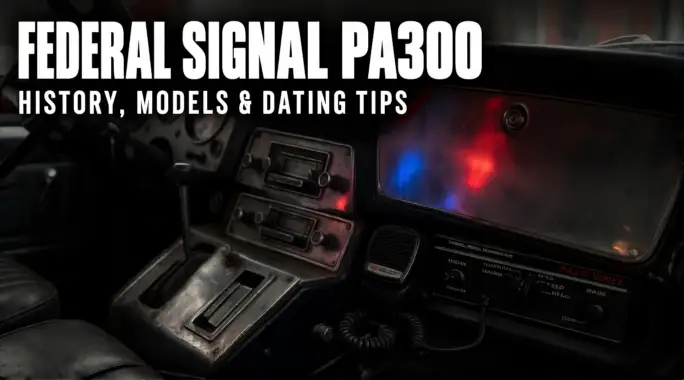
Federal Signal PA300 Siren: The History of an Industry Icon
Forty years on emergency vehicles, and no two of them sound quite alike.
You know the sound even if you never knew the name. Here is where the PA300 came from, how to date the one in front of you, and why three units off the same shelf can have three different voices.
If you’ve heard a police car or fire engine wail past in the last 40 years, there’s a good chance you’ve heard a Federal Signal PA300. You may not know the name. But you know the sound: the rising wail, the frantic yelp, the blast of electronic air horn at an intersection.
The Federal Signal PA300 showed up in the early 1980s and never really left. Along the way it picked up a following among siren collectors who can tell a 1985 unit from a 1995 unit by ear.
Most of what’s online about the PA300 is spec sheets, wiring diagrams, and scattered forum threads. We wanted to put the history in one place. Here’s where the PA300 came from, how it changed over four decades, how to date the one in front of you, and why no two of them sound quite alike.
When did the Federal Signal PA300 come out?
The Federal Signal PA300 was introduced around 1983. The first units had a silver faceplate, styled like the PA200 that came before it. A black faceplate followed around 1990.
That “around 1983” matters. Federal Signal hasn’t published a detailed product history, so the date comes from longtime siren collectors who’ve tracked serial numbers, manuals, and purchase records. One collector recalls buying a new, U.S.-made silver-face PA300 in 1987, only a few years after the model’s introduction. That lines up with the early-’80s consensus.
We’ll use that same honesty throughout this article. Where the record is solid, we’ll say so. Where it’s collector knowledge, we’ll tell you that too.
If you’re here because you’re shopping rather than researching, we currently have a new-in-box Federal Signal PA300, model 690000 in stock. It’s the 100-watt, 12-volt Hi-Lo version, complete with the harness and mounting kit. The rest of this article will help you understand exactly what you’d be getting.
Before the PA300: a short history of Federal Signal sirens
The PA300 didn’t come out of nowhere. It sits near the end of a long line of Federal Signal sirens, and the company itself goes back to the turn of the 20th century.
From store signs to sirens
Federal Signal dates itself to 1901, and its first products weren’t sirens at all — the company describes its own origins as illuminating city streets. It began as the Federal Electric Company in Chicago, building illuminated signs. By around 1915 it was making electrically driven mechanical sirens, including the famous Q siren that still rides on fire apparatus today.
The company changed names a few times as it grew. It became Federal Sign and Signal Corporation in the mid-1950s and took the name Federal Signal Corporation in 1976. That detail is handy for collectors: if a piece of equipment carries a “Federal Sign and Signal” tag, it almost certainly predates the mid-1970s.
The first electronic sirens: Director and Interceptor
Mechanical sirens are loud, but they draw a lot of current and take time to spin up. Electronic sirens solved both problems. They generate the tone with a circuit and play it through an amplifier and speaker, and they can double as a public address system.
According to collector research, Federal’s first electronic sirens, the PA-1 and PA-2, appeared around 1958. By the early 1960s the company had split its electronic line into two families:
- The Director (PA5, PA15, PA15A): the economy model
- The Interceptor (PA10, PA20, PA20A): the deluxe model
There’s a great snapshot of this era in a 1963 newspaper item from Blue Island, Illinois, where Federal Sign and Signal was manufacturing at the time. It reported that local police were testing a new Visibar light bar and a “PA-20 Siren with speaker,” equipment that wasn’t on the open market yet. It’s a nice reminder that before a siren is everywhere, it’s somewhere: a few patrol cars in a Chicago suburb, trying out the new gear.
The EMS Museum holds a 1967 PA-20A Interceptor in its collection. It offered three siren sounds, a microphone for public address, manual operation, and radio rebroadcast. Sound familiar? That feature set is essentially the PA300’s blueprint.
The shift to high-pitched tones
Here’s something most people don’t realize: sirens didn’t always sound the way they do now. Late-1960s Interceptors and Directors had a low, rich wail and a deep, throaty yelp. Collectors describe them almost like musical instruments.
In the 1970s, Federal Signal siren tones changed. The “E series” units moved to the high-pitched wail and yelp that became the modern standard. The PA200, the silver-faced siren that preceded the PA300, carried that high-pitched sound forward. So when the PA300 arrived in the early 1980s, it inherited 20 years of refinement in both features and sound.
Federal Signal siren models: an electronic siren timeline
| Era | Models | What changed |
|---|---|---|
| c. 1958 | PA-1, PA-2 | Federal’s first electronic sirens |
| c. 1960–1962 | PA5 (Director), PA10 (Interceptor) | Economy and deluxe lines established |
| c. 1962–1966 | PA15, PA20 | “Alert” tone added |
| Late 1960s | PA15A, PA20A | Hi-lo tone added on the PA20A; low, deep wail and yelp |
| 1970s | PA15A, PA20A “E series” | Shift to modern high-pitched tones |
| Before 1983 | PA200 | Silver faceplate; high-pitched tones |
| c. 1983 | PA300 (silver face) | The PA300 debuts |
| c. 1990 | PA300 (black face) | New faceplate; same basic design |
| 2012 | PA300-CN | Light and siren controller on the SmartSiren platform |
| Today | PA300-100 | Programmable 100 W siren; the current catalogue model |
Dates before 1983 are based on collector research and should be treated as approximate.
Inside the PA300: siren tones, PA, and TAP II
So what made the PA300 stick around when so many other sirens came and went? Mostly, it did everything an agency needed in a small, simple box.
Federal Signal’s PA300 Series installation manual — still published, covering models 690000, 690001, 690002 and 690004 — lays out what the unit actually does:
- Five basic siren tones: Wail, Yelp, Hi-Lo (or Priority), Air Horn, and Manual
- TAP II horn-ring transfer: the driver taps the vehicle’s horn ring to switch tones while clearing an intersection, without taking their hands off the wheel
- Public address: a noise-canceling microphone with push-to-talk that overrides any siren tone instantly
- Radio rebroadcast: plays two-way radio traffic through the vehicle speaker
- Air horn with siren override: an electronic air horn blast on demand
The electrical side is modest by design. The 100-watt models run on an 11 to 15 Vdc negative-ground system, draw 10 amperes maximum at 13.6 Vdc in wail mode into an 11-ohm load at high power, and idle at about 60 mA on standby. The housing measures 2½ × 6½ × 8½ inches (6.35 × 16.51 × 21.59 cm) and the unit weighs 4½ lb including the microphone. Connections are plug-in on the back of the housing.
That simplicity matters to a fleet manager outfitting 200 patrol cars. It also matters to a collector who wants to bench-test one on a power supply in the garage — a 10-amp draw is well within reach of an ordinary bench supply.
PA300 siren model numbers
The PA300 has been sold in several configurations. These are the four covered by the PA300 Series manual, all 100 watts at 12 volts:
| Model | Third tone | Cycle rate | Microphone |
|---|---|---|---|
| 690000 | Hi-Lo | 70 cycles/min | Included |
| 690001 | Hi-Lo | 70 cycles/min | Jack only |
| 690002 | Priority | 1300 cycles/min | Included |
| 690004 | Priority | 1300 cycles/min | Jack only |
Federal Signal has also sold higher-output variants over the years for agencies driving larger speaker setups; those are documented separately from the 100-watt series above.
The Priority tone is worth a note. It replaces Hi-Lo with a sound collectors describe as fast and phaser-like — and the numbers bear that out, cycling at 1300 times a minute against Hi-Lo’s leisurely 70. It’s less common, and opinions among collectors are split. Some love it, and plenty of others would rather have the classic Hi-Lo.
Silver face vs. black face: how to date a PA300
If you pick up a PA300 at a swap meet or estate sale, the faceplate is your first clue. Collectors generally sort the Federal Signal PA300 into three generations:
- Silver face (c. 1983 to about 1990): the original. Silver front panel like the PA200, and a wide, flat blade-style Horn/Manual switch. These are the hardest to find today.
- Early black face (around 1990 onward): Federal switched to a black faceplate but kept the flat blade switch at first. The earliest black-face units also used a 3x4 Molex connector on the back.
- Later black face: the blade switch gave way to a momentary toggle. Early plastic toggles had a reputation for breaking, and current production uses a metal toggle.
The rear connector is another tell. Older units generally use a 12-pin plug, while newer ones use a 10-pin plug. That’s important if you’re trying to match a harness, because the two aren’t interchangeable.
If you need a Federal Signal PA300 wiring diagram, the installation manuals on Federal Signal’s website cover the different versions. Check your connector first, then match the manual to it.
A quick dating checklist:
- Silver faceplate: likely 1980s production
- Black face with a flat blade switch: likely early 1990s
- Black face with a toggle switch: later production
- 12-pin rear connector: older unit; 10-pin: newer unit
Serial numbers alone won’t always pin down a year. Collectors still debate what the numbering tells you. Your best bet is to look at the faceplate, switch, and connector together.
If you’re hunting for a vintage Federal siren or building a collection of public safety equipment, it’s worth keeping an eye on our surplus collectibles and one-of-a-kind items. Pieces like this come through our doors when we least expect them.
Why no two PA300 sirens sound exactly alike
Here’s the part that turns casual buyers into collectors. Put three PA300s side by side and you may hear three different sirens.
This isn’t hypothetical. One collector reports buying three PA300s from the mid-1990s from the same source at the same time. Fired up, all three wailed differently. One was deeper and didn’t rise as high. One was higher than the others. The third landed in the middle, with more range to its wail. Same model, same era, three distinct voices.
The slow-rising “classic” wail
Collectors broadly agree the wail changed over the production run. Silver-face and the earliest black-face PA300s have a noticeably slow-rising wail. Many enthusiasts consider that the classic Federal Signal PA300 sound.
Later units rise faster, and collectors have compared some of them to competing sirens from Code 3 and Carson. The yelp, by contrast, stayed fairly consistent.
The engineering explanation
Why the variation? The PA300 generates its tones with analog circuits, not digital recordings. The manual puts the frequency range at roughly 725 Hz to 1800 Hz, with the wail sweeping that span 15 times a minute and the yelp chattering through it at 220. Both the sweep speed and the pitch depend on the values of specific resistors and capacitors on the circuit board.
Those parts aren’t perfectly precise. Electrolytic capacitors, the small cylindrical ones, can vary by 20% or more from their rated value right out of the box, and they drift further as they age. Early PA300s also have a factory-set, sealed adjustment for the tone oscillator. Stack those small differences together and every unit ends up with a slightly different voice.
The manual lists the components that shape each tone. That’s why experienced hobbyists can sometimes fine-tune an old unit toward a particular sound.
Agency custom tones
Some variation was on purpose. Federal Signal built custom-spec PA300s for certain large agencies. New York is the best-known example. The FDNY’s PA300 is a black-face unit with custom tones, including a different yelp and no Hi-Lo, and NYPD units had their own variations as well. Documentation on exactly what changed is thin, so we’ll leave it there rather than guess.
The PA300 today: PA300-CN and PA300-100
Most vehicle electronics from 1983 are long gone. The PA300 line is still being built.
Over the years, Federal Signal expanded the family rather than replacing it. In June 2012 the company announced the PA300-CN, a light and siren controller built on its SmartSiren platform and Convergence Network. It paired the familiar PA300 tones with simpler installation and programming.
The PA300-100 is where the line sits today: a programmable 100-watt siren configured from a laptop with Federal’s Convergence Network software, with a diagnostic LED that flags speaker faults and a backlit keypad that can be dimmed for stealth operation. Its default tones are the same five the 1983 unit had — wail, yelp, priority, hi-lo and air horn.
Federal Signal still publishes the PA300 Series manual for the original models, carrying a 2004–2020 copyright, which tells you how long those units stayed in service and how many are still out there needing documentation.
Why has it lasted? A few reasons come up again and again:
- It’s simple. Five tones, PA, radio, and horn transfer, with no menus to dig through
- It’s compact. It fits in tight consoles and under dashboards
- It’s serviceable. Plug-in connectors and accessible fuse protection make field repairs straightforward
- It’s affordable. Federal Signal has long pitched it on value, which matters to departments on tight budgets
Buying a Federal Signal PA300 siren: what to know
Whether you’re a collector, restoring a retired police car, outfitting a parade vehicle, or working for an agency that needs a replacement unit, a few things are worth knowing before you buy.
New in box vs. pulled from service. Most PA300s on the secondhand market were pulled from retired fleet vehicles. Many work fine, but they’ve lived years under a dashboard. Look for cut harnesses, cracked switches, and missing microphones. A new-in-box surplus unit skips all of that. If you’re curious why surplus is so often a strong value, we covered that in our honest look at buying military surplus.
Match the speaker. The PA300’s rated output assumes a Federal Signal speaker of the right wattage. A 100-watt unit like the 690000 pairs naturally with a 100-watt speaker such as the Federal Signal AS124. Mismatched speakers can sound weak or get damaged.
Before you install one: owning a siren is one thing; using one on the road is another. State laws generally restrict the use of emergency sirens on public roads to authorized emergency vehicles, and the rules vary by state. Collectors, restorers, and film and parade vehicles are common buyers, but check your state and local rules before you install one.
Consider a restorer bringing a retired 1980s police cruiser back to its original look. A silver-face PA300 would be period-correct. A late black-face unit with a toggle switch would give it away to anyone who knows what to look for. That’s the kind of detail that separates a nice restoration from a correct one.
The new-in-box PA300 (690000) we mentioned at the top is in stock right now, with the wiring harness, mounting kit, and installation instructions included. Stock on items like this comes and goes, so if you’ve been hunting for one, it’s a good time to look.
Where can I find a Federal Signal PA300 wiring diagram?
Federal Signal publishes installation and maintenance manuals for the PA300 series, and each one includes wiring diagrams for that version. Older units with a 12-pin connector and newer units with a 10-pin connector wire differently, so identify your connector before you start.
What’s the difference between the 100W and 200W PA300?
The PA300 Series manual covers the 100-watt models — 690000, 690001, 690002 and 690004 — all 12 volt. Higher-output variants have been sold over the years and drive larger speaker setups, but they’re documented separately. Whichever you have, match the siren to a Federal Signal speaker of the same wattage rating.
Can I own a PA300 siren as a collector?
Collectors, restorers, and prop and parade vehicle owners commonly buy them. Using a siren on public roads is a different matter and is generally restricted to authorized emergency vehicles. Check your state’s rules before installing one.
Final thoughts: 40 years of the PA300
The Federal Signal PA300 has one of the longest runs of any Federal Signal siren, and of any piece of emergency vehicle equipment. A few takeaways worth remembering:
- It arrived around 1983, the product of 25 years of Federal Signal electronic siren development going back to the late 1950s
- Silver faces came first, black faces followed around 1990, and switch style and connector type help narrow down the rest
- No two sound quite alike, thanks to analog tone circuits, component tolerances, and a few custom agency specs
- The line is still in production more than 40 years later, through the PA300-CN and the programmable PA300-100
For collectors, that long run is a gift. There’s always another variation to track down and another wail to compare.
If you have a silver-face PA300, an FDNY unit, or a vintage Interceptor sitting on a shelf, we’d love to hear about it. And if you’re ready to part with it, our Sell To Us program is always glad to take a look.