
Specialty Knives
TDI • Karambit • Butterfly • EOD • Strap Cutters • Training
Purpose-built knives designed for tasks no ordinary blade is built for — Ka-Bar TDI close-quarters defense knives (Greg Ellifritz's Tactical Defense Institute design for law-enforcement weapon-retention scenarios), the curved Indonesian karambit defensive blade, Bear & Son Damascus butterfly / balisong, the OKC M11 EOD knife for explosive-ordnance disposal work, emergency strap cutters from CRKT, Gerber, and Ontario, the French Army parachute line cutter, the Becker BK2 Companion heavy-duty survival knife, RAT 3 game-processing skinner, and the OKC training-knife trainer for safe martial-arts blade practice.
About Specialty Knives at Keep Shooting
Keep Shooting's Specialty Knives category is the home for purpose-built blades designed for tasks no ordinary fixed-blade or folder is built for — close-quarters defensive knives for law-enforcement weapon-retention, explosive-ordnance disposal tools with non-magnetic insulated blades, emergency strap and seatbelt cutters, training knives for safe martial-arts practice, and culturally distinctive blade patterns like the Indonesian karambit and the Filipino balisong butterfly knife. 16 SKUs spanning Ka-Bar (TDI Last Ditch, TDI Law Enforcement, Becker Companion, USSF Fighting Knife), Ontario Knife Company (M11 EOD, RAT 3 Skinner, Freedom Fighter trainer, Jericho J-Hook), Gerber, CRKT, Kershaw, Smith & Wesson, DPx Gear, Bear & Son, Walther, and authentic French Army surplus.
Ka-Bar TDI — the weapon-retention defensive blade. The TDI Last Ditch Knife and TDI Law Enforcement are designed by John Benner of the Tactical Defense Institute in Ohio — one of the most respected firearms-and-defensive-tactics training schools serving American law enforcement. The TDI design addresses a specific scenario that no other knife on the market is purpose-built for: a uniformed officer fighting at contact distance for retention of their duty firearm — a struggle in which the officer's gun hand is committed to gun retention and the support hand has a very narrow window to access a weapon. The TDI is carried inverted (handle-down, blade-up) on the duty belt ahead of the gun side, oriented for a weak-hand reverse-grip draw with the blade aligned to slash outward. The handle's distinctive downward curve allows weak-hand index-finger placement against a natural finger groove, giving positive grip orientation in adrenalized, low-light, weapon- retention conditions where fine motor control is compromised. The Last Ditch is the smaller compact variant; the Law Enforcement is the larger duty-belt variant. The TDI is now standard-issue or carry- approved across hundreds of US law-enforcement agencies and is the defining example of mission-specific knife design in the modern duty market.
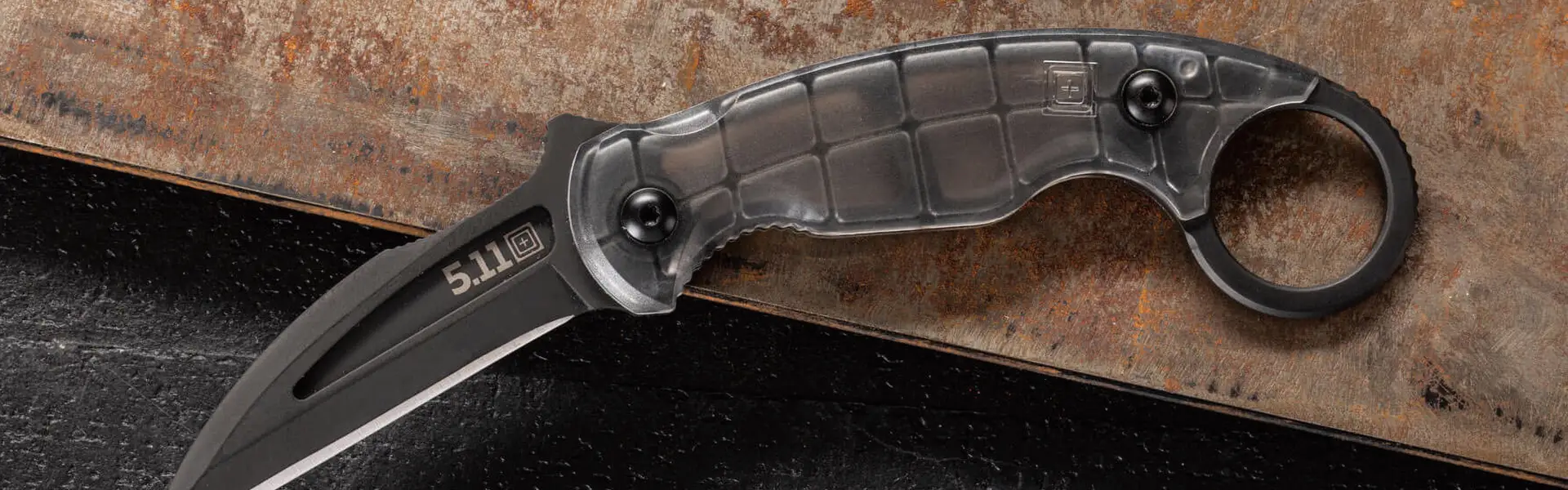
The karambit — Indonesian and Filipino curved hawkbill. The karambit (sometimes kerambit) is a traditional curved-blade fixed knife originating in Sumatra, Indonesia in the early second millennium AD — originally an agricultural tool for rice harvesting and root cutting, adapted into a martial-arts blade within Indonesian Pencak Silat and Filipino Pekiti-Tirsia Kali training traditions over hundreds of years. The karambit's defining features are the hawkbill curved blade (concave-edge, oriented for tearing/slashing rather than thrusting) and the finger ring at the butt of the handle (which retains the knife in the user's grip even when the hand is opened — a critical retention feature for martial-arts movements that involve the knife hand opening or releasing the grip momentarily). Modern karambits have spread from Southeast Asian martial-arts contexts into broader Western tactical/defensive use over the past 25 years, particularly following Steve Tarani's work teaching karambit-method to US special-operations communities. Our Walther Karambit Defense Knife is a fixed-blade karambit pattern with the traditional finger ring and hawkbill blade — appropriate as a defensive carry option for practitioners trained in karambit method, or as a familiarization piece for shooters interested in Southeast Asian blade traditions.
Bear & Son butterfly / balisong. The balisong (Filipino butterfly knife) is a Philippine traditional folder dating to roughly the late 1700s in Batangas province, Luzon — a folding knife with two counter-rotating handles that fold around the blade and lock together when closed. The butterfly knife became culturally iconic globally through martial-arts cinema (the Filipino arnis and eskrima traditions) and through 1970s-80s American urban-culture associations. Balisongs are federally legal but state-restricted: California, Hawaii, New Jersey, and New York classify balisongs as switchblade-equivalents and prohibit possession, while many other states permit possession with ownership/carry rules varying by jurisdiction. Our Bear & Son Silver Vein Damascus Steel Butterfly Knife is a Bear & Son Cutlery production (Jacksonville, Alabama, American manufacturer) with Damascus-pattern blade — a premium balisong appropriate for collectors in jurisdictions where balisong possession is legal.
OKC M11 EOD Knife — for explosive ordnance disposal. The Ontario Knife Company M11 EOD is a genuine military-spec explosive-ordnance- disposal knife — issued to US Army EOD technicians for cutting tasks in proximity to live explosive ordnance. The M11 incorporates several design features absent from any general-use knife: non-magnetic blade steel (so the knife can be used near magnetic detonator fuses without triggering magnetic- proximity activation), insulated handle construction (preventing electrical conduction in proximity to electrical-fuse ordnance), and a broader range of cutting features beyond a single straight edge. The M11 is one of the most expensive knives in our catalog at $338 — the cost reflects both the genuinely specialized engineering and the small-volume nature of EOD-issue production. For EOD technicians, EOD-history collectors, and explosive-ordnance specialists, the M11 is the genuine factory-issue article rather than a commercial equivalent.
Emergency strap and seatbelt cutters. A specific category of specialty knife addresses the emergency-rescue and strap-cutting use case: cutting woven webbing under tension — seatbelts in a crashed vehicle, downed paratrooper risers, woven load-bearing equipment trapped on a casualty, parachute lines tangled in terrain. Our four entries in this category cover the major patterns: the CRKT Combat Stripping Tool (small fixed-blade with hooked tip designed for webbing cuts and field-stripping cutaway tasks), the Gerber Strap Cutter (the classic Gerber emergency- rescue tool — guarded blade designed to cut webbing and seatbelt material without exposing the casualty's skin to the cutting edge), the Ontario Jericho J-Hook Strap Cutter (the ambulance/EMT standard J-hook pattern — a steel hook with internal cutting blade that captures webbing as it pulls, then cuts on retraction), and the French Army Parachute Line Cutter — a genuine French military-surplus parachute- line cutting tool issued to French paratroopers for emergency cutaway from tangled risers after airborne landings. The French Army cutter has the additional appeal of being authentic military surplus rather than commercial production.
Kershaw Secret Agent — the boot dagger. The Kershaw Secret Agent is a slim concealed-carry boot knife — a fixed-blade dagger sized and configured for inside-the-boot carry in a sheath that fits inside a typical work boot or duty boot cuff. The boot-knife pattern is one of the oldest concealed-carry blade patterns in American tradition, carried by riverboat gamblers, plainclothes police, military officers, and (in modern times) by concealed-carry citizens looking for a deep-carry blade option that complements rather than competes with a primary firearm carry. The Secret Agent's design — slim profile, symmetric double-edged dagger, low- profile sheath — is optimized for the deep-concealment carry context where minimal printing matters more than maximum cutting performance.
Ka-Bar Becker Companion — the heavy-use survival knife. The Becker Companion (BK2) is the iconic heavy-use survival knife designed by Ethan Becker of Becker Knife & Tool, now produced by Ka-Bar under license. The BK2 is engineered for genuinely abusive outdoor use — chopping wood, batoning through logs, prying, hard outdoor camp tasks — with a 0.25-inch-thick 1095 cro-van carbon-steel blade that is famously over-engineered for survival reliability. The BK2 has built a near-cult following among bushcraft, survival, and outdoor-prepper communities as one of the most genuinely durable survival fixed-blades on the American market. For broader Ka-Bar coverage see our Ka-Bar brand page.
DPx HEAT Hiker — the journalist's hiking blade. The DPx HEAT Hiker is a fixed-blade outdoor knife from DPx Gear — the knife company founded by Robert Young Pelton, the American war correspondent and author of The World's Most Dangerous Places. DPx Gear knives are designed around Pelton's actual fieldwork in conflict zones and high-risk travel contexts — gear that has to perform reliably in environments where equipment failure can be lethal. The HEAT Hiker is the lightweight outdoor / urban-travel pattern in the DPx line — a versatile fixed-blade suitable for backcountry hiking, international travel, and general-purpose outdoors use.
RAT 3 Skinner — the game-processing fixed blade. The RAT 3 Skinner is the Ontario Knife Company / ESEE Randall Adventure Training collaboration's dedicated game- processing knife — short fixed blade optimized for skinning, gutting, and field-dressing tasks on harvested game. The RAT (Randall Adventure Training) line also includes the RAT Model 1 and Model 2 folding knives — the same Jeff Randall / Mike Perrin design philosophy applied to folding- knife construction.
OKC Freedom Fighter — the training trainer. The OKC Freedom Fighter 6 is a dedicated training knife — a non-cutting trainer with the same shape, weight, and balance as a real combat knife, used in martial-arts blade-training and force-on-force scenario practice to develop knife technique without the laceration risk of a live blade. Trainers are essential for any serious knife- skills training program (the live-blade alternative is either unsafe or ineffective — full-speed sparring with sharpened steel is unworkable, while sub-speed sparring with sharps fails to develop adrenalized response timing). The Freedom Fighter trainer at $9.95 is the budget-tier option for shooters starting out in defensive-blade training programs.
US Space Force Ka-Bar Fighting Knife. The USSF Ka-Bar Fighting Knife is the licensed US Space Force variant of the classic Ka-Bar USMC fighting knife pattern — produced under official USSF branding for active- duty Space Force personnel, veterans, and enthusiasts of the US military's newest service branch (USSF stood up December 2019). The blade pattern itself is the classic 1219C2 / Mk2 Ka-Bar that has equipped USMC Marines since WWII — Ka-Bar's flagship fighting-knife design, in this case finished with USSF- specific markings and color scheme.
Smith & Wesson Search & Rescue. The S&W Search & Rescue is a multi-purpose emergency rescue knife combining a primary cutting blade, integrated seatbelt cutter, and glass-breaker pommel — the kind of multi-function emergency-rescue tool standard for EMT, firefighter, and emergency- responder vehicle kits. The glass-breaker is critical for vehicle-extrication scenarios where a casualty needs to be pulled from a wrecked vehicle through the side window — the carbide-tipped breaker shatters automotive tempered glass with minimal impact force. For broader S&W production see our Smith & Wesson Magazines category.
Legal note on specialty knives. Specialty knives carry significantly different legal status across US jurisdictions. Karambit and fixed-blade boot knives are generally treated as fixed-blade carry under state knife laws — varying blade-length, concealed-carry, and permit requirements per state. Balisong / butterfly knives are restricted as switchblade-equivalents in California, Hawaii, New Jersey, and New York — possession is prohibited in those four states. EOD knives and strap cutters are generally treated as ordinary utility knives. Training knives (non-cutting) are legal in all 50 states. Before ordering or carrying any specialty knife, verify your state and local rules. For broader knife coverage see our Folding Knives, Fixed Blade Knives, and Automatic Knives categories.
Keep Shooting ships all specialty knives from our Pennsylvania warehouse with free shipping on orders over $49.95 and hassle-free returns. Whether you are a law-enforcement officer adding a TDI weapon-retention defensive knife to a duty kit, an EOD technician sourcing the genuine Ontario M11, an EMT or first- responder building a vehicle- extrication kit with strap-cutter and glass-breaker, a karambit or balisong martial-arts practitioner, a survivalist looking for the Becker BK2 heavy-use companion, a hunter adding the RAT 3 to a game-processing kit, or a USSF veteran seeking the licensed Space Force Ka-Bar, every blade in our specialty catalog is from a respected manufacturer with purpose-built design pedigree — no anonymous filler, every knife engineered for the specific task it serves.
Frequently Asked Questions — Specialty Knives
Keep Shooting carries a wide selection of Specialty Knives products from trusted brands. Browse our catalog to see the full range, and use the filters on the left to narrow by brand, price, or product type.
Yes! All orders over $49.95 qualify for free shipping, including Specialty Knives products. Orders typically ship within 1–2 business days.
Keep Shooting offers hassle-free returns on Specialty Knives products. If you're not completely satisfied, contact our customer service team for a return authorization. All products must be in original, unused condition.
If you need help choosing the right Specialty Knives product, our team is available to assist. Check individual product descriptions for detailed specifications, or contact us directly and we'll help you find the best fit for your needs.