
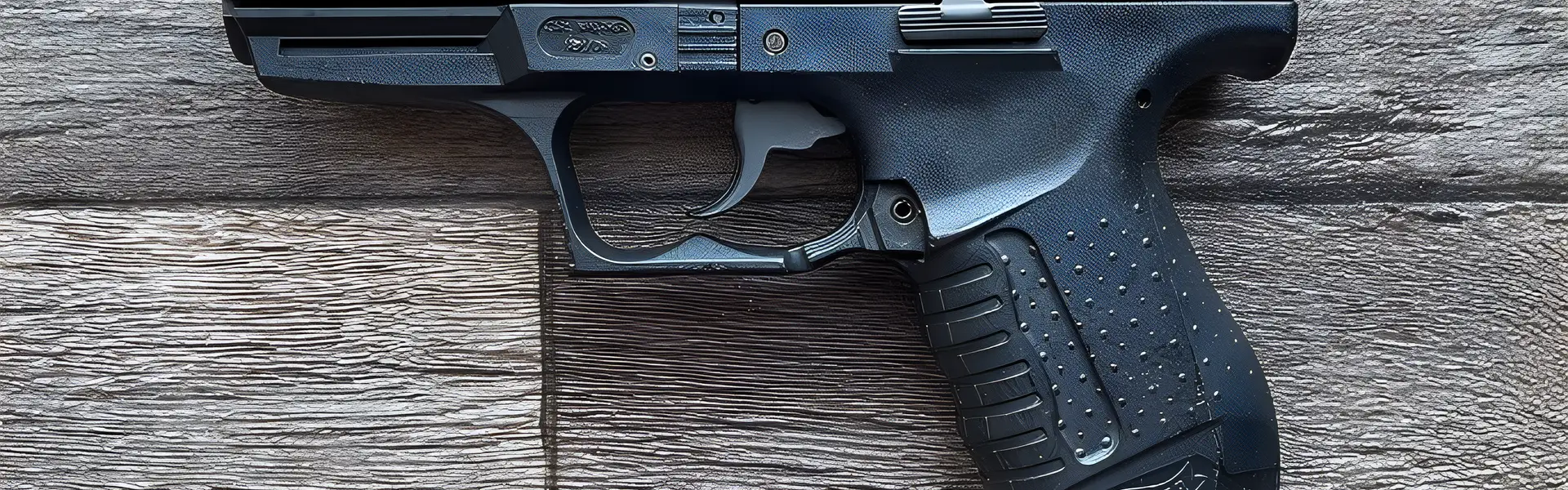
Walther Magazines
PPK • PPK/S • P22 • P99 • Colt M4-22 • .22 LR / .32 ACP / .380 ACP / 9mm
Factory Walther and MEC-GAR factory-licensed magazines for the iconic German pistol line — the PPK and PPK/S (the 1929 Fritz Walther design that became the defining European pocket pistol and the James Bond service sidearm), the P22 rimfire trainer, the polymer P99 service pistol, and the Walther-built Colt M4-22 rimfire-carbine magazine. Factory original and MEC-GAR OEM-contract production — the two Walther- approved sources for authentic replacement capacity.
About Walther Magazines at Keep Shooting
Keep Shooting carries the Walther magazine lineup covering the German pistol manufacturer's most recognized designs — the PPK and PPK/S (Fritz Walther's 1929 Polizeipistole and its post-1968 US-import adaptation), the P22 .22 LR rimfire target/training pistol, the polymer P99 DA/SA service pistol, and the Walther-built Colt M4-22 rimfire carbine magazine. Production is split between factory Walther (Ulm, Germany) and MEC-GAR (Gardone Val Trompia, Italy) — the Italian factory-OEM magazine specialist that holds Walther's contract production for several variants. For the complete Walther brand lineup see our Walther brand page.
Walther and the PPK — the defining European pocket pistol. Carl Walther Waffenfabrik was founded in 1886 in Zella-Mehlis, Thuringia, by gunsmith Carl Walther — initially a sporting-rifle manufacturer that transitioned to pistol design in the early 20th century. In 1929 Carl's son Fritz Walther completed the design of the Polizeipistole (PP) — a compact double-action / single-action semi-automatic pistol intended for uniformed European police service, with a hammer-fired blowback action, fixed barrel, and an innovative double-action first-shot trigger that eliminated the need to manually cock the hammer for duty carry. Two years later, in 1931, Walther released the smaller PPK (Polizeipistole Kriminalmodell) — a more compact "detective model" variant designed for plainclothes and concealed carry by criminal investigators. The PP and PPK were adopted by German police in 1931, issued to German officers and officials through WWII, and remained in widespread European police service for more than 50 years.
PPK and PPK/S — the US import distinction. The Gun Control Act of 1968 introduced a point-system import restriction on small handguns — pistols below a minimum combined barrel length, overall length, and feature-score could no longer be imported into the United States. The original PPK fell just below the import threshold. Walther's solution was the PPK/S (PPK-Sport) — the original PPK slide and barrel mated to the slightly larger PP-size frame, giving just enough overall size to qualify for US import. The PPK/S added one round of capacity (7+1 in .380 ACP versus the PPK's 6+1) as a side-effect of the taller frame, and became the dominant US-market version of the pistol for more than three decades. Original-style PPK pistols became available in the US again only after 1986 when Interarms (and later S&W under license) began producing PPK pistols on US soil. Today both PPK and PPK/S are available. Our catalog carries magazines for both: factory PPK .380 finger-rest (the curved pinky-extension floorplate), factory PPK/S blued and standard, and MEC-GAR factory-contract production in both PPK 6-round and PPK/S 7-round capacities.
The James Bond magazine. In Ian Fleming's 1958 novel Dr. No, M orders Bond to turn in his Beretta 418 .25 ACP and replace it with "a Walther PPK 7.65mm" — the chambering better known as .32 ACP. Fleming's choice was based on a real-world letter from PPK enthusiast Geoffrey Boothroyd (later fictionalized as Bond's armorer "Major Boothroyd"), who wrote to Fleming arguing that the Beretta .25 was too small a caliber for a field agent and recommended the PPK as the more authentic choice. The Walther PPK has remained Bond's signature sidearm across all 25 Eon-produced Bond films from Dr. No (1962) through No Time to Die (2021), making it arguably the most globally-recognized handgun in commercial fiction and pop culture. The cultural reach is a substantive reason the PPK remains in production 95 years after its 1929 design — far outlasting most of the pistol designs that competed with it through the 20th century.
Walther P22 — .22 LR rimfire trainer. Walther released the P22 in 2001 as an affordable entry-level rimfire pistol aimed at both target shooters and at Walther owners looking for a low-cost training understudy to their .380 or 9mm service pistols. The P22 is polymer-framed, uses a fixed-barrel blowback action like the PPK before it, and adopts much of the styling cues of the P99 service pistol scaled down for rimfire. The P22 is among the most commercially successful rimfire pistols on the US market, particularly for recreational range shooting where .22 LR ammunition economics make hundreds of rounds per session practical. Our factory Walther P22 magazine is the original 10-round capacity for the platform.
Walther P99 — the polymer service pistol. Released in 1996, the P99 was Walther's response to the Glock-led polymer-frame striker-fired revolution of the 1980s and 1990s. The P99 chamber 9×19mm Parabellum or .40 S&W, feeds from staggered- column double-stack magazines (10 rounds as originally imported under the expired 1994 Federal Assault Weapons Ban, 15 rounds standard after 2004), and introduced several design innovations that were subsequently widely copied: interchangeable back-strap inserts for grip sizing, a striker-indicator cocking status pin visible from the rear of the slide, and a distinctive DA/SA trigger-reset mechanism. The P99 was adopted by several European and Asian police and military organizations including the German state police forces of Rheinland-Pfalz and Saarland, the Finnish Army, and the Irish Garda. Our factory Walther P99 magazine is the standard factory replacement.
Walther-built Colt M4-22. The Colt M4-22 is a .22 LR rimfire semi-automatic carbine built and sold under Colt branding but manufactured by Walther under license — an arrangement that leverages Walther's rimfire pistol and long-gun tooling (the same facility that produces the P22) and Colt's M4/AR-15 trademark and marketing reach. The M4-22 is sized and styled to match a standard 5.56 AR-15 / M4 carbine externally — same sight height, same stock interface, same furniture — giving AR-platform shooters a low-cost rimfire training understudy for practice drills without the cost or noise of 5.56 ammunition. The rimfire magazine is proprietary to the Walther-built M4-22 platform and is NOT interchangeable with standard AR-15 STANAG magazines. Our factory Walther Colt M4-22 20-round magazine is the original-capacity replacement for the platform.
MEC-GAR — Walther's factory-contract partner. MEC-GAR Srl is the Italian factory-OEM magazine specialist (Gardone Val Trompia, Brescia province, Italy) that produces factory-contract magazines for many of Europe's major pistol manufacturers including Walther, SIG Sauer, Beretta, CZ, Browning / FN, and Taurus. MEC-GAR magazines carry each OEM manufacturer's markings and specifications and are the same magazines those manufacturers ship as original-equipment in new pistols. For Walther specifically, MEC-GAR produces the PPK 6-round and PPK/S 7-round magazines currently in our catalog — both sold as factory-equivalent replacement production with full Walther / MEC-GAR quality control.
Caliber and platform compatibility. Walther pistols span four distinct caliber families in our catalog: .22 LR rimfire (P22, Colt M4-22), .32 ACP / 7.65mm Browning (classic PPK), .380 ACP / 9×17mm (modern PPK and PPK/S), and 9×19mm Parabellum (P99). Magazines are platform- and caliber-specific: a PPK .32 ACP magazine does NOT fit a PPK .380, and neither fits a PPK/S (different frame height), which in turn does not fit a P99 (different magazine type entirely). A P22 magazine does NOT fit a Colt M4-22 despite both being Walther-built .22 LR rimfire magazines — the P22 is a pistol magazine and the M4-22 is a carbine-length magazine. Before ordering, verify your specific Walther model, caliber, and frame variant.
For the PPK collector and the PPK shooter — two different uses. Walther PPK pistols span nearly a century of production from the original 1931 German factory pistols through WWII-era Spreewerke contract production, post-war French Manurhin production (the French company licensed the design from Walther from 1952 through 1986), Interarms US-import production, modern Walther US (Fort Smith, Arkansas) production, and current Ulm Germany production. Any of these pistols can still be shot and carried today, and factory replacement magazines are available for all of them in our catalog. For PPK shooters who carry the pistol for personal defense, a pair of spare MEC-GAR or factory Walther magazines is the standard carry supplement. For PPK collectors who own historical pistols as display pieces, factory magazines preserve the original-equipment configuration and maintain the pistol's collector value.
Keep Shooting ships all Walther magazines from our Pennsylvania warehouse with free shipping on orders over $49.95 and hassle-free returns. The low-capacity PPK, PPK/S, and P22 pistol magazines ship to all 50 US states; the higher-capacity P99 and Colt M4-22 magazines comply with destination- state capacity rules (verify before ordering). For shooters looking to upgrade their reload speed, the Walther PPK/S and P99 magazines load smoothly with the Maglula UpLULA universal pistol loader — see our Magazine Loaders category. Whether you are a concealed-carry PPK owner stocking defensive spares, a P99 duty-pistol shooter maintaining training inventory, a P22 or Colt M4-22 rimfire enthusiast burning through bricks of .22 LR, or a Fleming-era PPK collector preserving a historical piece with original-equipment magazines, every Walther magazine in our catalog is factory Ulm production or MEC-GAR factory-contract — the two Walther-approved sources for authentic replacement capacity.
Frequently Asked Questions — Walther Mags
Keep Shooting carries a wide selection of Walther Mags products from trusted brands. Browse our catalog to see the full range, and use the filters on the left to narrow by brand, price, or product type.
Yes! All orders over $49.95 qualify for free shipping, including Walther Mags products. Orders typically ship within 1–2 business days.
Keep Shooting offers hassle-free returns on Walther Mags products. If you're not completely satisfied, contact our customer service team for a return authorization. All products must be in original, unused condition.
If you need help choosing the right Walther Mags product, our team is available to assist. Check individual product descriptions for detailed specifications, or contact us directly and we'll help you find the best fit for your needs.