
Warsaw Pact Surplus Collecting • May 2026
Collecting East German Army Surplus: A Beginner's Guide to NVA & DDR Gear
Strichtarn, M56 helmets, the Volksmarine, and how to start an NVA collection without making expensive mistakes.
The Nationale Volksarmee dissolved on October 2, 1990. Every piece of NVA gear in circulation today came out of that final dissolution. No factory is making more. After 23 years buying and selling Warsaw Pact surplus, here's what we'd tell a friend starting out.
The Nationale Volksarmee, East Germany's National People's Army, dissolved on October 2, 1990, one day before German reunification. Every piece of NVA gear in circulation today came out of that final dissolution. No factory is making more.
That's the thing to understand before you buy your first piece of East German Army surplus: this is a closed category. The supply that exists is the supply that will ever exist, and each year a little more of it disappears into private collections and museum holdings.
The good news is that NVA gear is still affordable, still well-made, and still organized enough that a new collector can find a clear starting point without getting lost. We've been buying and selling Warsaw Pact surplus for over two decades, and East German pieces remain some of the more interesting and accessible items in that part of our catalog. Here's what we'd tell a friend who was looking at this category for the first time.
A quick history of the Nationale Volksarmee
The NVA was formed on March 1, 1956, and dissolved on October 2, 1990. In those 34 years, roughly 2.5 million East German men served in its ranks, with peak strength of about 175,300 troops in 1987.
What's worth knowing as a collector: the NVA was widely regarded as one of the best-trained, best-equipped militaries in the Warsaw Pact. NATO assessments consistently rated it near the top of the alliance opposite. That meant consistent uniform standards, decent material quality, and well-documented patterns of issue across branches, all of which makes the surplus market a little easier to navigate than militaries that issued gear haphazardly.
It also means the items have institutional weight. An NVA helmet or field jacket wasn't just stamped out for show; it was worn by a soldier in one of the most heavily prepared forces of the Cold War, on the front line of the central European standoff.
Understanding Strichtarn, the rain-pattern camouflage
What is Strichtarn camo?
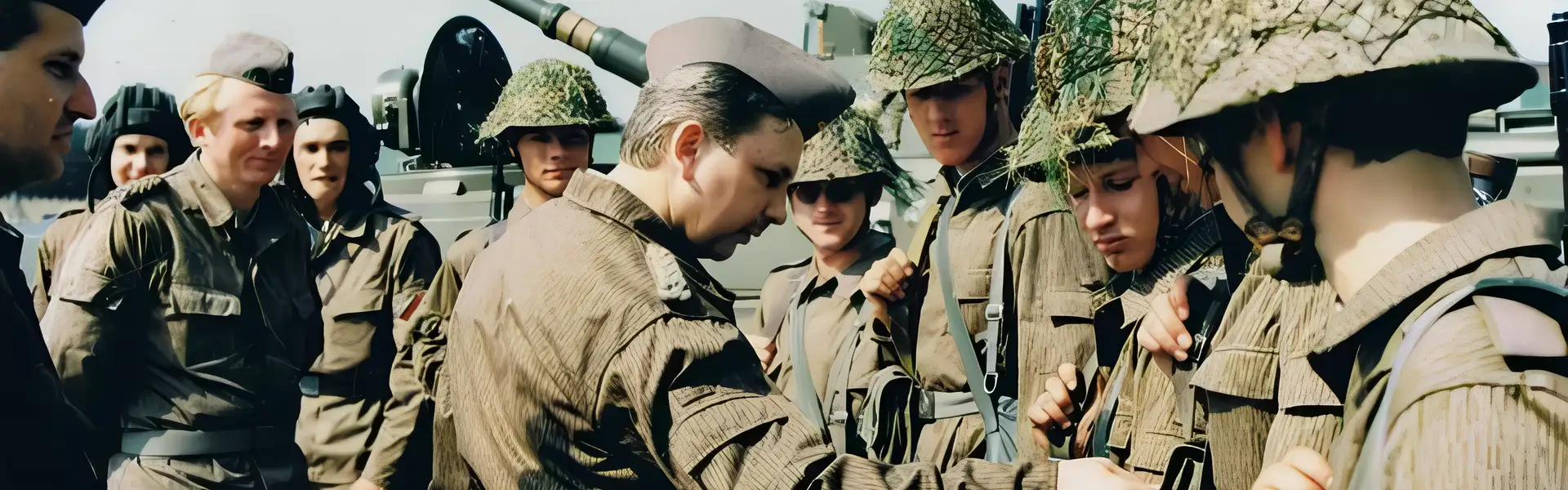
Strichtarn (literally “line camouflage”) is the rain-pattern camouflage adopted by the NVA in 1965 and issued continuously until the army's 1990 dissolution. It was developed at the Karl-Marx-Stadt Research Institute for Textile Technology as a replacement for the earlier Flächentarn (“blotch camo,” sometimes called Blumentarn or “flower camo”), which had been in service since 1958. The pattern is the visual signature of the NVA and the entry point most new collectors recognize.
A few practical notes:
- The pattern itself is short vertical brown dashes printed over an olive base. It's striking, easy to identify in a lineup, and surprisingly effective in broken European woodland.
- The reason for the switch from Flächentarn was identification. The earlier blotch pattern looked too similar to Soviet patterns, which caused friendly-fire identification issues during joint Warsaw Pact exercises.
- Strichtarn became more than camouflage. It's the pattern that distinguishes NVA equipment in collector circles, and it shows up on field uniforms, rain jackets, grenade pouches, and field caps from 1965 onward.
First-generation vs. second-generation Strichtarn
Two versions of the Strichtarn field uniform are common in surplus.
First-generation jackets have concealed pocket buttons, a flap covers the button so it doesn't show. Earlier production. Considered a little harder to find in collector-grade condition.
Second-generation jackets have exposed pocket buttons and minor cut differences. Generally more common on the surplus market today.
Neither generation is “better.” For a collector building a representative kit, having both is the goal. For someone just wanting an authentic Strichtarn jacket to wear or display, the second generation is usually easier to source at a reasonable price.
Winter weight uniforms also exist, heavier fabric, sometimes paired with a black non-officer collar, and tend to command a small premium over summer cuts. (For more on the pattern's full development history, Camopedia's East Germany entry is the standard reference collectors use.)
The most collectible East German Army surplus items
Here's what tends to come up most often when collectors are building out NVA holdings, and what we see move through our East German Army surplus selection.
Strichtarn field uniforms
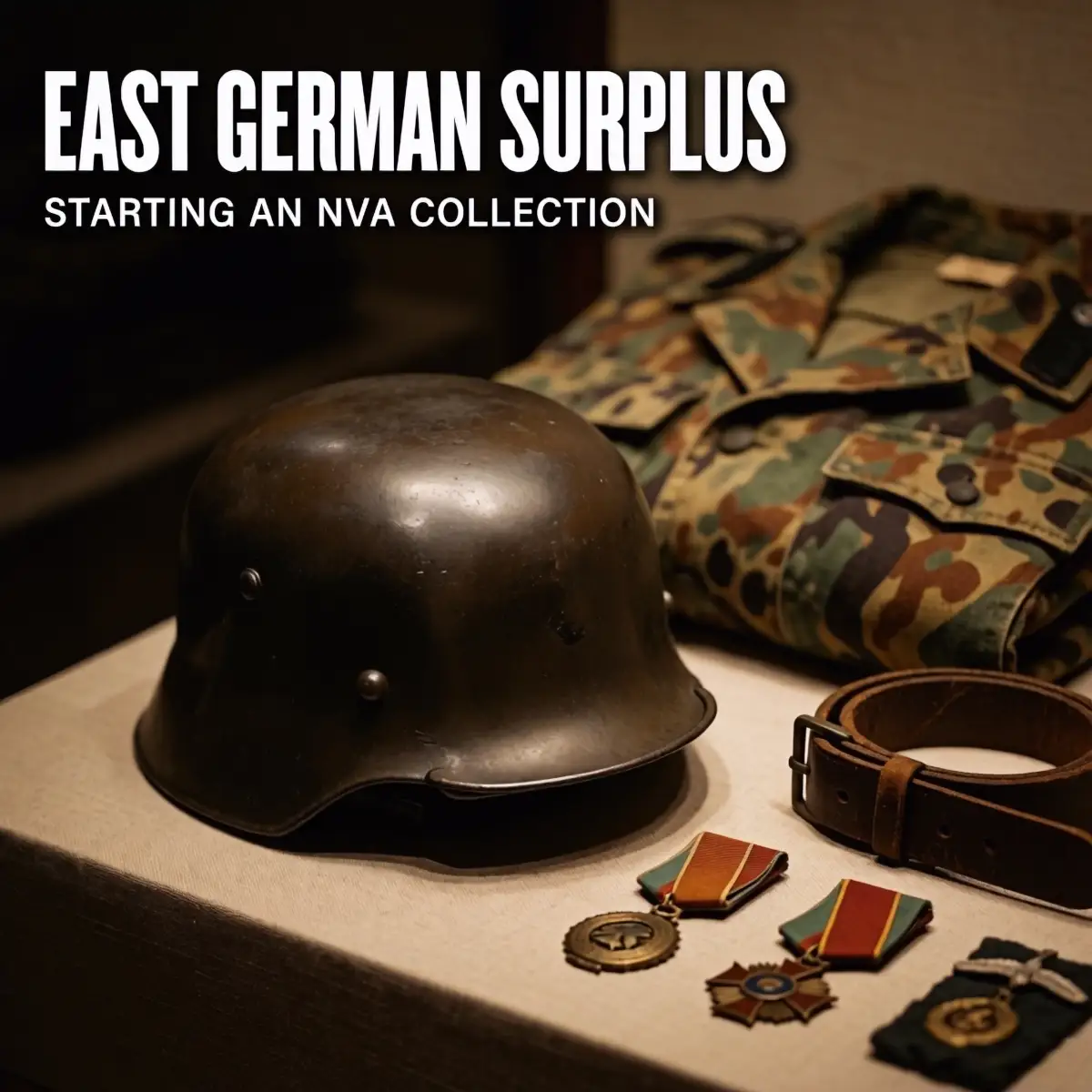
The signature category. Jackets, summer field pants, and rain coats in the rain pattern are the most recognizable NVA pieces and the most common starting point. Summer uniforms turn up regularly; winter uniforms are scarcer.
M56 and M76 steel helmets
The M56 (introduced 1956) and the slightly updated M76 are the iconic NVA combat helmets. They have a distinctive sloped silhouette that's instantly identifiable, quite different from both the Soviet SSh-style helmets and the West German M1-derived helmets of the same era. Look for intact liners, original chinstraps, and arsenal stamps inside the shell.
NVA parade helmet in Steingrau
Separate from the combat helmet, the parade helmet in Steingrau (“stone gray”) is a striking display piece. White MP (military police) helmet covers also exist for collectors focused on that branch.
Field gear, pouches, map cases, and Y-straps
The smaller items are where most collectors start because the price is friendly. Strichtarn grenade pouches, map cases, AK magazine pouches, bread bags, canteens, and load-bearing Y-straps are all common. They wear honestly, photograph well, and build out the look of a kit quickly.
Volksmarine (naval) items
The Volksmarine, the East German navy, has its own collector lane. Hat ribbons, shoulder boards, and dress uniform items are sought by collectors focused on the maritime side of the NVA.
GST medals and insignia
The Gesellschaft für Sport und Technik (GST) was the DDR's pre-military training organization. Original GST instructor medals in bronze and silver come up occasionally and are genuine state decorations from an institution that no longer exists.
Footwear, leather goods, and clothing accessories
NVA leather jackboots (the East German equivalent of the German “Knobelbecher”), wool gloves, leather greatcoat straps, and odds and ends round out the category. Sizing on the boots varies and they tend to run small by U.S. standards.
How to evaluate authenticity and condition
This is where new collectors run into trouble, especially online. Here's how we'd approach it.
Understand why the supply is finite
The NVA stopped existing in 1990. No factory has produced authentic NVA gear since then. Anything claiming to be NVA was either issued before October 1990 or it's a reproduction. There is no third category. That single fact rules out half the bad explanations you'll see online about why a piece doesn't quite look right.
Learn the condition language
Surplus condition is its own vocabulary, and East German gear gets graded the same way as any other surplus:
- Unissued: Never deployed to a soldier. Original factory condition. Rare on items more than 35 years old, and priced accordingly when found.
- Excellent / very good: Used but with minor wear. No significant damage or staining.
- Good: Honest service wear. Some fading, minor stitch repairs, light staining. Fully functional.
- Field grade / fair: Visible wear. Possible repairs or staining. Still displayable or wearable.
- Salvage / parts: Damaged or worn beyond practical use. For parts, conversions, or display only.
Sellers who refuse to describe condition in this kind of detail are either inexperienced or hiding something. Either way, slow down before buying.
Honest wear is a feature, not a flaw
A real NVA jacket from 1985 is going to show signs of having been worn by an actual soldier. Names written inside the collar. A mismatched button replaced during service. Light dye fade across the shoulders. A small field repair to a torn pocket. These aren't problems, they're authenticity markers. Some collectors specifically prize examples with named tags inside as small fragments of personal history.
What's a red flag: an item dated 1980 that looks like it just came off the factory line, with no service wear and no provenance story. Either it's genuinely “unissued” and priced and documented as such, or it's a reproduction.
Cross-reference patterns and stamps
Camopedia is the standard reference for Strichtarn variations and adjacent patterns. For helmets, arsenal stamps and date codes inside the shell are the main authentication points. For insignia, photographs of known-authentic examples from established reference sites are the best comparison tool.
If you're buying a piece you can't identify, ask the seller what they know. A reputable surplus dealer can usually tell you the era, the branch, and what to look for. A seller who can't is buying blind and selling blind, and that's a buyer's problem either way.
Where East German surplus fits in a larger collection
NVA gear is one of the better entry points into Warsaw Pact collecting for a few reasons.
Affordability. Compared to German, British, or U.S. surplus from similar eras, NVA pieces are still reasonably priced. A wearable Strichtarn shirt or summer field pants typically run under $50. A complete summer uniform is still under $150 in most conditions. That's a low bar for getting started.
Distinctive identity. Strichtarn is unmistakable. A new collector can build a visually coherent kit quickly because the pattern carries across so many items.
Cross-references with other militaries. If you're collecting more broadly across the Warsaw Pact, Czech Army surplus, Polish, Hungarian, Soviet, NVA gear sits in conversation with all of those. Items from joint exercises occasionally carry mixed unit markings. Understanding one Warsaw Pact military helps you understand the others.
Organized inventory. This is partly why we organize our surplus by country in the first place. Trying to find specific NVA items in a generic “miscellaneous military surplus” bin is frustrating. Filtering by surplus by country lets you shop the way collectors actually think.
A practical suggestion: don't try to collect “all East German surplus” without a focus. Pick an angle, Cold War field gear, Volksmarine, the helmet series, GST medals, a single uniform configuration, and work toward depth in that area. The collectors who end up happiest are the ones who built a focused kit, not the ones who tried to buy one of everything.
What to buy first if you're new
If you're new to NVA collecting and you want to start without making expensive mistakes, here's what we'd suggest.
Start with a Strichtarn summer field shirt or pants. Under $50, wearable or displayable, instantly recognizable as NVA. It teaches you what the pattern actually looks like in person, which is more useful than any photograph for spotting reproductions later.
Step up to a complete summer uniform. Shirt, pants, and a field cap. This is the foundation of any NVA kit. Once you have one, you've established a baseline of authentic material to compare future purchases against.
Add field gear in pieces. A Strichtarn grenade pouch, a bread bag, a canteen. These are inexpensive ways to build out the visual completeness of a kit and they teach you what authentic NVA hardware feels like, the buckles, the stitching, the period-correct material weights.
Then go for the specialty pieces. An M56 or M76 helmet. A parade helmet in Steingrau. An insignia or medal grouping. These are the higher-value pieces that reward the patience of having learned the basics first.
One honest note on pricing: NVA prices have crept up over the past decade and will likely keep doing so. Items that were $30 ten years ago are now $50. That doesn't mean you've missed the window, there's still plenty of inventory in circulation, but the trend line is what it is, and putting off a piece you actually want isn't usually a strategy that saves you money.
A note on respect and history
It's worth saying directly: these items were issued to soldiers who served in a military that no longer exists. Most of those men were conscripts in a country that gave them no choice about being there. Their gear has ended up in collector circulation because their state collapsed, not because they cast it off.
We try to treat what we sell accordingly. We don't romanticize the regime that issued these items, and we don't disrespect the people who wore them. NVA gear is a tangible connection to one of the most-studied militaries of the Cold War and to the roughly two and a half million people who served in it. That's the lens we'd encourage any collector to bring to the category.
Building your East German Army surplus collection
The shortest version of everything above:
- East German Army surplus is a finite category. The NVA dissolved in 1990 and no new authentic material is being produced.
- Strichtarn is the visual signature of the NVA, learn the pattern, learn the first-gen and second-gen differences, and you'll spot authentic pieces faster.
- The M56/M76 helmet series and Strichtarn field uniforms are the iconic items most collectors build around.
- Condition language matters. Honest wear is authenticity. Too-clean items on an 80-something-year-old uniform deserve skepticism.
- Affordable entry points still exist, a Strichtarn shirt under $50 is a reasonable first purchase, but prices on this category have been climbing.
If you want to see what's currently on the shelves, the East German Army surplus collection is the place to start. It updates as new lots come in, and what's listed is what we have; we don't post inventory we can't actually ship.
And if you're on the other side of this, you've inherited a relative's collection, or you've spent years building one and you're ready to part with pieces, our Sell To Us program is how a lot of the NVA inventory in our catalog gets there. Tell us what you have. We'll take a look.
We've been handling Warsaw Pact military surplus for over 20 years. If you've got questions about a specific piece, yours or one of ours, get in touch. Someone on our team has probably already seen one.