
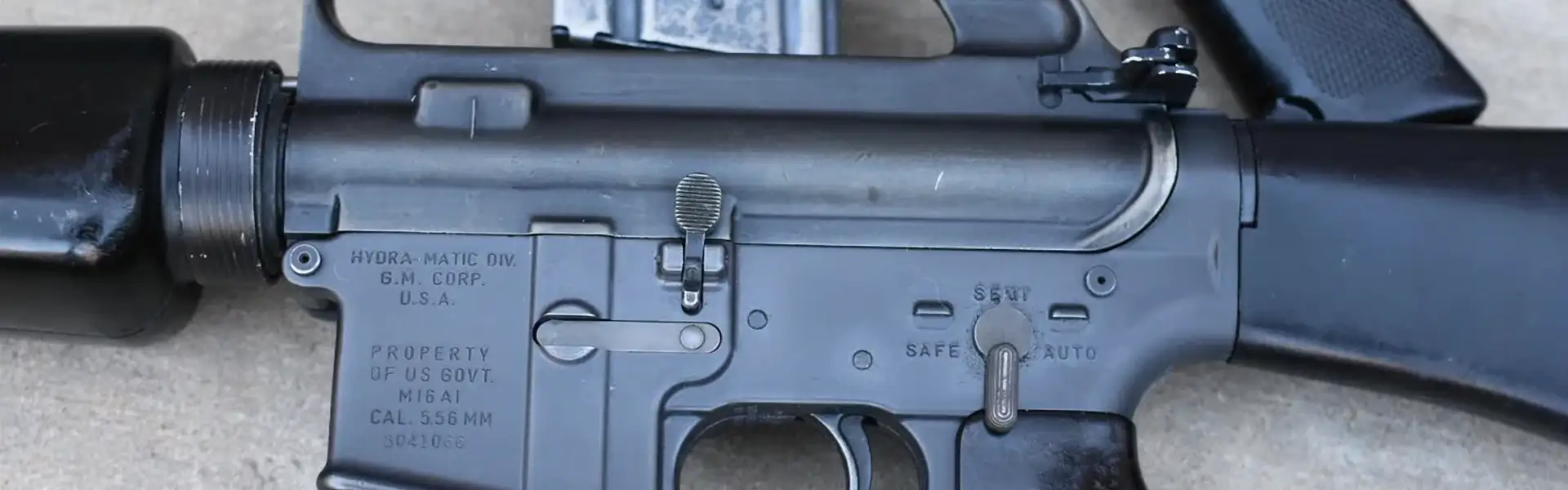
M-16 Parts
Authentic M16-Pattern Fire Control Components
Genuine M16-pattern fire control group parts — M16 trigger, M16 hammer, M16 disconnector, and the M16 three-position safe/semi/auto selector. These are the authentic Eugene Stoner-pattern components from the rifle that has served the United States military as its standard service weapon since 1964, built to military specification and intended for registered M16 owners, Class III SOT dealers and manufacturers, and replacement-part needs.
M-16 Parts at Keep Shooting
Keep Shooting carries authentic M16-pattern fire control group components — the M16 trigger, M16 hammer, M16 disconnector, and the three-position M16 selector switch (safe / semi / auto). These are the genuine military-specification fire control parts from the rifle that Eugene Stoner originally designed at ArmaLite as the AR-15 in 1956 and that Colt redesigned and adopted as the M16 rifle for the United States military in 1964 — the same fire control architecture that has equipped American troops in Vietnam, Grenada, Panama, the Gulf War, Somalia, Iraq, and Afghanistan, and that remains in service today as the M16A4 and its M4 carbine derivative.
The M16 traces its lineage to Eugene Morrison Stoner (1922–1997), the American firearms designer who joined ArmaLite in 1954 and patented the gas-operated direct-impingement bolt and carrier system in 1956. Stoner's original design was the 7.62×51mm AR-10. At the request of the U.S. military, Stoner's chief assistant Robert Fremont and engineer Jim Sullivan scaled the AR-10 down to fire the new small-caliber .223 Remington (5.56×45mm) cartridge — the result was the ArmaLite AR-15. Colt acquired the rights to the AR-15 in 1959, refined the design for military production, and the U.S. Air Force adopted it as the M16 in 1964. By 1969 the M16A1 had replaced the M14 as the standard service rifle of the United States military, and the basic Stoner architecture has remained in continuous American service for over six decades — the longest-serving service rifle in U.S. history.
The M16 fire control group is what distinguishes a select-fire M16 from a semi-automatic AR-15. The components look superficially similar to standard AR-15 lower parts kit components, but they have specific geometric differences engineered for full-auto operation. The M16 hammer has a different profile than the AR-15 hammer, with an additional notch and timing surface to interface with the auto sear. The M16 disconnector is cut differently than the AR-15 disconnector to release the hammer for sustained fire. The M16 trigger has a modified rear surface to clear the auto sear's reset path. And the M16 selector is a three-position switch — safe, semi-automatic, and full-automatic — versus the two-position selector on a semi-auto AR-15. Together with a registered auto sear or a registered M16 lower receiver, these parts complete a fully-functional select-fire fire control group built to mil-spec.
These parts are intended for specific lawful use cases. Owners of pre-1986 transferable registered M16 rifles use them as direct-replacement parts when original components wear out — the National Firearms Act registry closed to new civilian machine gun registrations on May 19, 1986 under the Hughes Amendment to the Firearm Owners Protection Act, so the existing registered M16 inventory is finite and replacement parts are an essential consumable. Class III Special Occupational Taxpayer (SOT) dealers and manufacturers use them to maintain dealer sample machine guns and to manufacture post-sample M16s for law enforcement and military demonstration. Federally licensed manufacturers building M16-pattern firearms under proper FFL/SOT credentials use them as production components. And firearms collectors and historical researchers use them as reference specimens of an important piece of 20th-century American small arms engineering.
A critical legal note: under federal law and ATF rulings, installing M16 fire control components into a semi-automatic AR-15 lower receiver alongside a functional auto sear or M16 bolt carrier — or in any combination that produces more than one shot per trigger pull — constitutes the unlawful manufacture of a machine gun, a federal felony under 18 U.S.C. § 922(o). The ATF has further opined that possession of M16 fire control parts together with an AR-15 lower receiver may, in certain circumstances, be evaluated for "constructive intent" to manufacture a machine gun. These parts are sold strictly for the lawful purposes described above — registered NFA M16 maintenance, Class III SOT operations, licensed manufacturer use, and historical collection — and the buyer is solely responsible for compliance with all federal, state, and local laws governing their possession and use. If you are not certain whether your intended use is lawful in your jurisdiction, consult an attorney who practices firearms law before placing an order.
Keep Shooting is a federally licensed FFL and ships M16 parts from our Pennsylvania warehouse with fast delivery and hassle-free returns. Every part we list is genuine military-specification — built to the same drawings that govern Colt, FN, and other military M16 production — not commercial AR-15 lower parts kit components rebranded as M16-pattern. Free shipping on orders over $49.95.
Frequently Asked Questions — M16 Parts
Keep Shooting carries a wide selection of M16 Parts products from trusted brands. Browse our catalog to see the full range, and use the filters on the left to narrow by brand, price, or product type.
Yes! All orders over $49.95 qualify for free shipping, including M16 Parts products. Orders typically ship within 1–2 business days.
Keep Shooting offers hassle-free returns on M16 Parts products. If you're not completely satisfied, contact our customer service team for a return authorization. All products must be in original, unused condition.
If you need help choosing the right M16 Parts product, our team is available to assist. Check individual product descriptions for detailed specifications, or contact us directly and we'll help you find the best fit for your needs.