
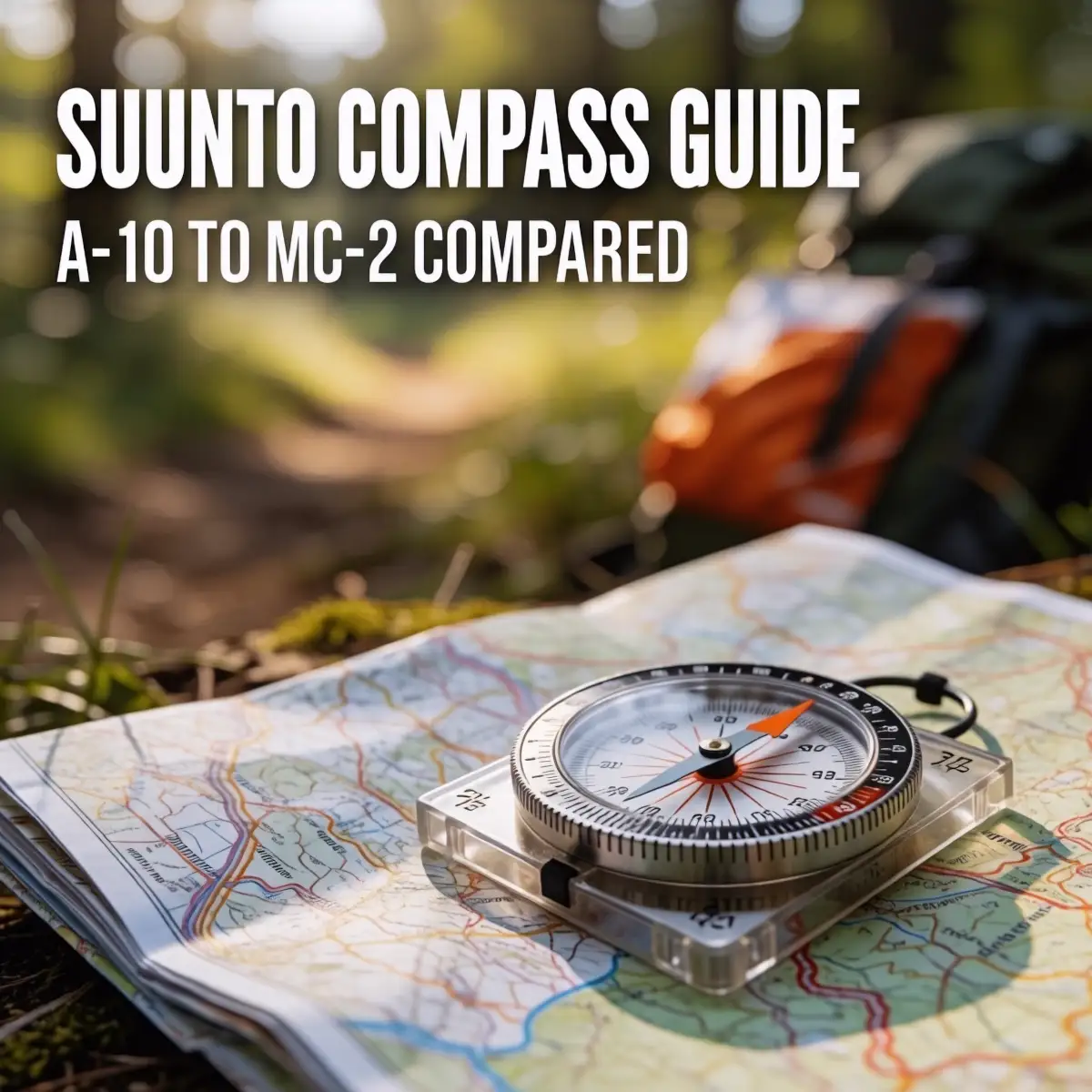

Brand Spotlight • Buyer’s Guide
Suunto Compasses: A Brand Spotlight and Buyer’s Guide
The gear that gets you home shouldn’t need a battery. Who Suunto is, what each model does, and which one is worth your money.
From the $20 pocket Clipper to the precision MC-2 mirror, we break down the whole Suunto lineup — so whether you hunt new country, backpack solo, or build a preparedness kit, you’ll know exactly which compass fits before you buy.
Your phone reads 4% and the fog just settled into the draw you were about to cross. The GPS you trusted all morning is now a paperweight, and the ridge you meant to walk back to has disappeared into gray. This is the exact moment a good compass earns every penny you spent on it.
We’ve sold outdoor and navigation gear for over two decades, and one brand comes up again and again when the conversation turns to compasses: Suunto. A Suunto compass is a piece of gear that does one job, does it without batteries, and keeps doing it for decades. That’s a rare thing to be able to say about anything you buy today.
This guide covers who Suunto is, what each model in our lineup actually does, and which one is worth your money. Whether you’re a hunter heading into new country, a backpacker who wants a real backup to the phone, or someone building out a preparedness kit, you’ll leave knowing exactly which Suunto compass fits.
Who is Suunto? The brand behind the needle
Suunto has been making compasses in Finland since 1936. The name comes from the Finnish word suunta, which means “direction” or, in navigation terms, “bearing.” That’s a fitting name for a company that has spent 90 years pointing people the right way.
The story starts with an engineer named Tuomas Vohlonen. He patented a liquid-filled compass design in 1935, and the following year it went into production as the wrist-mounted M-311. Liquid-filled compasses weren’t brand new, but Vohlonen’s was compact and stable enough to wear on your wrist, which was a genuine leap forward. According to Suunto’s own company history, that wrist compass was later adopted by the Finnish Army as the M-34.
Military work shaped the brand early. During World War II, Suunto built a compact liquid sighting compass, the M/40, for artillery officers who needed to measure an accurate bearing under pressure. That heritage of precision instruments built to survive hard field use still runs through the current catalog.
Today Suunto is based in Vantaa, Finland, and its products sell in more than 100 countries. The mechanical compasses carry a lifetime warranty. When a company backs a simple tool for life, it usually means the tool holds up, and in our experience these do. That kind of staying power is something we respect. It’s the same reason customers keep coming back to a shop that’s been in business for 23 years.
Baseplate vs. mirror: which Suunto compass type do you need?
Before you pick a model, you need to know the two families a Suunto compass falls into. Get this right and the rest of the decision gets easy.
A baseplate compass is the flat, clear, rectangular orienteering design most people picture. The needle sits in a rotating housing on a see-through plate you lay right on a map. It’s light, simple, and fast to use. For plotting a course on a topo map and walking a bearing, a baseplate does everything most people need.
A mirror compass adds a hinged lid with a mirror inside. Hold it up to eye level and you can sight a distant landmark and read the needle in the same glance. That folding lid also nearly doubles the length of the baseplate, which helps when you’re spanning a large map. It’s the more precise tool for taking a bearing on something far away.
Here’s the honest part most gear sites skip: for the way most hunters and outdoorsmen actually use a compass, a quality baseplate is plenty. When people ask us for the best compass for hunting, we usually point them at a solid baseplate, not the priciest mirror model. A good baseplate gets you accuracy within a couple of degrees, and a couple of degrees rarely matters when you’re navigating to a truck, a ridgeline, or a stand. Buy the mirror if you want the extra precision and the signal-mirror bonus. Don’t buy it because a review told you it’s the “serious” choice.
Tip: If this is your first compass and you’re not sure which way to go, start with a baseplate. You can always add a mirror model later, and a lot of people find they never need to.
Not sure which category fits your kind of trips? Our compass selection lays the Suunto models out side by side so you can compare at a glance.
The Suunto compass lineup, model by model
Here’s what we carry, what each one is built for, and who should look at it. Prices shift, so treat these as ballpark figures and check the current listing before you order.
| Model | Type | Rough price | Best for |
|---|---|---|---|
| A-10 | Baseplate | ~$20 | First compass, tight budget |
| A-30 | Baseplate | mid-$30s | Step-up map work |
| M-9 | Wrist | mid-$30s | Backup you always wear |
| Clipper | Thumb clip-on | ~$20 | Grab-and-go quick check |
| MC-2 Mirror | Mirror sighting | ~$70 | One compass to do it all |
| MC-2 USGS | Mirror sighting | ~$70 | Working off USGS topo maps |
Suunto A-10, the value baseplate
The A-10 is the entry point and, for a lot of people, the only compass they’ll ever need. It’s a straightforward baseplate with a fixed declination scale, clear ruler markings, and a fast-settling needle. At around $20, it’s the one we’d hand a new hunter or a scout leader without a second thought. Simple, honest, and reliable.
Suunto A-30, the step-up baseplate
The A-30 is the A-10’s slightly more capable sibling. You get more scale options and a bit more map-tool functionality for a small bump in price, usually in the mid-$30s. If you expect to do real map work and want a touch more than the bare basics, this is the sweet spot in the baseplate range.
Suunto M-9, the wrist and zipper-pull backup
The M-9 is a tiny wrist compass, and it’s not meant to be your primary navigation tool. Think of it as the compass you always have on you. Clip it to a pack strap or a jacket zipper and you can grab a quick bearing without digging out your main compass. As a backup, it’s cheap insurance.
Suunto Clipper, the clip-on quick reference
The Clipper is even smaller, a thumb-sized unit that clips onto a watch band, pack strap, or map edge. At around $20, it’s a grab-and-go reference for a fast direction check, and it pairs well with a full baseplate as your primary. Plenty of paddlers and day hikers run one just for the convenience.
Suunto MC-2 mirror, the do-it-all upgrade
The MC-2 is the one serious navigators reach for. It’s a mirror sighting compass with a clinometer for measuring slope angle, a set-and-forget declination adjustment, and the sighting precision that comes with the mirror lid. Reviewers at outdoor publications routinely call it a benchmark for land navigation. Outdoor Life, for one, treats it as the standard other compasses get measured against. It runs in the $70 range and is the model to buy if you want one compass to cover everything for the next couple of decades.
Suunto MC-2 USGS, the same compass, USGS map scales
The MC-2 USGS is the same tool with scales matched to standard USGS topographic maps. If you work primarily off USGS quads, this version saves you conversion headaches. If you don’t know what a USGS quad is, the standard MC-2 is the one you want.
Here’s one honest note. A lot of buyer’s guides push the Suunto M-3, the mid-tier baseplate with adjustable declination. It’s a fine compass, but we don’t stock it. Rather than steer you toward something we can’t ship, our take is simple: get the A-10 or A-30 if you want a value baseplate, and step up to the MC-2 if you want adjustable declination and mirror sighting in one package.
What is declination adjustment, and why it matters
Declination is the difference between true north (the actual North Pole) and magnetic north (where your compass needle points). Depending on where you stand in North America, that gap can be more than 15 degrees. A compass that lets you adjust for declination lets you work in true north directly, so you skip the error-prone mental math every time you take a bearing.
Nearly every experienced navigator will tell you the same thing: adjustable declination is the single most useful feature on a compass. It’s the difference between “set it once for the area you’re in and forget it” and “add or subtract degrees on every single reading, in the cold, under stress, hoping you did the arithmetic right.”
In our lineup, the MC-2 is the model with set-and-forget declination adjustment built in. The baseplate A-series uses a printed declination scale you account for manually, which works fine once you learn it but asks a little more of you in the field. If adjustable declination is the feature you care about most, the MC-2 is the Suunto compass to get.
How to actually use a compass in the field
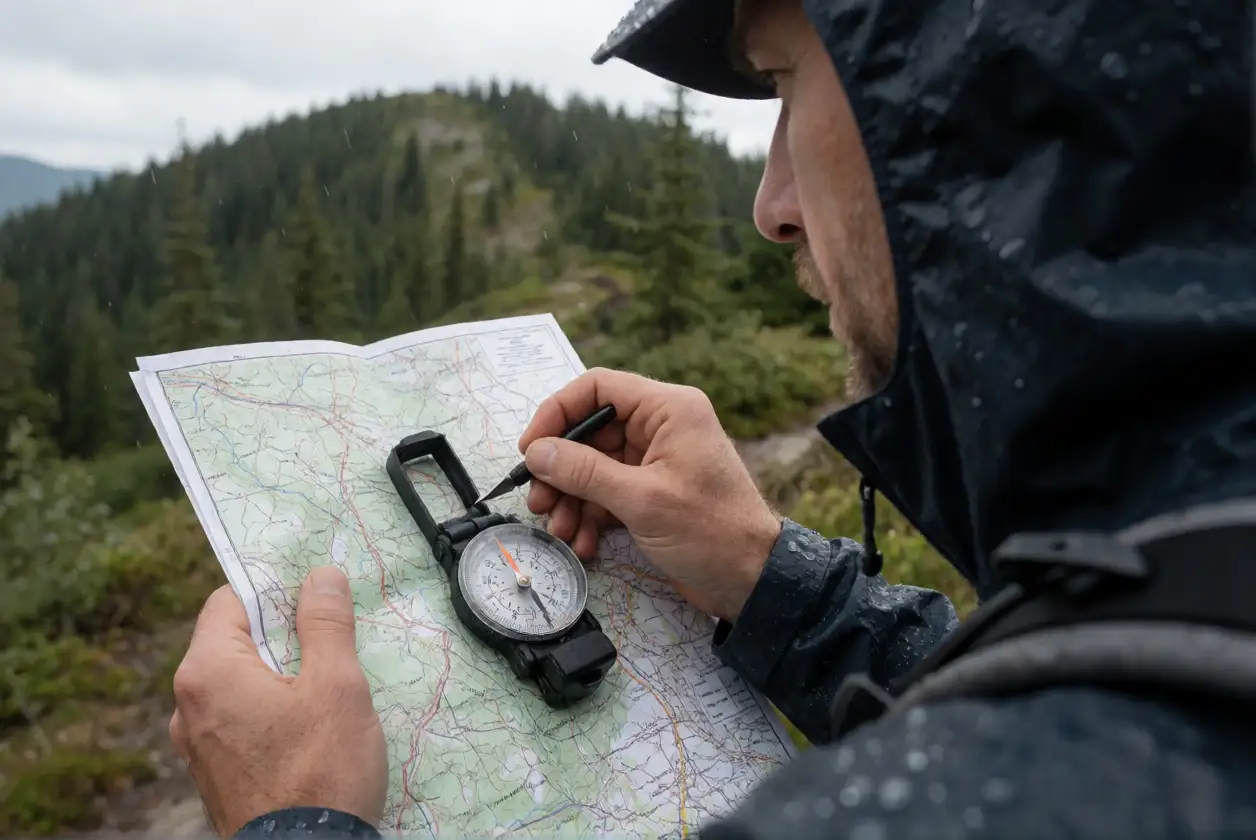
A compass only helps if you know the basics. Here’s the short version that covers most real situations.
- Take a bearing to a landmark. Point the compass’s direction-of-travel arrow at the object. Rotate the housing until the orienting lines frame the needle (“put red in the shed”). Read the bearing at the index line.
- Follow a bearing. With the bearing set, turn your whole body until the needle sits back inside the orienting arrow. Walk in the direction the travel arrow points, picking an intermediate landmark to aim for.
- Orient a map. Lay the compass on the map, line up the edge with your route, then rotate the map until the needle matches the map’s north. Now the terrain in front of you lines up with the paper.
- Keep it away from steel. Rifles, belt buckles, phones, truck hoods, and knives all throw a magnetic needle off. Step away from metal before you trust a reading.
The most important habit of all: carry a paper map to go with the compass. A GPS or phone is faster right up until the battery dies or the screen fogs over. A map and a Suunto compass are the backup that always works, which is exactly why they belong in the pack next to your first aid kit and other survival gear.
A quick scenario: Picture Dave, a Pennsylvania whitetail hunter who pushed into an unfamiliar block of state game land chasing a buck at last light. His phone died on the walk in. Because he had a $20 baseplate compass clipped to his pack and had shot a quick back-bearing that morning, he walked a straight line back to the logging road in the dark instead of circling in the timber for two hours. The compass cost less than a box of ammo. It saved his evening.
Which Suunto compass should you buy?
Here’s how we’d sort it, based on how you actually get outdoors:
- New to land navigation or on a budget: Start with the A-10. It does the core job and won’t overwhelm you.
- Want better scales and room to grow: Step up to the A-30. A little more capability for a little more money.
- Serious backcountry, hunting new ground, or you want one compass for life: Get the MC-2. Mirror sighting, a clinometer, and adjustable declination in one tool.
- You just need a backup on your body at all times: Add an M-9 or a Clipper. Cheap, small, always there.
Think about Karen, who started backpacking solo last spring and wanted a real safety net beyond her phone. She almost bought the most expensive mirror model because a forum told her to. Instead she picked up an A-30 and a Clipper for backup, spent an afternoon practicing bearings in a local park, and now covers new trails with confidence. The right compass isn’t the priciest one. It’s the one you’ll actually learn and carry.
Whichever way you lean, the full Suunto compass lineup is worth a look, and it sits right alongside the rest of our outdoor gear if you’re rounding out a pack.
The bottom line on choosing a Suunto compass
A Suunto compass is one of the few tools you can buy once and rely on for decades. The brand has spent 90 years, since 1936, doing basically one thing, and it shows in the build quality and the lifetime warranty on the mechanical models. That track record is why it keeps coming up when serious outdoorsmen talk navigation.
Three things to remember. First, most people are well served by a baseplate; buy the mirror MC-2 only if you want the extra precision and adjustable declination. Second, whatever model you choose, pair it with a paper map and learn to take a simple bearing, because the tool is only as good as the hand using it. Third, our honest picks from what we stock are the A-10 for value, the A-30 for a step up, and the MC-2 if you want one compass to do it all.
The gear that gets you home shouldn’t need a battery. When you’re ready, browse our compass selection and grab the one that fits how you get outdoors, then throw it in the pack before your next trip. And if you’re not sure which model is right for your kind of country, get in touch. We’re happy to talk it through.