
Surplus Buying Guide • May 2026
Why Buy Military Surplus Gear?
An honest look at the value, the tradeoffs, and what's worth your money.
After 23 years of buying, sorting, and selling surplus from a dozen different militaries, here's where the real value lives — and where surplus falls short.
The first time someone picks up a Czech military rucksack at our warehouse, the question is almost always the same: “Wait, this is how much?”
That reaction is the short answer to why people buy military surplus. The longer answer — the one that gets you the right gear instead of a closet full of items you'll never use — takes a little more unpacking. After 23 years of buying, sorting, and selling surplus from a dozen different militaries, we've seen what holds up, what doesn't, and where the real value lives.
This article covers it honestly. By the end, you'll know why people buy military surplus, where it genuinely outperforms commercial gear, and the tradeoffs no one selling it usually talks about.
What “military surplus” actually means
Military surplus is government-issued or contract-overrun gear sold off when a military updates its inventory, draws down a unit, or hits the end of a service life. The items have either been issued to soldiers and pulled from service, or they were produced under contract and never made it to the field at all.
That definition matters because it draws a line between surplus and three other things often confused with it:
- Military-style commercial gear is made to look like surplus but was produced for civilian sale. It's not surplus.
- Reproductions are modern recreations of surplus items, often for reenacting or collecting. Some are honest about it. Some aren't.
- “Tactical” branded products are commercial gear designed to evoke a military aesthetic. They may be excellent or terrible, but they're not surplus either.
When this article talks about military surplus, it means the real thing: gear that was actually made for a military, to military standards, and is now available to civilian buyers because the military doesn't need it anymore.
Why buy military surplus? Six reasons that actually hold up
The honest answer comes down to value, durability, uniqueness, history, supply, and a small environmental footprint. Each holds up under scrutiny — not all apply to every item, but together they explain why surplus has stuck around when most retail categories chase the next thing.
1. The value is real, and it's not just sticker price
A surplus Swiss wool blanket runs $25 to $40, depending on condition and production year. A comparable commercial wool blanket from a name-brand outdoor retailer sits at $80 to $150. Both will keep you warm. The surplus blanket will likely outlast the commercial one by a couple of decades.
That math repeats across most surplus categories. Field jackets, rucksacks, mess kits, wool sweaters, ponchos — the surplus version usually costs 30 to 70 percent less than the closest commercial equivalent and was built to a more demanding specification. Cost per use, the metric that actually matters, almost always favors surplus.
2. It's built to survive things civilian gear isn't designed for
Military procurement specs are written by people who assume the gear will be dragged through mud, frozen, soaked, and dropped from the back of a truck — and still need to work the next morning. Commercial gear is designed for users who expect to baby their equipment.
That difference shows up in details: redundant stitching at stress points, oversized hardware, reinforced bottoms on packs, double-thick fabric in high-wear zones. An Alice pack frame from the 1980s will outlast three generations of consumer-grade hiking packs. A surplus wool sweater holds up to thorns and brush that will shred a $200 fleece. The trade is weight and bulk, not durability.
Note: Built tough doesn't mean indestructible. Older surplus has often already absorbed decades of use before you bought it. The construction holds up. The rubber and elastic don't always — covered below.
3. You can find things that don't exist on the commercial market
Commercial outdoor brands tend to converge on a handful of designs and materials. Surplus gives you access to gear that's genuinely different.
Specific camouflage patterns are the obvious example. Czech Vz. 95 woodland, German Flecktarn, British DPM, Italian Vegetato, Swiss Alpenflage — each pattern was developed for a specific terrain, and most aren't available in any commercial product. Same for designs: a Swiss mountain rucksack, an Italian Alpini wool jacket, a Cold War-era Czech field shelter all reflect design decisions you don't see in modern outdoor gear.
If you want something that doesn't look like everyone else's REI haul, surplus is one of the few places you can still find it. Browsing our surplus by country of origin collection is the easiest way to see what each military got right.
4. There's real history in your hands
A Mosin-Nagant with a 1943 Izhevsk arsenal stamp was made during a specific year of a specific war. A Bundeswehr field jacket from a depot rebuild has been through a service life and a refurbishment. A Czech rucksack with original-issue markings carries the history of the unit it came from. Reference collections like the Smithsonian National Museum of American History catalog the same kind of arsenal-stamped service gear, which is part of why the markings matter.
This is the part of surplus that turns casual buyers into long-term collectors. Once you start noticing arsenal stamps, depot marks, and issue tags, the gear stops being just gear. It's a tangible piece of the people and events that shaped it. We treat surplus this way ourselves, and we expect our customers will too. For collectors leaning into this side of it, our military collectibles section is the deeper end of the catalog.
5. Supply is steadier than most buyers expect
The surplus market shifts, but it doesn't disappear. Through the 1990s and early 2000s, U.S. surplus dominated. As that supply tightened, European surplus filled the gap. NATO standardization cycled a lot of older gear out of national inventories, and the result was a multi-decade flow of Czech, German, British, Italian, and other European surplus onto the civilian market.
Today the steady categories are post-Cold War European militaries cycling through equipment updates, and post-conscription drawdowns in countries that ended mandatory service. The next decade will look different again. The point is: when one country's surplus dries up, another's tends to come online. Patient buyers find what they're looking for.
6. Buying it reuses gear that already exists
This isn't the loudest reason to buy surplus, but it's true. The environmental cost of producing a wool blanket, a steel mess kit, or a canvas rucksack was paid decades ago, in the original manufacturing run. Buying the surplus version reuses what already exists instead of triggering new production.
If sustainability matters to you, this is one of the cleanest ways to outfit yourself. If it doesn't, it's still a free benefit on top of the other five reasons.
Where surplus wins by category
Not every surplus category is a value play. Here's where the gear consistently delivers.
Clothing and outerwear
Field jackets (M65, German parka, Czech Vz. 95), wool sweaters, ponchos, and rain gear are some of the strongest surplus categories. The construction is honest, the materials hold up, and the prices are well below commercial equivalents. Sizing is the catch, covered below.
Bags, packs, and field gear
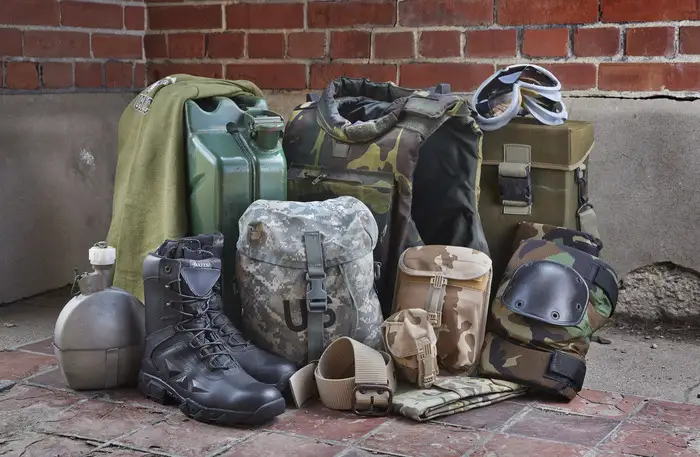
Easily the strongest surplus category overall. A surplus rucksack will run a third the price of a commercial pack with comparable durability, often more. Pouches, magazine bags, and load-bearing equipment fall in the same range. Our surplus field gear section is where most first-time surplus buyers get hooked.
Mess kits, canteens, and camp gear
Often built to outlast their commercial equivalents by decades. A stainless or aluminum surplus mess kit from the 1970s still works as well as it did the day it was issued. Backpackers and bushcrafters keep coming back to surplus for this category.
Footwear
A mixed bag. Modern surplus boots in good condition can be excellent — genuine leather, proper construction, prices below comparable commercial boots. Older surplus boots are riskier; rubber and adhesives don't last forever, and a 30-year-old boot may look fine and fail on the first hike. Inspect, ask questions, and lean toward newer surplus stock for footwear.
Collectibles
Different value calculation. With collectibles, provenance and condition matter more than function. A 1943 helmet with documented unit history is worth more than a 1985 helmet in the same physical shape because the first one tells a verifiable story. Buy collectibles for the history, not for utility.
Be honest: here's where surplus falls short
If you're searching for why buy military surplus, you're going to find plenty of articles that skip this section. We're not going to. Surplus has real downsides, and knowing them up front gets you a better outcome.
Sizing is unpredictable
Foreign militaries use foreign sizing. Even within a single country's surplus, sizes from different eras don't always match. Czech sizing differs from U.S. sizing. German sizing differs from Czech. Older Soviet-bloc surplus runs small in some categories and oddly large in others. Read measurements where listed, and expect to size up or down compared to what you'd buy commercially.
Age-related material breakdown is real
Rubber, elastic, foam, and adhesives have a service life. A 1970s rain poncho may have brittle rubber. A 1980s boot may have a sole that's about to delaminate. A wool blanket from any era will be fine. Soft goods, fabrics, leather, and metal age well. Anything with elastic, rubber, or foam needs to be inspected.
Fit and finish are functional, not boutique
Surplus is built to work, not to look pretty in a catalog. Seams are reinforced, not invisible. Stitching density prioritizes strength over neatness. Hardware is sturdy, not anodized. If you want a $400 outdoor jacket that looks like it came off a runway, surplus isn't your category. If you want something that won't quit, it is.
Reproductions and fakes exist
This applies most to collectibles, but it shows up in some clothing too. Modern reproductions of historic camouflage and uniforms are widely available, and not every seller is upfront about which is which. Reputable surplus dealers identify reproductions as such. Sellers who can't tell you anything about a piece's origin probably bought it from someone who couldn't tell them either.
Country variation is huge
Not all surplus is created equal. Swiss surplus is built like a tank and priced accordingly. Czech surplus is the value play — solid construction at lower prices than comparable Western European gear. German Bundeswehr surplus is consistently good quality. Romanian and other Eastern Bloc surplus is hit-or-miss; some pieces are excellent, some were thrown together at the end of a production run. Knowing which country produced a piece tells you a lot about what to expect.
How to buy surplus without getting burned
A few practical rules from 23 years of doing this:
- Buy from sellers who can answer questions. A surplus dealer should be able to tell you what era a piece is from, what country produced it, and what condition it's in. If the seller shrugs, look elsewhere.
- Read condition descriptions carefully. “Unissued” means never deployed to a soldier. “Very good” or “excellent” means used but in great shape. “Good” means honest service wear. “Field-grade” or “fair” means visible wear, possibly repairs. The terms mean specific things — learn them before you buy.
- Start with low-risk categories. Bags, packs, mess kits, and field gear are forgiving. Sizing matters less, age affects them less, and the upside is highest. Once you're comfortable, move into clothing and footwear, then collectibles.
- Ask before you buy on anything unclear. Photos and descriptions are the information you have. If you can't tell what era a piece is from or what condition the rubber is in, ask the seller. A good seller will give you a real answer.
- Pay attention to what's getting harder to find. Surplus that's been on the market for a decade tends to keep flowing. Surplus that's just started showing up may be a one-time lot. If you see something you actually want, don't assume it'll be there next month.
If you ever land on the other side of this and want to sell a piece or a collection, our Sell To Us program buys collections, lots, and individual items. We're buyers as well as sellers, which is part of how the supply keeps moving.
So why buy military surplus? The takeaway
Military surplus offers real value, real durability, and real history. It also has real tradeoffs. Sizing runs unpredictable. Age-related material breakdown is a thing. Fit-and-finish prioritizes function over polish. And reproductions occasionally try to pass as the genuine article. The buyer who understands both sides gets the most out of the category.
The short answer to why buy military surplus: it's gear built to a higher standard than most civilian equipment, often at a lower price than the commercial equivalent. It comes with a story you can verify. And it lasts long enough that the math almost always favors the surplus version. The reason to be careful: not every piece is worth what's being asked, and sizing and condition catch a lot of new buyers off guard.
If you're new to the category, start with field gear or a rucksack — low risk, high upside, and a good way to see what surplus quality actually feels like in your hands. From there, our military surplus catalog is organized by category and by country, so you can shop the way you actually think about it.
We've been buying and selling this stuff for 23 years. We've gotten a lot of it right and made our share of mistakes along the way. The honest take is that surplus is one of the best values left in outdoor and field gear — if you go in knowing what to expect.