
Knife History
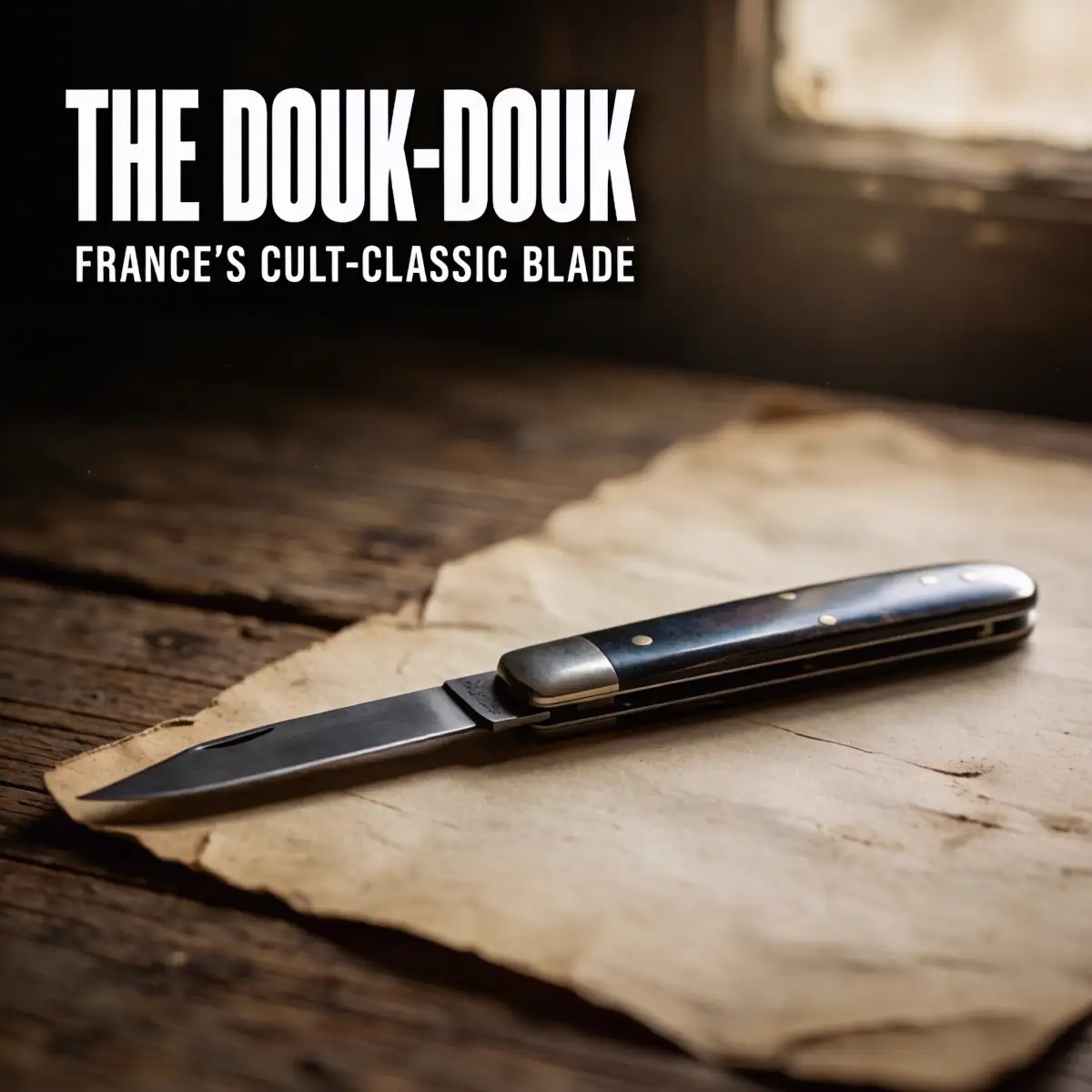
The Douk-Douk Knife: France’s Cult-Classic Folder
Named after a spirit of doom. Made by one family since 1929. Still going.
Six parts, folded steel, and a marketing blunder for the ages — how a failed colonial export became a French national icon, which variants collectors hunt, and whether one belongs in your pocket.
Here’s a marketing strategy you won’t find in any business school: name your product after a Melanesian spirit of doom and destruction, stamp its picture on the handle, and then act surprised when the people who believe in that spirit refuse to buy it.
That’s the true origin story of the Douk-Douk knife, and it gets better from there. Since 1929, this simple folded-steel pocket knife has gone from failed colonial export to French national icon. Along the way it picked up soldiers, farmers, electricians, and collectors as fans. It has been made by the same family, in the same town, on the same basic pattern, for nearly a century. The company’s response to almost 100 years of knife-industry innovation has been, in effect, a Gallic shrug.
We love surplus and historical gear precisely because of stories like this one. So grab a coffee. By the end of this article you’ll know what a Douk-Douk is, why it flopped and then didn’t, how to tell the variants apart, and whether one belongs in your pocket or your collection.
What is a Douk-Douk knife?
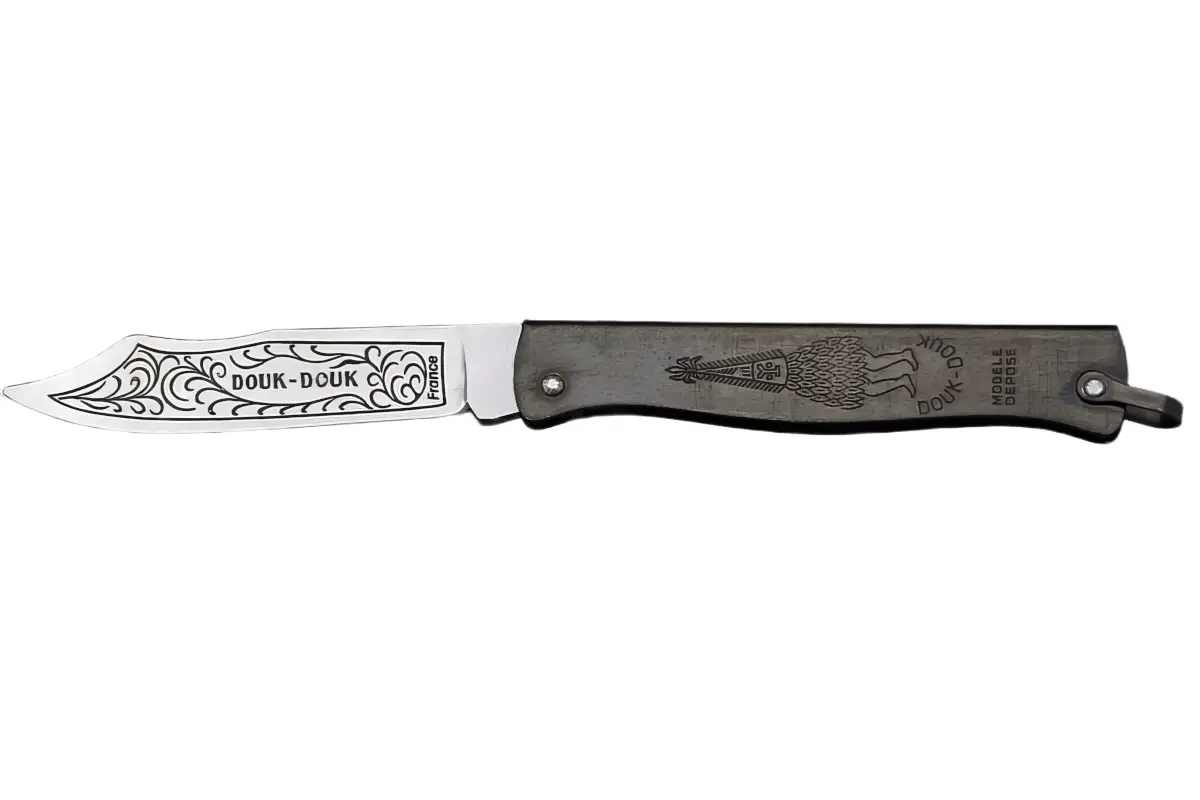
The Douk-Douk is a French slip joint pocket knife made by the M.C. Cognet cutlery firm in Thiers, France, since 1929. It uses a folded sheet-metal handle, a carbon steel blade with a “Turkish clip” scimitar profile, and just six total parts. The handle bears an engraving of the Duk-Duk, a Melanesian spirit figure that gave the knife its name.
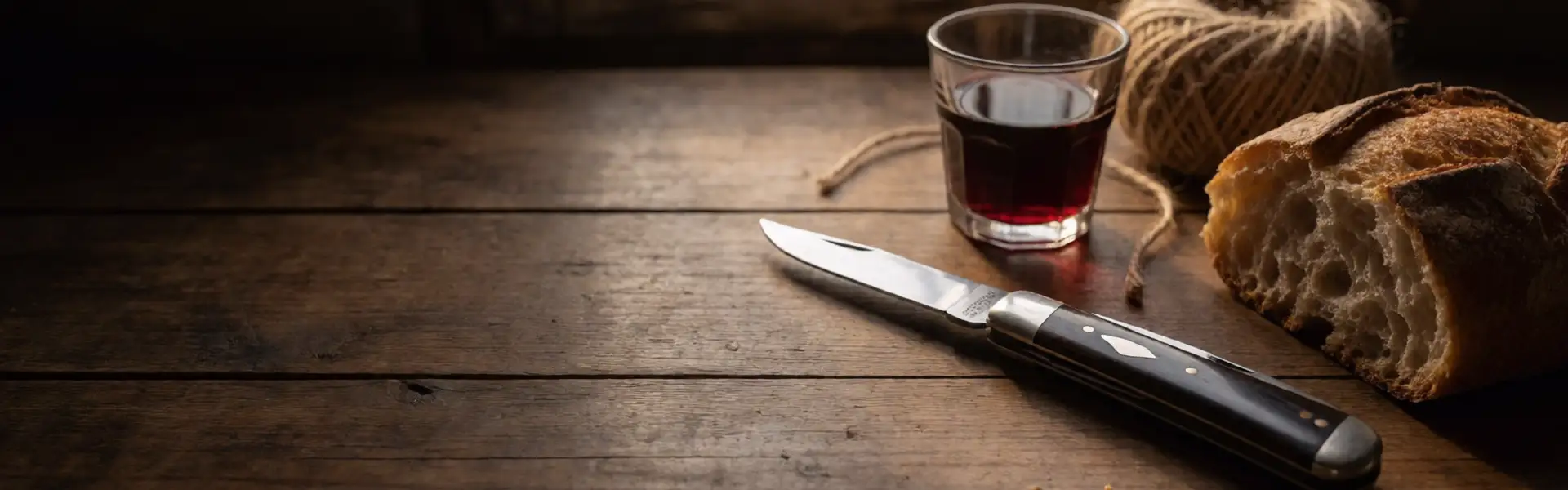
That’s the textbook answer. The practical answer: it’s a flat, light, stubbornly simple work knife that costs about as much as a range trip and refuses to go out of production.
A marketing flop named after a doom spirit
Picture Thiers, France, in 1929. The town has been making cutlery since the Middle Ages, and Gaspard “Gaston” Cognet is looking for an export product. France has colonies across Africa and Oceania, and colonial markets need affordable, sturdy knives. Gaston designs one: cheap to make, tough to break, easy to sharpen.
He needs a name and an image that will resonate in the Pacific markets he’s targeting. So, according to the family’s own telling, he flips through an encyclopedia in his workshop and lands on an illustration of the Duk-Duk, a spirit figure from Melanesian tradition. Exotic, striking, memorable. He has it engraved on the handle and ships the knives off to Oceania.
Sales were terrible. As his descendants later admitted in an interview with InsideHook, the people of Melanesia had understandable reservations about carrying a knife decorated with a spirit associated with doom and destruction. Imagine an overseas cutler trying to sell Americans a pocket knife with the Grim Reaper on the handle and you’ve got the general idea.
But here’s the twist that saved the company: the same knife found an enthusiastic market in French North Africa, where nobody had any particular feelings about Melanesian spirits and everybody appreciated a tough, affordable blade. The Douk-Douk became a working man’s staple across Algeria, Morocco, and beyond. The failed Pacific export became a Mediterranean success story, doom spirit and all.
There’s a lesson in there about product-market fit. There’s also a lesson about not naming things after gods of destruction, though the Cognet family would probably argue the name worked out fine in the end.
Six parts, zero pretension: how the Douk-Douk is built
Pick up a modern pocket knife and you might find pivot bearings, adjustment screws, pocket clips, thumb studs, and a locking mechanism with its own patent portfolio. Pick up a Douk-Douk and you find six parts:
- A carbon steel blade with a Turkish clip point (that gentle scimitar sweep)
- A handle folded from a single piece of sheet metal
- A backspring
- Two rivets
- A bail (the metal loop for a lanyard)
That’s the whole knife. No scales, no liners, no screws. The handle on the classic model is ferro-blackened, a heat treatment that gives it that deep gunmetal finish, and decorated with the famous spirit engraving and acid-etched arabesques on the blade.
The steel: soft, honest, and easy to love
The blade is high carbon steel hardened to roughly 50-53 on the Rockwell scale, per the specs published by Cognet and its retailers. If you follow knife steels, that number probably made you wince. Modern super steels run 59-62 and hold an edge through a week of hard use.
Here’s the thing, though: softer steel sharpens fast, on anything. A worn whetstone, the bottom of a coffee mug, a smooth river rock in a pinch. The Douk-Douk was built for people who used a knife all day and touched up the edge as part of the routine, the same way you’d wipe down a rifle after a range session. It takes a genuinely keen edge in about a minute of work.
The trade-off is honest: carbon steel rusts if you ignore it, and the edge needs regular attention. Wipe it down, oil it occasionally, and it develops a gray patina that collectors consider half the charm. Neglect it in a damp shed and it will punish you, same as any carbon steel blade.
One more honest note: the Douk-Douk is a slip joint. There’s no lock, just a strong backspring holding the blade open. Reviewers consistently describe that spring as much stiffer than a Swiss Army knife’s, but it’s still not a locking folder, and the flat metal handle isn’t cushioned. This is a knife for cutting cordage, food, and packaging, not for hard stabbing or prying. Know what you’re buying.
From the colonies to the Casbah: a complicated history
Like a lot of the pieces in our military surplus collectibles category, the Douk-Douk carries history that isn’t all pleasant, and we’d rather tell it straight than pretend otherwise.
The knife’s popularity in North Africa meant it was everywhere when the Algerian War broke out in 1954. During that conflict, the Douk-Douk acquired a grim reputation: it was inexpensive, easy to conceal, and, according to the documented history, sometimes converted into a crude fixed blade by hammering the sheet-metal handle shut behind the bolster. A peasant’s cheese-and-rope knife became, for a period, a knife associated with violence on both sides of an ugly war.
We’re not going to dwell on the details, and we’d encourage you to be skeptical of sellers who romanticize them. The honest framing is the one the knife’s own history supports. The Douk-Douk was designed as a working tool and spent most of its century slicing bread and trimming rope. It passed through one of the 20th century’s harder chapters the way tools tend to: because it was there. If you collect French military and colonial gear, that context is part of what you’re holding. Respect it, understand it, and don’t invent stories beyond it.
By the way, if you find this corner of history interesting, our guide to why people buy military surplus digs into the broader value case for owning gear with a past.
Douk-Douk variants and sizes worth knowing
For a knife with six parts, the Douk-Douk family tree has some interesting branches. Cognet built regional variants for different colonial markets, and they’re all still recognizable today:
- The classic (Sorcier): Blackened handle, Duk-Duk spirit engraving, carbon steel blade. The one everybody pictures.
- El Baraka: Nickel-plated handle stamped with the Cross of Agadez, built for the North African market. The name means “the blessing”, a friendlier pitch than a doom spirit, you have to admit.
- Tiki: Made for Polynesia, with a tiki figure in place of the Duk-Duk.
- L’Écureuil (the Squirrel): A spear-point blade and squirrel engraving, aimed at mainland France and French Canada.
Sizes run from a small pocket model around 6″ overall up through the standard sizes near 8″, plus an oversized version collectors nickname “the Giant.” Modern production adds stainless steel and colored-handle options, but the construction hasn’t changed: same six parts, same folded handle, same family running the shop in Thiers.
As of this writing, our own case covers most of that family tree: the bright-chrome Le Chromé dress version of the classic, the El Baraka folder and its compact pocket version, and Cognet’s upscale Le Thiers in polished stainless. (And yes, there’s a morale patch for the true believers.)
Vintage Douk-Douk knives: what collectors look for
Because the design never changed, dating a vintage Douk-Douk knife takes some homework. Collectors look at the blade stamps, the style of the engraving, and the handle finish. A few pointers if you’re hunting one:
- Condition beats age. A clean 1970s example with crisp engraving is a better buy than a rusted-out older piece, unless provenance is documented.
- Expect patina, not perfection. Gray carbon steel is normal and desirable. Active red rust and pitting on the edge are not.
- Check the spring. The backspring should snap the blade open and shut with authority. A lazy spring means wear or a bent handle.
- Watch for hammered handles. Given the wartime history above, some old examples turn up with the handle pinched shut. That’s a historical artifact to some collectors and damage to others, but either way it should be disclosed and priced accordingly.
And a friendly note from the buying-and-selling side of our shop: if you’ve inherited a drawer of old French knives or a broader militaria collection, our Sell To Us program is always happy to take a look.
Douk-Douk vs. Opinel: the French pocket knife question
Ask about French pocket knives online and two names dominate: Opinel and Douk-Douk. (Laguiole is the third, but that’s a story about steak knives and trademark chaos for another day.) Both are century-old peasant knives that cost very little and inspire irrational devotion. Here’s the honest comparison:
| Douk-Douk | Opinel No. 8 | |
|---|---|---|
| Born | 1929, Thiers | 1890, Savoie |
| Handle | Folded sheet metal | Beechwood |
| Lock | None (stiff slip joint) | Virobloc twist collar |
| Carry | Extremely flat and light | Rounder, bulkier |
| Character | Doom spirit engraving | Crowned hand logo |
The Opinel is more comfortable for long cutting sessions and has a lock. The Douk-Douk is flatter in the pocket, tougher in construction, and considerably better at starting conversations. Plenty of enthusiasts eventually own both, because at these prices there’s no reason to choose.
Is a Douk-Douk knife worth buying today?
Short answer: if you like knives with a story, yes. Read any honest Douk-Douk knife review, including this one, and the verdict comes back the same: buy it for what it is.
What you’re getting is a light, slim, sharp working blade with 95+ years of continuous production behind it, usually for somewhere in the $25-$50 range depending on model and where you shop — our current Douk-Douk lineup sits right in that neighborhood. What you’re not getting is a modern one-hand-opening, locking EDC folder. Two-hand opening, no lock, no pocket clip, carbon steel that asks for basic care. If your daily carry needs lean modern, browse our fixed-blade and folding knives and you’ll find plenty of options with locks and clips.
But if you appreciate tools that have earned their reputation the long way, the Douk-Douk is one of our favorite recommendations in the “history you can hold” department. It pairs naturally with the kind of gear in our French Army surplus collection, and it makes a memorable gift for the collector who already owns everything sensible.
Common Douk-Douk questions, answered
Where are Douk-Douk knives made?
Every Douk-Douk is made in Thiers, France, by the Cognet family cutlery firm, which has produced the knife continuously since 1929. The company’s roots in Thiers cutlery go back to 1835. There are no licensed overseas versions; if it’s a real Douk-Douk, it came from Thiers.
Does the Douk-Douk knife lock?
No. The Douk-Douk is a slip joint: a stiff backspring holds the blade open, but there’s no locking mechanism. The spring is noticeably stronger than most traditional slip joints, which is part of the knife’s reputation, but treat it like any non-locking folder and keep pressure off the spine.
What size Douk-Douk should I buy?
The standard model, around 8″ overall when open, suits most hands and most tasks. The smaller pocket version disappears in a coin pocket and makes a tidy backup blade. The oversized “Giant” is mostly a collector’s piece. When in doubt, start with the standard; it’s the size the knife’s reputation was built on.
The knife the doom spirit couldn’t kill
Let’s recap what a century of Douk-Douk knife history teaches us. A French cutler named a knife after a spirit of destruction and tanked his own product launch. The knife survived anyway, on the strength of a design so simple there was nothing to break: six parts, folded steel, carbon blade, done. It fed and worked and occasionally fought its way through the French colonial world, and today the same family still makes it in the same town while the knife industry sprints past chasing the next super steel.
There’s something to admire in that. Most gear we cover chases improvement. The Douk-Douk decided in 1929 that it was finished, and 97 years of customers have agreed.
We don’t always have Douk-Douks on the shelf, French surplus and French cutlery come through our warehouse in waves, but our knife selection always has something with a story behind it. Browse the collection, and if you’re hunting for something specific, get in touch. After 23 years of buying interesting gear, we’ve learned that the odd stuff is usually the good stuff.