

American Surplus Classics • May 2026
Debunking M1 Carbine Myths: What the Record Actually Shows
Eighty years of tall tales, examined against the actual ballistics, production records, and combat history.
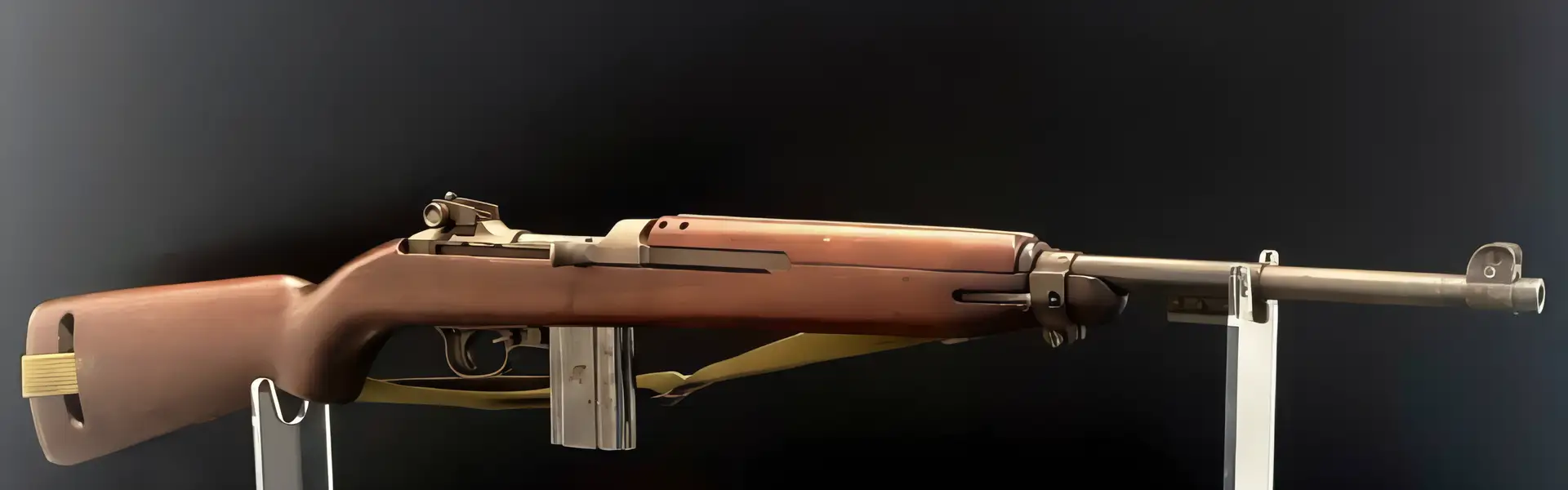
Few American firearms have collected as many tall tales as the M1 Carbine. The same handful of stories still circulate at gun shows, in YouTube comments, and on every milsurp forum. After 23 years buying and selling them, here's what the record actually shows, and what to ignore.
Few American firearms have collected as many tall tales as the M1 Carbine. Eighty years after the last GI rolled one off a parts cart in the Pacific, the same handful of M1 Carbine myths still circulate at gun shows, in YouTube comments, and across every milsurp forum that's ever existed.
Some of those stories have a grain of truth. Most don't. And the gap between what the M1 Carbine actually is and what people say it is has cost a lot of collectors money on bad purchases and steered a lot of new owners away from one of the most enjoyable surplus rifles ever fielded.
We've been buying, selling, and handling M1 Carbines for over 23 years. Here's what the record actually shows. If you're shopping for one or trying to evaluate the one you already own, our military surplus collection and our dedicated M1 Carbine landing page are both good places to start, once you know what's true and what isn't.
Myth 1: “The .30 Carbine round couldn't penetrate winter clothing”
This one comes straight out of Korea. The story goes that GIs at the Chosin Reservoir in the winter of 1950 reported their M1 Carbines failing to drop Chinese soldiers wearing heavy padded coats. The round, the legend says, just bounced off.
Here's what we actually know. The .30 Carbine cartridge fires a 110-grain bullet at roughly 1,990 feet per second from the carbine's 18-inch barrel. That produces around 967 ft-lbs of muzzle energy, comparable to a hot 9mm Luger out of a carbine and more than a .357 Magnum revolver. It penetrates roughly 10–12 inches in standard ordnance gelatin and passes through several layers of heavy clothing without meaningful loss of velocity at typical engagement distances.
What actually happened at Chosin was a combination of factors that had nothing to do with the round's penetration capability:
- Temperatures dropped to 30 below zero, and lubricants in carbines and magazines congealed, causing feeding and cycling issues.
- Magazine springs lost tension in the cold, producing failures to feed.
- Soldiers were exhausted, ammunition was rationed, and shot placement suffered under combat stress at close range against massed infantry.
- Some of the “bounced off” reports were almost certainly hits that didn't immediately incapacitate, a known limitation of any handgun-class cartridge then and now.
A U.S. Army Operations Research Office study published in 1951 on small-arms performance in Korea found the carbine's actual ballistic performance unchanged in cold weather. The mechanical issues were real. The “couldn't penetrate a padded coat” claim never held up to testing.
The .30 Carbine is not a magnum, and it was never designed as a long-range battle round. It was meant to give support troops more reach and capability than a 1911, and it did that.
Myth 2: “The M1 Carbine and M1 Garand fire the same ammunition”
This one trips up a surprising number of new collectors, and we've taken phone calls from customers asking why their .30-06 won't chamber in their carbine.
These are completely different cartridges. They share almost nothing except the word “thirty” and a country of origin:
- .30 Carbine: 110-grain bullet, .308″ diameter, straight-walled rimless case. Designed for the M1 Carbine and a few civilian revolvers and pistols.
- .30-06 Springfield: 150–180 grain bullet, .308″ diameter, bottleneck case. The M1 Garand's cartridge and a full-power rifle round.
A .30 Carbine round looks like a stretched-out pistol cartridge. A .30-06 round looks like a proper rifle cartridge. Side by side, the difference is obvious, but in mixed surplus ammo cans or poorly labeled lots, mistakes happen. Always verify the headstamp.
If you're shopping for ammunition, browse our rifle ammo selection and check the caliber filter carefully before you order.
Myth 3: “M1 Carbines are inaccurate”
Walk into a gun show and someone will tell you the M1 Carbine is a “spray and pray” rifle that can't hit a barn door past 50 yards. That's a myth built on a misunderstanding of what the rifle was for.
The M1 Carbine was designed to engage targets out to 300 yards, with practical effective range generally considered 200 yards for most shooters. A military-acceptance carbine in good condition will hold 3–4 MOA at 100 yards with surplus ball ammo, roughly a four-inch group. Match-grade .30 Carbine in a tuned rifle can shrink that further.
For comparison:
- An issue M1 Garand was held to about 4 MOA acceptance standards.
- An issue M16A1 was specified at about 5 MOA with ball ammo.
- A well-tuned bolt-action sporting rifle in .308 might shoot 1–2 MOA.
The carbine wasn't built to win benchrest matches. It was built to be light, fast-handling, easy to shoot, and effective inside 200 yards. Within that envelope, it does the job, as the 6.1 million GIs who carried it can attest.
What people often mistake for “inaccuracy” is usually one of three real issues:
- A worn rifle. Many surviving carbines have been shot hard, rebuilt multiple times, or had key parts (barrels, op rods, slides) swapped during arsenal rebuilds.
- Bad magazines. Magazine condition affects how the round presents to the chamber, and on the M1 Carbine that affects accuracy more than people realize. Quality replacements from our M1 Carbine magazines selection solve most of these problems immediately.
- Bad ammo. A lot of surplus .30 Carbine on the market is old, has been improperly stored, or comes from manufacturers that never produced consistent ammunition.
Sort those out, and most issue carbines will surprise you.
Myth 4: “The M1 Carbine is select-fire”
This is the M1-vs-M2 confusion, and it comes up constantly.
The M1 Carbine is semi-automatic only. One trigger pull, one round.
The M2 Carbine is select-fire; it can be switched between semi-auto and fully automatic, with a rate of fire around 750–775 rounds per minute. The M2 was introduced in 1944 to give the carbine more firepower in close combat, and externally it looks nearly identical to an M1 except for the selector switch and a few minor parts.
For collectors, this distinction matters in two ways:
- Legal status. M2 Carbines are NFA-regulated machine guns. Owning one requires the appropriate ATF paperwork, and transferable examples are rare and expensive. If you're interested in NFA items, work with a licensed Class 3 dealer who knows the process.
- Parts confusion. Some M1 Carbines have had M2 parts installed during rebuilds or by previous owners. M2 fire control parts in a semi-auto M1 receiver can create legal complications. If you're buying an M1 Carbine, particularly one that's been rebuilt, have a knowledgeable buyer or gunsmith verify the fire control group is correctly configured. Reference parts from our M1 Carbine parts catalog can help you spot what's correct.
For most buyers, an issue semi-auto M1 Carbine is exactly what you want, and what you'll find on the surplus market.
Myth 5: “Only Winchester made them”
Winchester developed the M1 Carbine and was the first to produce it, but they were far from the only manufacturer. Wartime production was spread across ten primary contractors, including several companies that had never made firearms before:
- Winchester
- Inland Manufacturing (a division of General Motors)
- Underwood (the typewriter company)
- Rock-Ola (the jukebox company)
- IBM
- Quality Hardware
- National Postal Meter
- Standard Products
- Saginaw Steering Gear
- Irwin-Pedersen / Saginaw S’G’
Inland produced more carbines than any other manufacturer, roughly 2.6 million of the 6.1 million made, but each maker's production is collectible in its own right. Some manufacturers (Irwin-Pedersen, Rock-Ola) produced relatively few carbines and command premium prices today.
For collectors, this matters because:
- Manufacturer markings affect value significantly.
- Mismatched parts (a Winchester receiver with an Inland barrel) are common after decades of arsenal rebuilds and depot maintenance.
- Original, all-correct examples from any maker are increasingly hard to find.
When inspecting a potential purchase, look for the manufacturer stamp on the receiver, check the barrel marking, and compare both to standard reference materials. (The Springfield Armory National Historic Site is the standard institutional reference for U.S. military small-arms development, including the carbine program.) If the parts don't match the receiver maker, you have a rebuild, which is still a perfectly good shooter, just not a collector-grade original.
Myth 6: “M1 Carbines are unreliable”
The carbine has a reputation for being finicky. That reputation isn't entirely undeserved, but it's also largely a magazine and maintenance problem rather than a rifle problem.
The carbine's gas system is short-stroke tappet, a clever, compact design that works reliably when clean, properly lubricated, and fed good ammunition through good magazines. Where it gets tricky:
Magazines are the most common failure point. Original GI 15-round and 30-round magazines vary widely in condition after 70-plus years. Weak springs, worn feed lips, and bent bodies cause most of the feeding problems people blame on the rifle. New-production magazines from reputable manufacturers (Korean War-era spec) have largely solved this for current owners.
Op rod springs and slide condition matter. A worn op rod spring or a buggered slide can produce short-stroke cycling, especially with weaker ammunition. These are inexpensive parts to replace and dramatically improve reliability.
The gas piston gets gummed up. The piston is a small steel cup screwed into the underside of the barrel. After decades, it can carbonize shut. Proper cleaning and occasional removal (when reaming permits) keeps it functioning.
Ammo quality varies. Cheap or old surplus .30 Carbine can produce inconsistent pressures. Modern production ammunition from major manufacturers feeds reliably in most carbines.
A clean carbine with quality magazines and good ammunition is no less reliable than any other semi-auto rifle of its era. Take care of it, and it'll run.
Myth 7: “Universal and Plainfield carbines are the same as a GI M1 Carbine”
This one costs new collectors real money.
After WWII, several commercial manufacturers produced civilian rifles styled after the M1 Carbine. The most common were Universal, Plainfield, Iver Johnson, and a handful of others. These rifles look superficially like a GI M1 Carbine but:
- Use different internal parts that aren't always interchangeable with GI components.
- Have inconsistent build quality, some are decent, many are notably worse than GI production.
- Are often incompatible with GI magazines, or require modification to feed reliably.
- Have substantially lower collector value than even a rebuilt GI carbine.
A worn but real GI M1 Carbine is a better buy than a like-new Universal in almost every case. If you're shopping the used market and the price seems too good to be true for an “M1 Carbine,” check the receiver markings carefully. Real GI carbines will be stamped with one of the wartime manufacturer names listed above. Commercial copies will say “Universal,” “Plainfield,” “Iver Johnson,” or similar.
Modern production by Auto-Ordnance, Inland Manufacturing (the modern company, not the GM division), and Fulton Armory builds new-production M1 Carbines that are generally well-regarded, but those are distinct from the postwar commercial copies that gave the platform a reputation for being hit-or-miss.
Myth 8: “Only rear-echelon troops carried it”
The carbine was originally designed to replace the 1911 pistol for support troops: mortar crews, machine gunners, radio operators, drivers, officers. The idea was to give those soldiers more reach and capability than a sidearm without the weight of a full-power battle rifle.
But the carbine ended up in combat in every theater of WWII and Korea, often with frontline infantry who chose it over the heavier M1 Garand or who picked one up after losing or trading their issued rifle. Paratroopers carried the folding-stock M1A1 variant. Marines used carbines extensively in the Pacific. SOE and OSS personnel deployed with them across Europe and Asia.
The “rear area only” narrative undersells the carbine's actual combat history. It saw more frontline use than any other intermediate-power rifle of its era.
What to check before believing the next M1 Carbine myth
If you're considering an M1 Carbine, here's a quick checklist for evaluating one:
- Receiver markings: Real wartime manufacturer (Winchester, Inland, Underwood, Rock-Ola, IBM, Quality, National Postal Meter, Standard Products, Saginaw, Irwin-Pedersen).
- Parts match: For collector grade, parts should match the receiver maker; for shooters, mismatched parts are acceptable but affect value.
- Bore condition: Look for sharp rifling, no significant pitting, and a clean throat.
- Headspace: Have a gunsmith check headspace before firing an unknown carbine; 70-plus years of use takes its toll.
- Stock condition: Original wartime stocks command premium; replacement stocks are common and acceptable for shooters.
- Magazine quality: Plan to replace your magazines with current-production examples unless the included GI mags test reliably.
The pattern across most M1 Carbine myths is the same: someone judged the rifle against the wrong benchmark, then passed the complaint on without checking. Treat any “everyone knows” claim about this rifle with the same skepticism you'd bring to any unsourced firearms wisdom.
We periodically have M1 Carbines, magazines, and parts come through inventory. Our surplus collectibles category is where historical pieces with real provenance get listed when they're available, and the M1 Carbine landing page pulls everything we currently stock for the platform into one view.
The bottom line
The M1 Carbine isn't a magnum, isn't a sniper rifle, and isn't a battle rifle. It's exactly what it was designed to be: a light, handy, easy-shooting semi-automatic with effective range out to 200 yards, chambered for a cartridge that splits the difference between pistol and rifle power. Inside its envelope, it does its job, and it's been doing it for 85 years.
Most M1 Carbine myths trace back to people expecting the rifle to be something else: a .30-06, a Garand, a modern carbine. Judged against what it actually is, the M1 Carbine is one of the most enjoyable, historically significant, and collectible American firearms ever fielded.
If you're hunting for one, take your time, learn the markings, and don't let a story at a gun show steer you toward a bad purchase. And if you've got a carbine you're considering selling, our Sell To Us program buys collections and individual pieces from customers regularly. Good ones don't come through as often as they used to, and we're always interested in a look.
Whatever you decide, the carbine deserves better than the tall tales. Eighty years in, the record speaks for itself.