
Gun Parts Guide • June 2026
Why You Want a Thread Adapter for Your Firearm
Your suppressor won't thread on. Here's the small part that bridges the gap — and the honest trade-offs nobody mentions.
You finally picked up a suppressor, or a muzzle brake you've been eyeing for months. You go to thread it on, and it won't start. The threads don't match. A thread adapter is what bridges that gap — here's what it does, why you'd want one, and when you shouldn't.
You finally picked up a suppressor, or maybe a muzzle brake you've been eyeing for months. You go to thread it onto your rifle, and it won't start. The threads don't match. Now what?
This is one of the most common questions we get from customers who own more than one firearm. Your AR-15 has one thread pitch, your .308 hunting rifle has another, and the can you bought is cut for something else entirely. A firearm thread adapter is the small part that bridges that gap, and for a lot of shooters it's the difference between one suppressor that fits everything and a drawer full of mismatched parts.
We've sold parts and accessories for over two decades, and the thread adapter question comes up constantly. So here's the straight story: what a thread adapter actually does, the real reasons you'd want one, the honest trade-offs nobody likes to mention, and how to pick one that won't cause you problems down range.
What is a thread adapter?
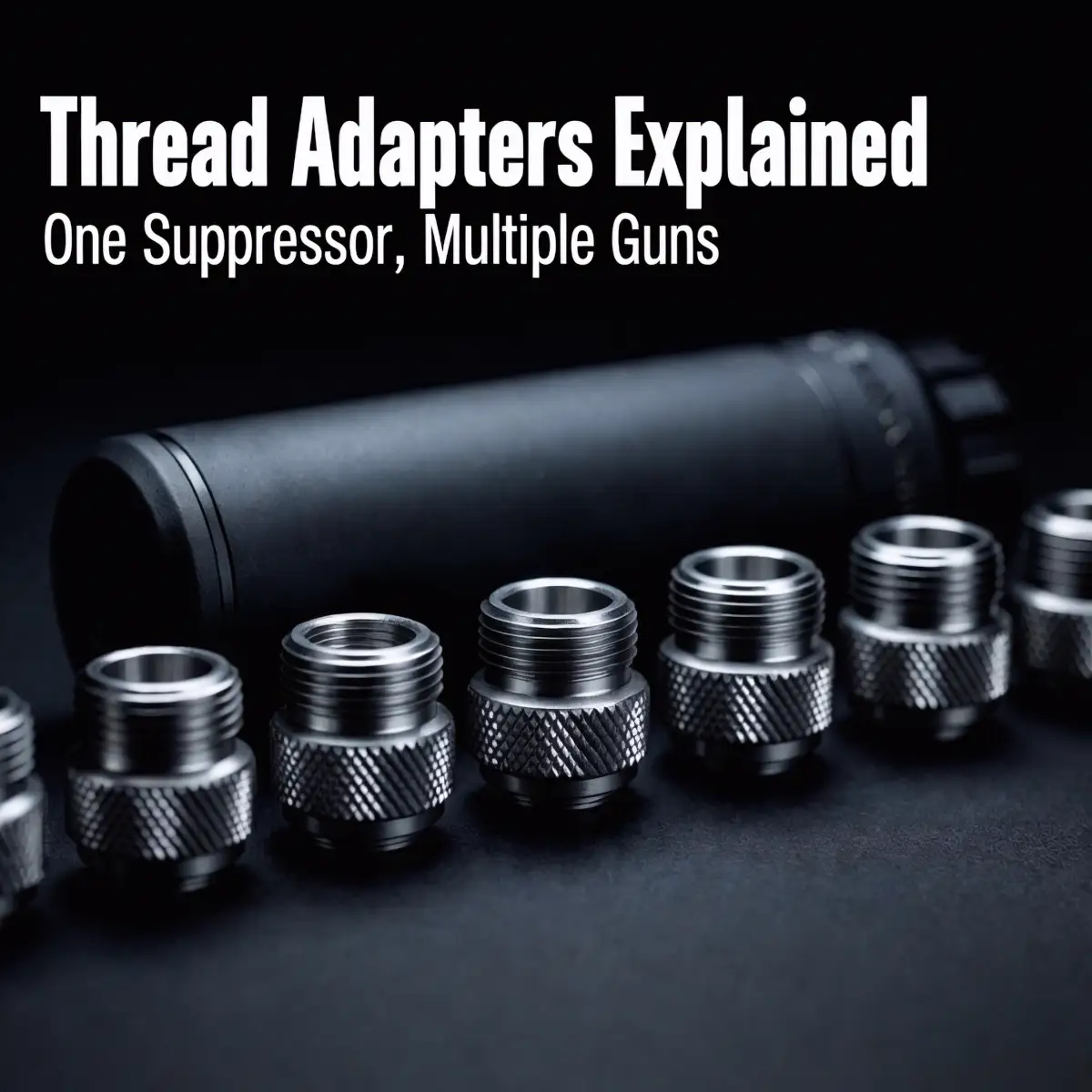
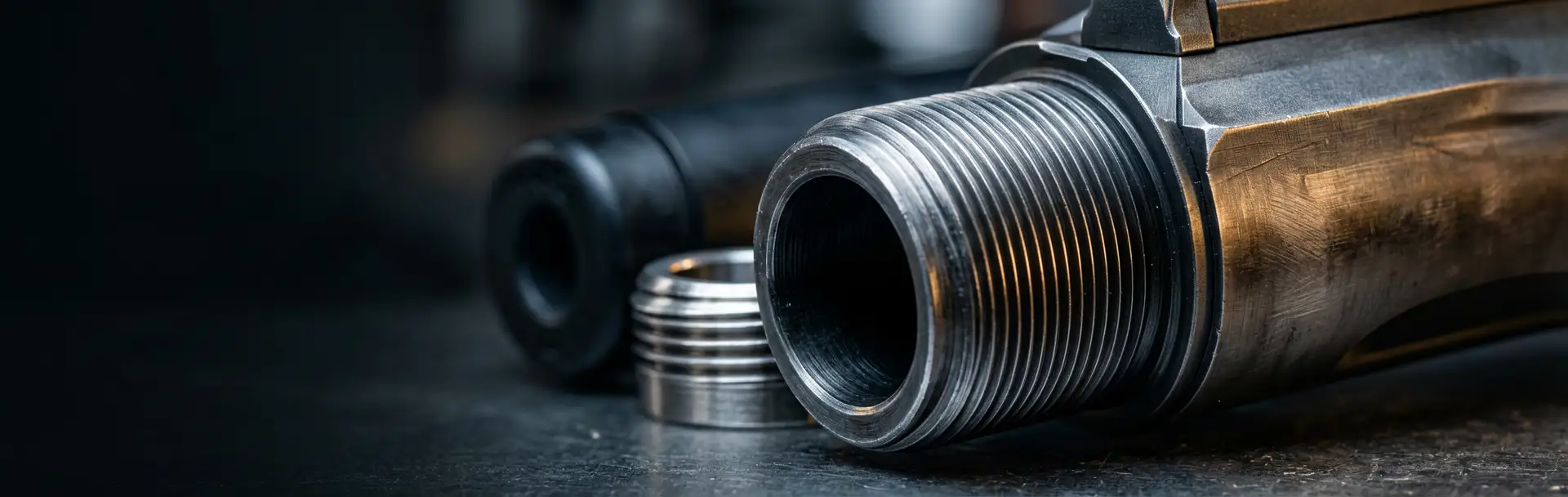
A firearm thread adapter is a small machined piece that converts your barrel's muzzle threads from one thread pitch to another. One end threads onto your barrel (the female side), and the other end carries different threads (the male side) for your suppressor or muzzle device. It lets you mount gear that wouldn't otherwise fit.
That's the whole job. It sits between your barrel and your muzzle device, translating one thread standard into another so the two can talk to each other.
The most common example by far is a 1/2x28 to 5/8x24 adapter. That converts the 1/2x28 threads found on most .223/5.56 barrels to the 5/8x24 standard used by .30-caliber suppressors and muzzle devices. If you've got an AR-15 and a .30-cal can, that one adapter is probably what you're looking for — you'll find our full range in the thread adapters section.
Note: A thread adapter is just a part, not a regulated item. The suppressor it might attach to is an NFA item that requires a tax stamp and federal paperwork. The adapter itself ships like any other muzzle accessory, subject to normal state rules.
A quick primer on barrel thread pitch
Before you buy anything, it helps to understand why thread mismatches happen in the first place. Barrel threads are described by two numbers: the diameter and the pitch. With 1/2x28, the “1/2” is the thread diameter in inches and the “28” is the number of threads per inch (TPI). That's an imperial measurement.
Plenty of pistols, especially European designs, use metric threads instead. A common one is M13.5x1 LH, where the measurements are in millimeters and “LH” means left-hand thread. Mixing those standards up is exactly how people end up with a muzzle device that won't seat.
Here's a quick reference for the pitches you'll run into most often:
| Platform / caliber | Common thread pitch |
|---|---|
| AR-15 (.223 / 5.56) | 1/2x28 |
| .30-cal rifles (.308, 6.5, magnums) | 5/8x24 |
| 9mm pistols (U.S. pattern) | 1/2x28 |
| 9mm pistols (many European) | M13.5x1 LH |
| .40 S&W / 10mm | 9/16x24 |
| .45 ACP | .578x28 |
| .22 LR | 1/2x28 |
A few takeaways. Most 5.56 rifles and a lot of 9mm pistols share the same 1/2x28 thread, which is why a single .30-cal can with the right adapter can cover a surprising chunk of a typical safe. And if you're not sure what your barrel is cut for, that's a question worth answering before you spend a dollar, which we'll come back to near the end.
Why use a thread adapter? The real benefits
So why bother with an adapter instead of just buying gear that already fits? For most shooters, it comes down to five practical reasons:
- One suppressor across multiple firearms. This is the big one. A single .30-cal can will run on your AR-15, your bolt gun, and several other hosts if you adapt the threads to match. Suppressors aren't a small purchase, and the tax stamp wait is real, so getting one can to serve several rifles is genuine value.
- Cost savings over rethreading. Having a gunsmith cut new threads on a barrel costs money and turnaround time. A quality adapter is a fraction of that, and it doesn't permanently change your barrel.
- Versatility when you switch gear. Adapters make it easy to move between a flash hider, a muzzle brake, and a suppressor, or to run a device built for a different thread standard than your barrel.
- Protecting your investment. When the suppressor or device comes off, exposed muzzle threads collect carbon, grit, and corrosion fast. An adapter paired with a thread protector keeps those threads clean so your gear seats correctly next time.
- The suppressor look without the stamp. Some shooters run a thread adapter with a fake suppressor or a longer muzzle device purely for the look and the added handling balance. There's nothing wrong with that, as long as you're honest with yourself that it's cosmetic.
Picture a common counter conversation. A customer comes in with a Glock threaded for the European M13.5x1 LH standard and a suppressor cut for 1/2x28. Without an adapter, those two parts will never meet. With the right adapter, that pistol joins the rotation. That's the kind of problem these parts quietly solve every day — see what we keep in stock in thread adapters.
Adapting a barrel that isn't threaded
Everything above assumes your barrel already has threads. Plenty don't. If you've got a barrel with a bare muzzle, you have two main paths, and the difference between them matters for safety.
Slip-on adapters clamp over the outside of the muzzle, usually with set screws, and give you a threaded end to work with. These are built for low-pressure applications. On a rimfire like .22 LR or .17 HMR, where muzzle pressure is minimal, a set-screw slip-on can safely hold a suppressor. They're an affordable way to get a threaded mount without machine work.
Clamp-on adapters are custom-fit to your barrel's exact measurements and generate far more clamping force, often machined from 416 stainless steel. They're the better pick for semi-permanent mounting or for centerfire use where pressures climb.
Rimfire pistols are a special case worth calling out, because most take a clean, purpose-made adapter rather than a slip-on. We stock model-specific thread adapters for the popular rimfire handguns — the Glock 44, the S&W M&P22, the Walther P22, and 1911-style .22 conversions — each cut to give that specific pistol a standard 1/2x28 thread for a rimfire can.
Here's the honest line we'd give anyone at the counter: for a centerfire rifle, the right answer is usually professional threading, not a slip-on. The pressures are higher, the consequences of a device coming loose are worse, and a properly threaded barrel removes a whole category of risk. Slip-on adapters earn their place on rimfire and low-pressure setups. Past that, spend the money on real threads.
The honest trade-offs of a thread adapter
Plenty of product pages will sell you an adapter without mentioning the downsides. We'd rather you know them, because they're real and they're the reason adapters aren't always the right call.
The main concern is concentricity. Every part in the stack — your barrel, the adapter, and the muzzle device — has its own manufacturing tolerances. Stack a few of them together and small misalignments can add up. If the bore of your suppressor ends up even slightly off-center relative to your barrel's bore, a bullet can clip the inside of the device. That's a baffle strike, and it can destroy an expensive can in a single shot.
An adapter adds one more mechanical interface where that misalignment can creep in. Done right, with a quality part and proper installation, it works fine. Done sloppily, with a loose-fitting bargain adapter, it's a genuine hazard.
A few other honest points:
- Adapters add length and a little weight. Usually minor, but worth knowing if you care about balance or overall length.
- More parts means more to check. Every range trip, give the stack a quick inspection. An adapter that backs off under recoil is a problem you want to catch early.
- Some mount systems have a reputation for alignment issues. A handful of quick-detach designs have caused enough concentricity headaches that certain suppressor makers have pushed back on warranty claims tied to them. Match quality to quality.
When does it make sense to skip the adapter entirely? If you're doing precision work, running a high-dollar suppressor you can't afford to risk, or building a dedicated setup you'll shoot hard, get the barrel threaded correctly for the device you'll actually use. An adapter is a smart convenience for a multi-host shooter. It's not a shortcut around doing a precision build right.
Because suppressors fall under federal regulation, it's worth pointing out that the National Firearms Act (NFA) governs the can, not the adapter. If the suppressor side of this is new to you, the ATF's resources lay out the process, and we handle NFA items as a licensed Class 3 dealer if you want to talk through it with someone who's processed the paperwork before.
How to choose and install the right thread adapter
If you've decided an adapter is the right move, here's how to get one that won't give you trouble.
- Identify your thread pitch first. This is the step people skip, and it causes most of the headaches. You need to know exactly what your barrel is threaded for and exactly what your device needs. If you're not certain, a gunsmith can measure it in a couple of minutes, or you can check your barrel maker's published specs. Don't guess and order.
- Buy quality, and match the materials. Good adapters are machined to tight tolerances, often to ISO Class-2 thread standards, from materials like 416 stainless steel. The threads should be cut cleanly and concentrically. A few dollars saved on a sloppy adapter is a bad trade when a baffle strike is the downside.
- Install it correctly. Thread it on fully and torque it down so it won't back off under recoil. Where your device needs to be timed, like a muzzle brake that has to sit level, use the correct crush washer or shim setup to get the timing right. A device that's clocked crooked isn't just ugly; it can affect how it works.
- Verify alignment before you shoot. For suppressor use especially, an alignment rod is cheap insurance. Drop it through the assembled stack and confirm the bore lines up before you ever send a round. It takes two minutes and can save a suppressor.
- Use a thread protector when the device is off. When the can or brake comes off, thread a protector onto the exposed threads right away. We stock them to match the common pitches — a 1/2x28 protector for AR-15 and most pistol threads, a .223 rifle version, and a .30-cal rifle version. They collect carbon and corrosion fast, and damaged threads mean your device won't seat right next time — keeping the threads clean is part of the same habit as the rest of your gun cleaning routine.
The bottom line on thread adapters
A firearm thread adapter is a small part that solves a specific, common problem: getting a muzzle device or suppressor to fit a barrel it wasn't cut for. Used well, it's one of the better values in the accessory world. Here's what to carry away:
- A thread adapter converts one barrel thread pitch to another, with the 1/2x28 to 5/8x24 conversion being the most common.
- The biggest reason to use one is running a single suppressor across several firearms, which saves real money given what cans and tax stamps cost.
- For non-threaded barrels, slip-on adapters suit rimfire and low-pressure use; centerfire rifles deserve professional threading.
- The real risk is concentricity and baffle strikes, so buy a quality adapter, install it right, and check alignment before you shoot.
- Identify your exact thread pitch before you order, and keep a thread protector on the threads when nothing's mounted.
If you're not sure what your barrel is threaded for, what adapter you need, or whether an adapter is even the right call for your setup, that's exactly the kind of thing our team is glad to talk through. Browse the thread adapters and thread protectors we carry, or reach out and we'll help you sort it out before you spend a dime. Getting the thread adapter question right the first time beats learning it the hard way at the range.